Distance Is a Ranking, Not a Verdict
A sales-search feature treats cosine 0.82 as confidence and shows a document that sounds relevant but belongs to another product line. The failure is not that embeddings are useless.

Key Takeaways
- Vector distance is a ranking signal, not a verdict. Cosine 0.82 does not mean 82 percent correct.
- Thresholds are local instruments shaped by corpus, model, preprocessing, query class, and task risk.
- Expose calibrated decisions only after evaluation shows how distance scores behave on the exact retrieval job.
Read this beside why RAG pipelines fail in month three, Retrieval That Survives Contact, and the Embeddings, Honestly overview when you turn the chapter into a production retrieval review.
Opening Problem
A sales-search feature treats cosine 0.82 as confidence and shows a document that sounds relevant but belongs to another product line. The failure is not that embeddings are useless. The failure is that the team expected the embedding to carry information it was never designed to carry. This is the honest starting point for this chapter: Cosine similarity, dot product, Euclidean distance, top-k search, thresholds, score calibration, and model-specific interpretation.
A production embedding system sits between human language and machine ranking. Humans ask questions with missing context, overloaded words, abbreviations, time references, permissions, and expectations about truth. The system converts some object into a vector and then searches for nearby vectors. That conversion is useful because it makes fuzzy language computable. It is dangerous because it quietly removes structure. A vector does not preserve the original document, the author's authority, the approval workflow, the user's permission boundary, or the business rule that says one source should override another. Those things have to be represented somewhere else in the system.
The recurring motif of this book is simple: a vector is a shadow, not the object. A shadow can tell you the rough shape of something. It cannot tell you everything the object is made of, when it was last changed, who owns it, whether it is safe, whether it is current, or whether it is legally binding. Good semantic systems are not built by denying that limitation. They are built by respecting it.
This chapter uses the chapter theme to make that limitation practical. We will look at what the embedding layer contributes, what it cannot contribute, which engineering controls must surround it, and how to recognize the failure pattern before users do. The aim is not to make you suspicious of embeddings. The aim is to make you accurate about them.
Plain-English Mental Model
Think of an embedding as a learned address. The model reads an object, such as a sentence, chunk, support ticket, product description, code function, image, or user profile, and places that object somewhere in a geometric map. Objects that the model has learned to treat as related tend to land near one another. This makes a certain kind of search possible: instead of asking only for exact words, the system can ask for nearby meaning.
That is the power. The limitation follows immediately. An address is not the house. If two houses are near one another, they may share a neighborhood, but they do not become the same house. A policy draft and an approved policy may discuss the same subject and therefore land close in vector space. A sales proposal and a binding contract may use nearly identical language and therefore look similar. A support ticket saying "I cannot access my account" and a help article saying "reset your password" may be close enough to be useful. The geometry captures relatedness (see OpenAI Embeddings and Pinecone Semantic for how distances are computed and returned). It does not certify correctness.
In engineering terms, this means the vector layer should be treated as a candidate-generation layer. It proposes possible neighbors. It should not be treated as the final authority. The final system must decide which candidates are allowed, current, authoritative, safe, complete, and useful.
Technical Explanation
The core pipeline has four movements. First, an object is prepared. In text systems, preparation often includes cleaning, splitting, chunking, preserving structure, and attaching metadata. Second, an embedding model maps the prepared object into a dense vector. Third, an index stores those vectors in a way that supports fast nearest-neighbor search. Fourth, a query is embedded and compared against the indexed vectors so the system can retrieve candidates.
Each movement introduces its own failure mode. If preparation is bad, the vector represents the wrong unit of meaning. If the embedding model is mismatched to the domain, the map itself may be wrong for your use case. If the index uses approximate search with poorly tuned recall, the right neighbor may not be found even when it exists. If the query is ambiguous, the nearest neighbors may answer the wrong intent. If ranking stops at cosine similarity, the system may surface the nearest text instead of the useful, authorized, or current one.
The most important discipline is to separate representation from decision-making. Embeddings represent. Retrieval proposes. Ranking decides. Policy constrains. Evaluation verifies. Monitoring watches. A system that collapses all of those into "vector search" will eventually fail in a way that looks surprising only because the architecture hid the distinction.
Table: What the Vector Layer Contributes and What the System Must Add
| Concern | Vector layer can help | Vector layer cannot guarantee | System control required |
|---|---|---|---|
| Semantic similarity | Finds nearby meaning and paraphrases | Correctness, authority, freshness | Reranking, metadata, source policy |
| Fuzzy matching | Handles wording variation | Exact IDs, SKUs, names, negation | Keyword/sparse lane and exact fields |
| Candidate retrieval | Produces a useful top-k list | Final answer quality | Evaluation and answer verification |
| Clustering | Groups related objects | Business category truth | Human labels and taxonomy mapping |
| Recommendation | Finds similar users/items | Diversity, fairness, safety | Exploration, constraints, monitoring |
| RAG context | Supplies possible evidence | Faithfulness of generated answer | Citations, grounded generation, evals |
Engineering Pattern
The practical pattern is to build a retrieval stack that keeps each responsibility explicit:
- Prepare the object with structure preserved.
- Embed the correct unit of meaning, not arbitrary blobs.
- Store metadata beside the vector, not in a separate forgotten spreadsheet.
- Retrieve more candidates than you plan to show.
- Filter by tenant, permission, status, date, locale, and product before anything is exposed.
- Combine dense vectors with sparse/keyword search when exact terms matter.
- Rerank candidates using a stronger relevance model when quality matters.
- Evaluate retrieval separately from answer generation.
- Monitor drift, freshness, latency, cost, and failure cases after launch.
The pattern is intentionally boring. Production retrieval quality usually improves less from a heroic model choice than from disciplined object preparation, metadata, evaluation, hybrid search, and reranking.
Code / Config Example
from math import sqrt

def cosine(a, b):
 dot = sum(x*y for x, y in zip(a, b))
 na = sqrt(sum(x*x for x in a))
 nb = sqrt(sum(y*y for y in b))
 return dot / (na * nb)

query = [0.3, 0.1, 0.7]
doc_a = [0.2, 0.0, 0.8]
doc_b = [0.8, 0.1, 0.1]
print(cosine(query, doc_a), cosine(query, doc_b))
The point of this example is not to prescribe a vendor or framework. The point is to expose the decision boundary. Wherever your production code hides this boundary, future debugging becomes forensic archaeology.
Failure Pattern
The most common failure in this chapter's territory is semantic over-trust. The system retrieves something that sounds right, and because it sounds right, the product treats it as right. This is especially dangerous in legal, healthcare, finance, HR, customer support, and internal knowledge-base systems where similar documents often coexist across versions, departments, jurisdictions, and approval states.
A good incident review does not stop at "the embedding returned the wrong result." It asks which missing control allowed the wrong result to become user-visible. Was the chunk boundary wrong? Was there no metadata filter? Did the index include drafts? Was there no freshness rule? Did the query need keyword matching for an exact identifier? Was the reranker absent? Did evaluation fail to include this class of query? The answer is rarely one thing. It is usually a chain of skipped controls.
Checklist
- Can we state exactly what object is being embedded?
- Do we know which facts are intentionally stored outside the vector?
- Are permissions, freshness, status, tenant, source, and version represented as metadata?
- Is vector similarity treated as candidate generation rather than final truth?
- Do exact identifiers have a keyword or structured-search path?
- Do we evaluate retrieval with realistic user queries?
- Do we monitor failures after launch instead of trusting the demo?
One-Sentence Takeaway
A vector is a shadow, not the object. The system must decide what the shadow is allowed to mean.
Deep Dive: Scores Are Local Instruments
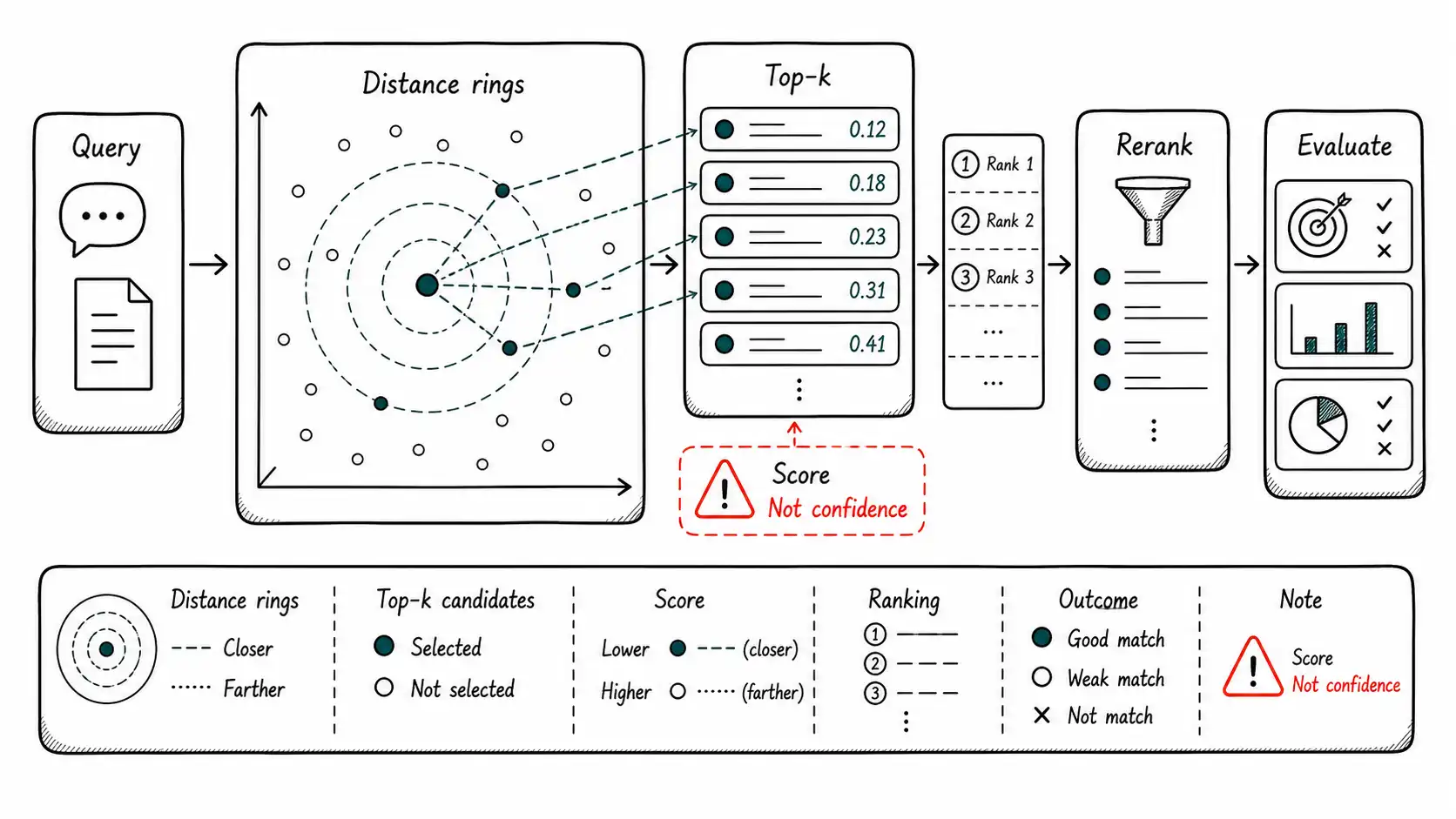
Cosine similarity is a measurement, not a verdict. Dot product is a measurement, not a verdict. Euclidean distance is a measurement, not a verdict. Each score is meaningful only inside the assumptions of the model, preprocessing, corpus, index, and task. A score threshold that works for short support questions may fail for long legal documents. A cosine score that looks high in one embedding model may not be comparable to a score from another.
Production systems should avoid exposing raw similarity scores as confidence. Confidence implies calibrated probability: if the system says 80% confident, roughly 80% of such cases should be correct. Cosine similarity does not provide that guarantee (see Semantic Recall for research quantifying the gap between score and actual recall). It is a ranking signal. It can be turned into a calibrated decision signal only through evaluation and calibration on your task.
Top-k introduces another subtlety. Top five results are not necessarily good results. They are merely the five nearest among whatever the index contains and returns. If the corpus lacks the answer, top-k will still produce something. This is why retrieval systems need abstention logic, minimum evidence thresholds, and evaluation cases where the correct answer is absent.
Threshold Discipline
Thresholds should be learned from labeled examples, not copied from a tutorial. Build a small set of queries with known relevant documents. Plot score distributions for relevant and non-relevant candidates. Choose thresholds based on the business cost of false positives and false negatives. Revisit thresholds when the corpus or model changes.
| Decision | Needs labeled data? | Why |
|---|---|---|
| Top-k size | Yes | Balances recall and cost |
| Minimum score | Yes | Controls bad candidates |
| Rerank cutoff | Yes | Controls latency and quality |
| Abstain threshold | Yes | Prevents forced answers |
The safest interpretation is: distance ranks candidates. The system decides what the ranking is allowed to mean.
Additional Production Notes for Chapter 6
In production, the chapter's principle should be converted into a named design review item. The team should not rely on tribal knowledge or on the memory of the engineer who built the first prototype. A named review item creates accountability. It also creates a place where research, product constraints, security requirements, and operational evidence can meet before launch.