What Work Becomes When Drafting Is Cheap
The first week after rollout, everyone was delighted by drafts. The legal team drafted contract clauses faster.

Key Takeaways
- Generation is only one layer of work; intent, context, evaluation, and ownership still need human design.
- Prompt quality matters, but prompt theater cannot replace business judgment or evidence.
- Recurring prompts should become work contracts with purpose, inputs, evaluation, owner, and expiry.
- Teams should audit whether drafts are increasing faster than decisions.
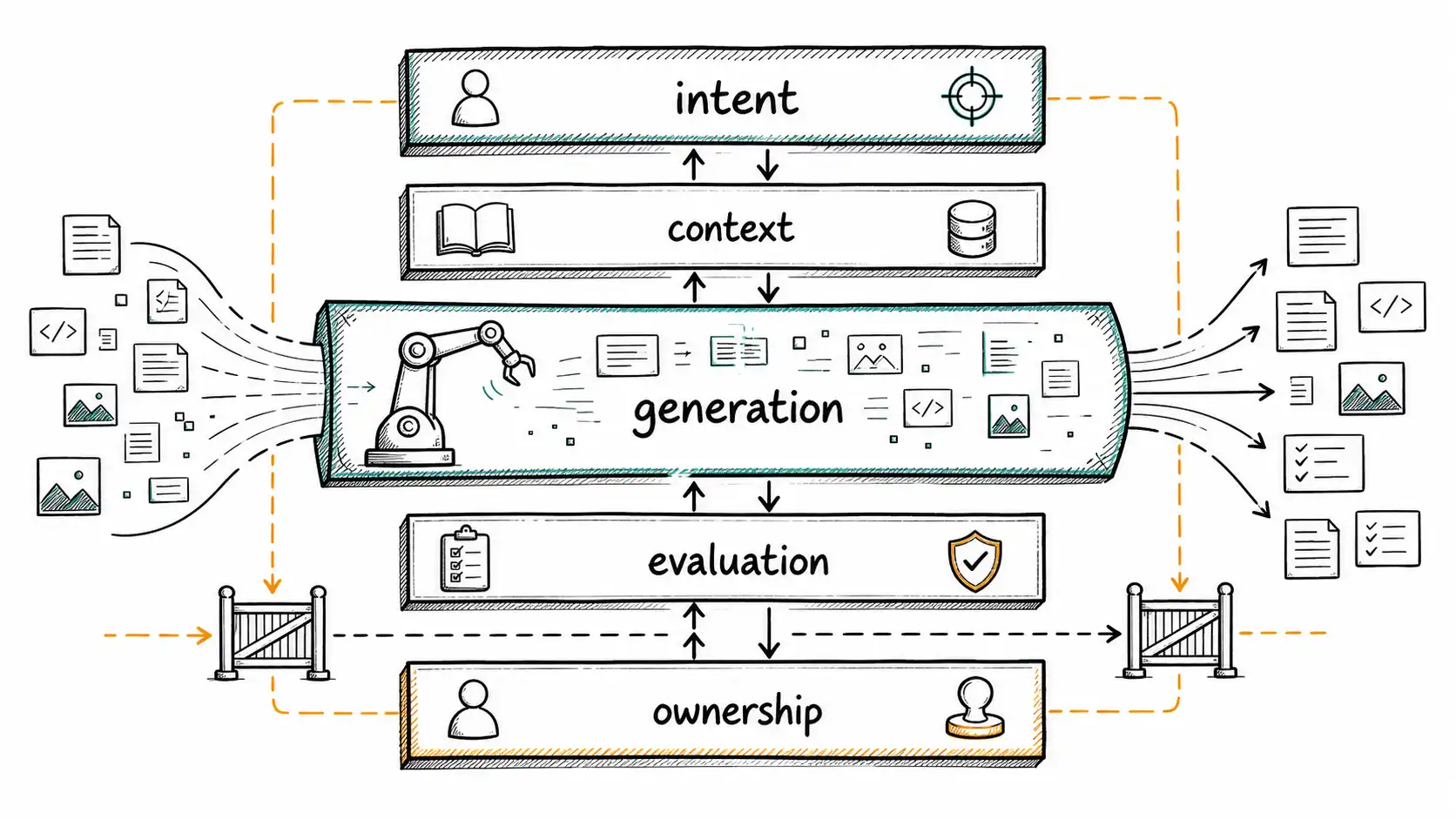
Cheap drafting moves the valuable work into intent, context, evaluation, and ownership; generation becomes the middle layer.
The first week after rollout, everyone was delighted by drafts. The legal team drafted contract clauses faster. The product team drafted launch memos faster. Engineering drafted test cases faster. Sales drafted follow-up emails faster. Then the second week arrived, and the organization discovered that drafts do not retire risk. Someone still had to know whether the clause could be used in the customer's jurisdiction, whether the launch memo matched the roadmap, whether the test case protected the actual failure mode, and whether the email promised something support could deliver.
Drafting had become cheap. Knowing what the draft meant had not.
This chapter reframes work into five layers: intent, context, generation, evaluation, and ownership. Traditional teams often treated generation as the center because it consumed visible labor. AI-native teams treat generation as the middle layer, surrounded by higher-value human work. The machine can write the draft; the team must decide what should be drafted, what evidence makes it acceptable, what context cannot be lost, and who owns the result.
Research spine
This chapter uses: Brynjolfsson, Li, Raymond, Generative AI at Work, NBER Working Paper 31161; Brynjolfsson, Li, Raymond, Generative AI at Work, Quarterly Journal of Economics; Google Cloud / DORA, 2025 AI-assisted Software Development Report; Team Topologies, Key Concepts.
The five-layer work model
The first layer is intent: what change should exist in the world after this work is done. Intent is not the same as a prompt. A prompt is an instruction to a model; intent is an accountable claim about a customer, system, risk, or business outcome. The second layer is context: the constraints, domain facts, dependencies, politics, history, and user needs that make the work local. The third layer is generation: drafts, code, documents, analyses, messages, plans, and variants. The fourth layer is evaluation: the tests, reviews, metrics, rubrics, and customer signals that distinguish useful output from plausible output. The fifth layer is ownership: the person or team that accepts consequences after the artifact leaves the tool.
AI lowers the cost of the third layer first. It can help with the others, but it does not remove accountability for them. A team becomes AI-native when it redesigns its operating model around the full stack rather than celebrating cheaper generation alone.
Why this changes roles
Roles built around production volume must be rewritten. A content marketer who used to produce three emails a day may become the owner of message-market fit, compliance-safe phrasing, audience segmentation, and performance evaluation. A QA engineer who used to manually write regression cases may become the owner of failure taxonomies and automated eval generation. A backend engineer who used to implement tickets may become the owner of interface contracts, generated-code review standards, and production traceability. The work does not disappear. It migrates from typing to judgment scaffolding.
Team Topologies helps leaders reason about this migration. Stream-aligned teams still own customer value. Platform teams still reduce cognitive load. Enabling teams become more important because AI-native practices are learned unevenly. Complicated-subsystem teams may own model platforms, evaluation infrastructure, security layers, or regulated workflows that should not be reinvented by every product team.
The danger of prompt theater
When leaders misunderstand the work stack, they over-index on prompt quality. Prompt craft matters, but it is not the operating system. A great prompt can produce a polished artifact against the wrong intent, with missing context, no evaluation, and no owner. Prompt theater is the belief that better instructions to the machine substitute for better organizational decisions.
The antidote is to treat prompts as one part of a larger work contract. Every recurring prompt should eventually sit next to a purpose, input contract, allowed sources, evaluation method, approval path, and expiry rule. Otherwise the organization creates a shadow process: people copy prompts from private notes, outputs become impossible to trace, and quality depends on undocumented individual habits.
Operating table
| Layer | Human question | Machine contribution | Failure if unmanaged |
|---|---|---|---|
| Intent | What outcome are we trying to create? | Can suggest options and clarify language. | Beautiful work aimed at the wrong problem. |
| Context | What local facts constrain the answer? | Can summarize supplied material. | Generic output that ignores the business. |
| Generation | What artifact should be produced? | Can draft, transform, code, compare, and simulate. | Artifact flood. |
| Evaluation | How do we know it is good? | Can run checks and propose tests. | Plausible wrongness. |
| Ownership | Who accepts consequence? | Can record lineage and route approvals. | No accountable decision. |
Artifact example: a work contract that surrounds the prompt
{
 "work_contract": {
 "intent": "Reduce failed onboarding calls for enterprise customers",
 "context_required": ["current onboarding script", "failure taxonomy", "customer segment", "legal promises"],
 "generation_task": "Draft revised call guide and objection-handling branches",
 "evaluation": ["review against compliance rubric", "pilot on 20 calls", "measure completed setup rate"],
 "owner": "Head of Customer Success",
 "expires": "2026-09-30"
 }
}
Checklist
- Map one workflow into intent, context, generation, evaluation, and ownership.
- Find the layer where your team currently spends the least explicit attention.
- Turn one recurring prompt into a work contract with owner and evaluation.
- Separate prompt libraries from production workflow standards.
- Audit whether drafts are increasing faster than decisions.
Takeaway
Cheap drafting does not make work simple; it exposes the layers that were previously hidden by the cost of drafting.
Internal map
For the larger argument, keep this chapter connected to the AI-Native thesis, Building an AI-Native Team, The Judgment Economy, and Human in the Loop Is Not a Plan.