The JOLT Framework
The founder said the company needed "AI people." The VP of Engineering asked what that meant. The answer came back as a list of tool names.

Key Takeaways
- AI-native teams need responsibility coverage, not one mythical AI generalist.
- Judgment Owners define what good means and accept consequences for the standard.
- Orchestrators, Learning Operators, and Trust Stewards keep workflows coherent, improving, and defensible.
- JOLT is a capability map that can be split or combined depending on company size.
The JOLT framework makes AI-native staffing a responsibility map: judgment, orchestration, learning, and trust all need owners.
The founder said the company needed "AI people." The VP of Engineering asked what that meant. The answer came back as a list of tool names. That was the wrong list. The company did not need one person who knew every tool. It needed a role system that could absorb a new kind of use without turning every senior person into a reviewer and every junior person into a prompt operator.
JOLT is the role map this chapter proposes: Judgment Owners, Orchestrators, Learning Operators, and Trust Stewards.
JOLT is not an org chart. It is a capability map. One person may hold multiple roles in a small company; a large company may split each role across teams. The point is to make the missing responsibilities visible. AI-native teams fail when judgment is assumed, orchestration is ad hoc, learning is passive, and trust is bolted on after launch.
Research spine
This chapter uses: Team Topologies, Key Concepts; DORA, State of AI-assisted Software Development 2025; NIST AI Risk Management Framework; OWASP Top 10 for Large Language Model Applications.
J - Judgment Owners
Judgment Owners decide what good means for a domain. They are not merely approvers. They define the standard by which machine-generated work will be evaluated. In a support automation team, the Judgment Owner may define what counts as a resolved case rather than a deflected case. In an AI coding team, the Judgment Owner may define which classes of generated changes require architectural review. In a sales team, the Judgment Owner may define the acceptable boundary between helpful personalization and overpromising.
Judgment Owners must have domain authority and consequence ownership. A person can review a draft without owning the judgment. A Judgment Owner accepts that if the team optimizes toward this rubric, the business result is defensible.
O - Orchestrators
Orchestrators design the flow of work between humans, models, systems, and approval gates. They decide which steps can be automated, which steps can be assisted, which steps need human sampling, and which steps require full review. The Orchestrator is close to operations, product systems, and integration. They think in queues, failure modes, instrumentation, permissions, and rollback.
In many companies this is the most missing role. People adopt tools locally and create islands of automation. The Orchestrator turns tool usage into an operating system.
L - Learning Operators
Learning Operators convert usage into improvement. They own feedback loops, labels, review outcomes, coaching signals, and eval datasets. They ask whether the system is becoming better from contact with work or merely producing more artifacts. They are not trainers in the classroom sense; they are maintainers of the learning flywheel.
This role becomes critical when AI changes apprenticeship. If the model does the easy first draft, junior people lose some of the reps that previously taught them how judgment develops. Learning Operators design new reps: compare model outputs, diagnose failure cases, write rubrics, conduct replay reviews, and graduate from safe tasks into consequential ownership.
T - Trust Stewards
Trust Stewards own risk boundaries: privacy, security, compliance, provenance, customer promises, auditability, and abuse cases. They work with legal and security, but they are not merely blockers. Their job is to make trust operable. They translate policy into workflow gates, evidence requirements, logging, retention, and escalation paths.
AI-native teams need Trust Stewards because AI output often crosses boundaries faster than old processes were designed to handle. A generated answer can mix customer data, internal policy, old documentation, and an external model's probabilistic guess. Trust requires system design, not vibes.
Operating table
| JOLT role | Primary scarcity it protects | Artifacts it owns | Bad substitute |
|---|---|---|---|
| Judgment Owner | Decision quality | Rubrics, acceptance gates, trade-off records | Generic senior approval |
| Orchestrator | Workflow coherence | Automation map, queue design, escalation paths | Tool admin |
| Learning Operator | Compounding improvement | Eval sets, feedback loops, coaching reps | Ad hoc training session |
| Trust Steward | Defensible autonomy | Risk controls, audit trails, policy gates | Late compliance review |
Artifact example: a JOLT assignment for one AI-native workflow
jolt_assignment:
 workflow: "AI-assisted enterprise proposal generation"
 judgment_owner:
 role: "VP Sales Engineering"
 owns: ["solution correctness", "scope boundaries", "technical promises"]
 orchestrator:
 role: "RevOps Systems Lead"
 owns: ["CRM inputs", "proposal workflow", "approval routing"]
 learning_operator:
 role: "Revenue Enablement Manager"
 owns: ["win/loss feedback", "rubric improvements", "rep coaching examples"]
 trust_steward:
 role: "Legal + Security Partner"
 owns: ["data sharing policy", "contractual language gate", "audit retention"]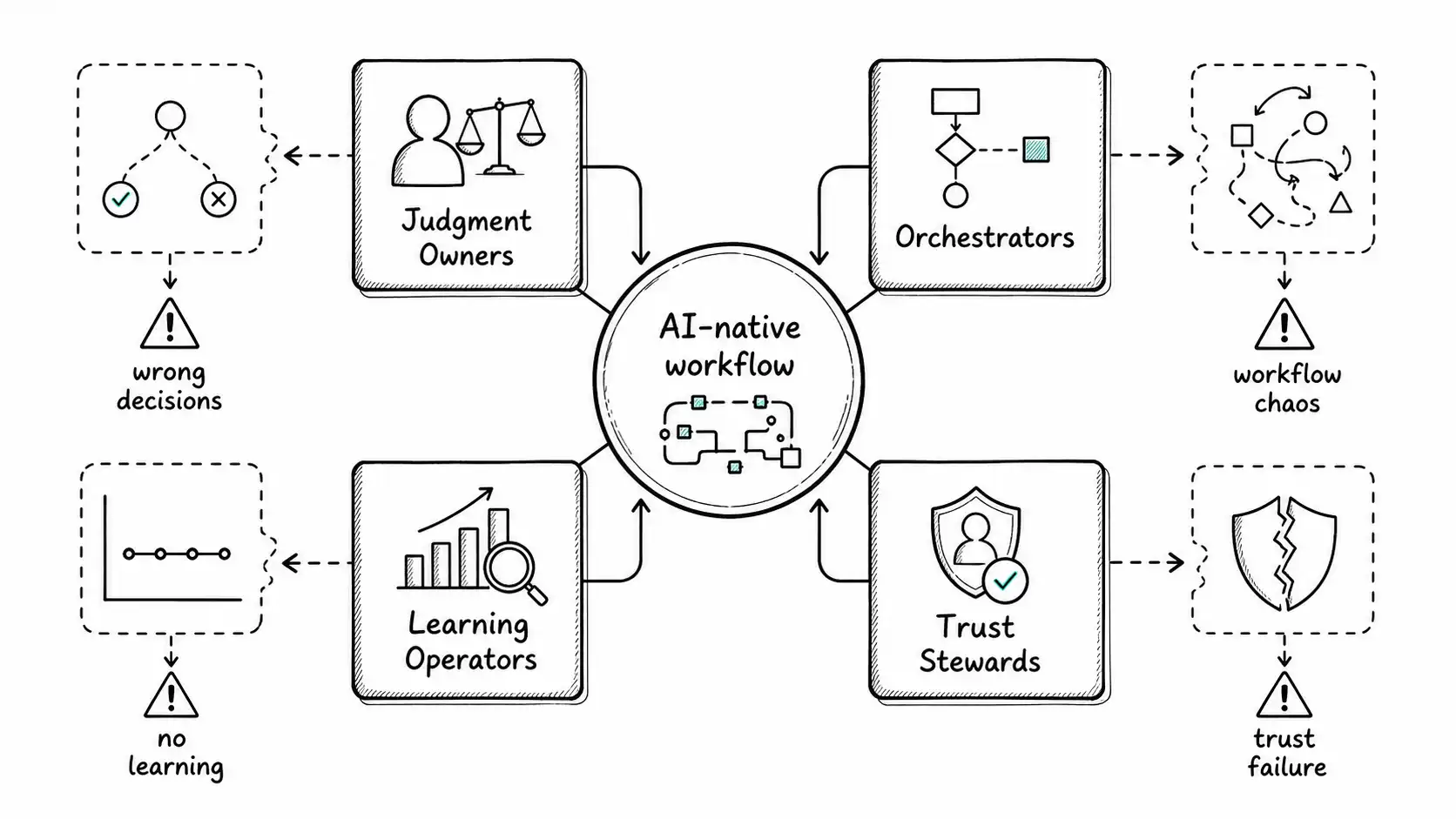
Checklist
- Assign JOLT roles to one important workflow.
- Do not let tool ownership masquerade as judgment ownership.
- Make the learning loop explicit before scaling usage.
- Give trust a design seat before launch, not after incident.
- Revisit assignments when autonomy level changes.
Takeaway
JOLT turns AI-native staffing from a tool-skills conversation into a responsibility conversation.
Internal map
For the larger argument, keep this chapter connected to the AI-Native thesis, Building an AI-Native Team, The Judgment Economy, and Human in the Loop Is Not a Plan.