Choosing the Value Metric
The company priced by document page because pages were easy to count. Customers hated it.

Key Takeaways
- Choosing the Value Metric is a chapter about AI revenue engineering, not a generic AI adoption note.
- The operating rule is to sell proved work, measured risk, and margin discipline rather than demo theater.
- The failure mode to watch is polished output without evidence, owner, cost line, or rollback path.
- The useful next step is an artifact a future teammate can replay without folklore.
AI revenue work converts when the seller can prove resolved work, cost, risk, and expansion evidence, not just a polished demo.
The company priced by document page because pages were easy to count. Customers hated it. A simple document and a complex document could have the same page count and wildly different value. The vendor's costs tracked pages loosely, but the customer's value tracked accepted decisions. The pricing model was legible and wrong.
AI-native pricing lives or dies by the value metric.
The value metric should correlate with value, be easy to understand, be feasible to meter, support expansion, preserve margin, and avoid perverse incentives. In AI-native products this is harder because model cost, human review cost, and outcome value may scale differently.
Research spine
This chapter uses: OpenView, Usage-Based Pricing; Stripe Billing; Zuora, Quote-to-Cash; Bessemer Venture Partners, State of AI 2025.
Value metric criteria
A strong value metric is value-correlated, auditable, predictable enough for buyers, granular enough for expansion, and controllable enough for the vendor. It should also fit procurement. A metric that perfectly captures value but cannot be explained on an invoice will slow deals. A metric that is easy to invoice but detached from value will compress price.
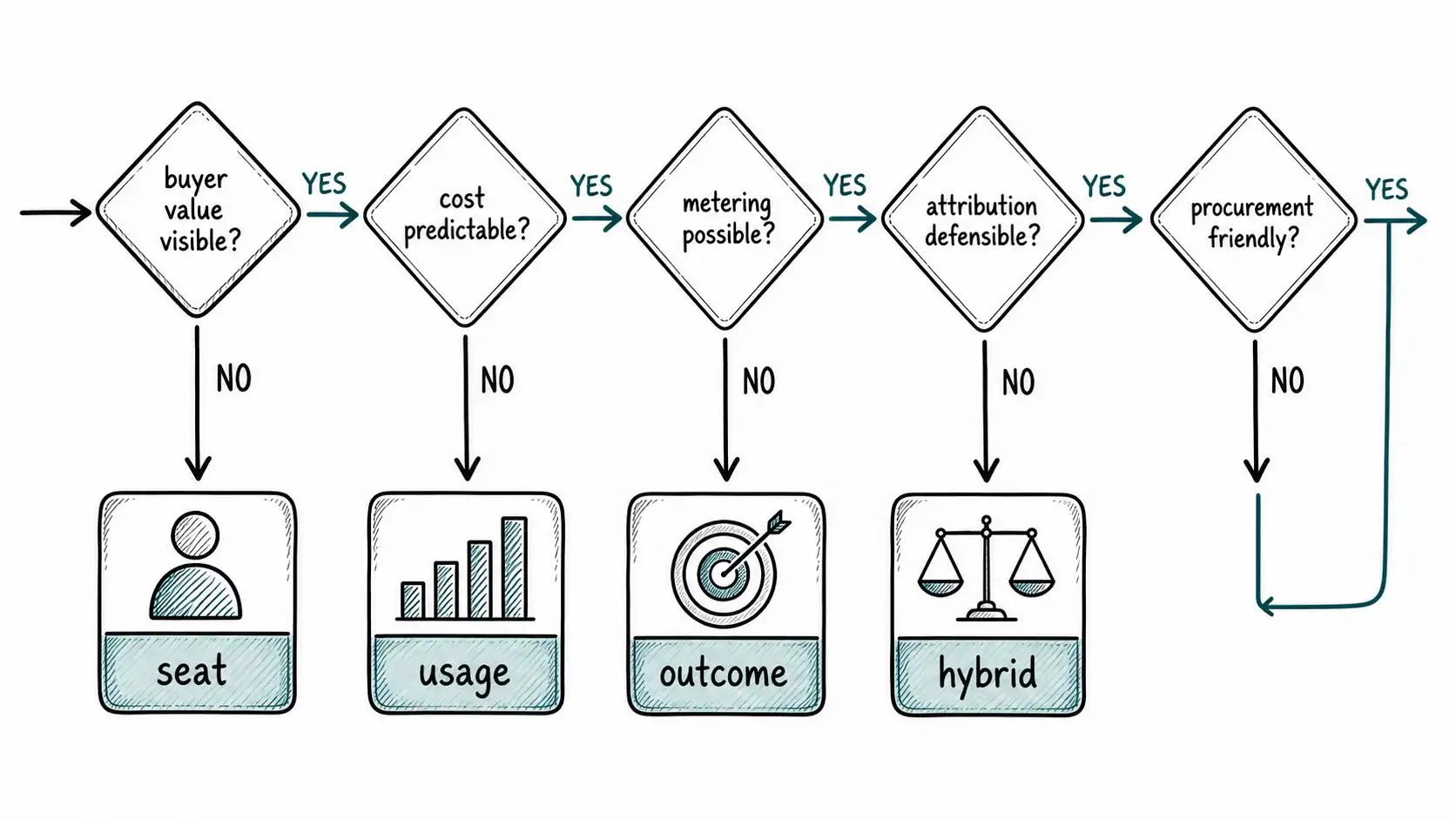
The cost-value mismatch
AI products often incur cost by token, compute, retrieval, storage, human review, or third-party model call, while customers value resolved work. The vendor must understand both curves. If the value metric grows while cost grows faster, scale destroys margin. If price grows with raw cost but not value, customers resist adoption.
Metric gaming
Every value metric creates behavior. If a support product prices per response, it may reward too many responses. If it prices per resolved case, it must define resolution carefully to avoid cheap deflection. If it prices per generated lead, it may reward low-quality volume. The metric should point the customer and vendor toward the same outcome.
Operating table
| Metric | Pros | Cons | Best use |
|---|---|---|---|
| Token | Matches vendor cost | Weak buyer value story | Infrastructure/API buyers |
| Task | Easy to understand | Requires task definition | Workflow automation |
| Resolved outcome | Strong value alignment | Needs attribution and quality controls | Support, ops, finance workflows |
| Seat + usage | Procurement-friendly hybrid | Can hide margin risk | Enterprise platforms |
Artifact example: comparing seat pricing and task pricing
def compare_metrics(monthly_seats, seat_price, tasks, price_per_task, vendor_cost_per_task):
 seat_revenue = monthly_seats * seat_price
 task_revenue = tasks * price_per_task
 task_cogs = tasks * vendor_cost_per_task
 return {
 "seat_revenue": seat_revenue,
 "task_revenue": task_revenue,
 "task_gross_margin": round((task_revenue - task_cogs) / task_revenue, 2)
 }

print(compare_metrics(
 monthly_seats=40,
 seat_price=75,
 tasks=12000,
 price_per_task=0.85,
 vendor_cost_per_task=0.18
))
Checklist
- Test whether the metric maps to customer value, not only vendor cost.
- Model margin at low, expected, and high usage.
- Define quality rules for outcome metrics.
- Make the invoice explainable.
- Check incentives created by the metric.
Takeaway
The value metric is the bridge between what the AI system does and what the customer will pay for.