The Demo Was Not the Deal
The demo won the room. The assistant read the customer's website, drafted an account plan, produced a qualification summary, and recommended a next step.

Key Takeaways
- The Demo Was Not the Deal is a chapter about AI revenue engineering, not a generic AI adoption note.
- The operating rule is to sell proved work, measured risk, and margin discipline rather than demo theater.
- The failure mode to watch is polished output without evidence, owner, cost line, or rollback path.
- The useful next step is an artifact a future teammate can replay without folklore.
AI revenue work converts when the seller can prove resolved work, cost, risk, and expansion evidence, not just a polished demo.
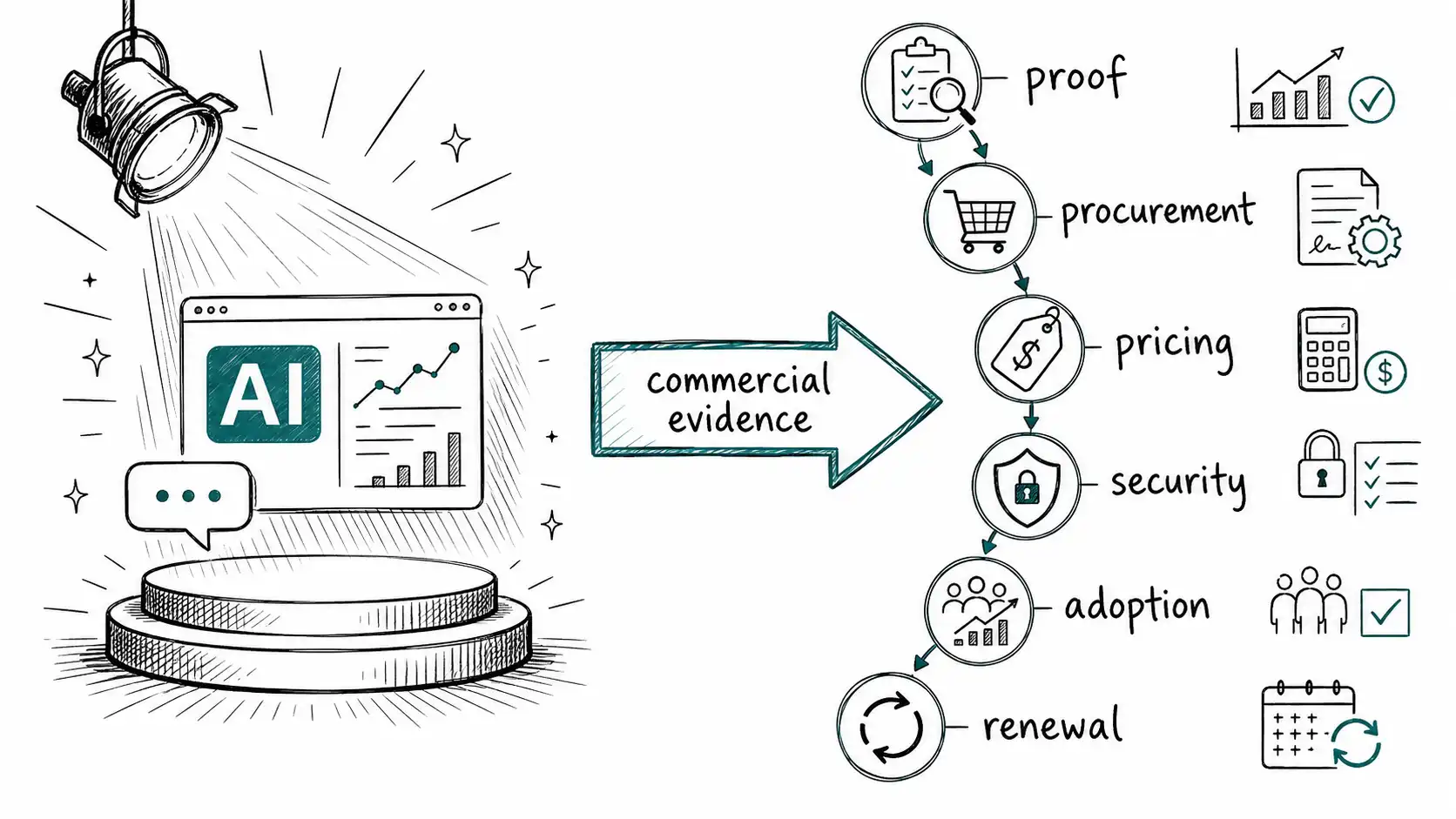
The demo won the room. The assistant read the customer's website, drafted an account plan, produced a qualification summary, and recommended a next step. The CRO watched the buyer smile and knew the deal was not won. The buyer had seen magic. They had not yet seen proof, procurement fit, data boundaries, cost predictability, service ownership, or a renewal story.
AI demos create belief quickly. Deals require evidence slowly.
This chapter separates demonstration value from commercial value. A demo shows capability. A deal requires a buyer to believe the capability will produce reliable value inside their workflow, under their constraints, with acceptable risk, at a price that matches procurement and ROI logic. The difference is where many AI-native companies lose momentum.
Research spine
This chapter uses: Bessemer Venture Partners, State of AI 2025; OpenView, Usage-Based Pricing; Brynjolfsson, Li, Raymond, Generative AI at Work, NBER Working Paper 31161; NIST AI Risk Management Framework.
Why AI demos overperform
AI demos are unusually persuasive because they compress a complex promise into a visible moment. The product appears to perform work that used to require a human. That creates emotional clarity. Buyers can imagine saved hours, fewer handoffs, faster response, better analysis, or a new kind of customer experience. The demo makes the future feel near.
But the demo often avoids the hard commercial questions. What happens on the messy cases? What data was used? How much does it cost at production volume? Who owns a wrong answer? How do permissions work? What proof will the buyer take to finance? What changes in the customer's process? What happens when the model provider changes price or behavior?
The CRO's hidden checklist
A revenue leader must translate the demo into a deal path. That path includes economic buyer, use-case owner, technical evaluator, legal/security reviewer, budget source, value metric, adoption sequence, proof plan, pricing model, and renewal evidence. Engineering may reasonably focus on whether the product can work. Revenue must focus on whether the customer can buy, deploy, trust, and expand it.
The strongest AI-native companies design for this chain early. They know which use case is easiest to prove, which value metric survives procurement, which risk objections will appear, and which margin assumptions can break the deal.
REV-AI preview
REV-AI is the commercial architecture used throughout this book. Resolved work names the actual job the product performs. Evidence of value proves that work mattered. Value metric turns that proof into pricing logic. Adoption path maps how the customer moves from pilot to scale. Incident ownership answers what happens when the AI system is wrong, costly, slow, unsafe, or misused.
A deal becomes durable when all five are aligned.
Operating table
| Demo question | Deal question | Revenue implication |
|---|---|---|
| Can it do the task once? | Can it do the task reliably in the customer's workflow? | Pilot design |
| Does the output look impressive? | What value metric improves? | Pricing and ROI |
| Is the model powerful? | Is the system trusted and governable? | Security/legal path |
| Can users try it? | Can the account expand? | Adoption and renewal |
Artifact example: a deal review that turns demo capability into proof
ai_native_deal_review:
 demo_capability: "automated account-plan generation"
 resolved_work: "create first-pass account research package"
 buyer_value_metric: "hours saved per qualified account"
 proof_required:
 - "baseline manual time"
 - "quality score from sales engineering"
 - "conversion from generated plan to accepted pursuit"
 commercial_risks:
 - "unverified claims in generated account notes"
 - "CRM data permissions"
 - "high token cost on large accounts"
 next_step: "paid pilot with 50 accounts and success criteria"
Checklist
- Never leave a successful demo without a proof plan.
- Name the resolved work, not only the feature.
- Identify the buyer's value metric before pricing.
- Surface security and cost objections early.
- Design the pilot to produce renewal evidence, not applause.
Takeaway
A demo sells possibility; a deal requires proof that the possibility survives the customer's reality.
Internal map
For the larger argument, keep this chapter connected to Revenue, Re-Engineered, Pricing Software That Thinks, selling AI to burned buyers, and the judgment economy.