2026 / Free online book · Points of View
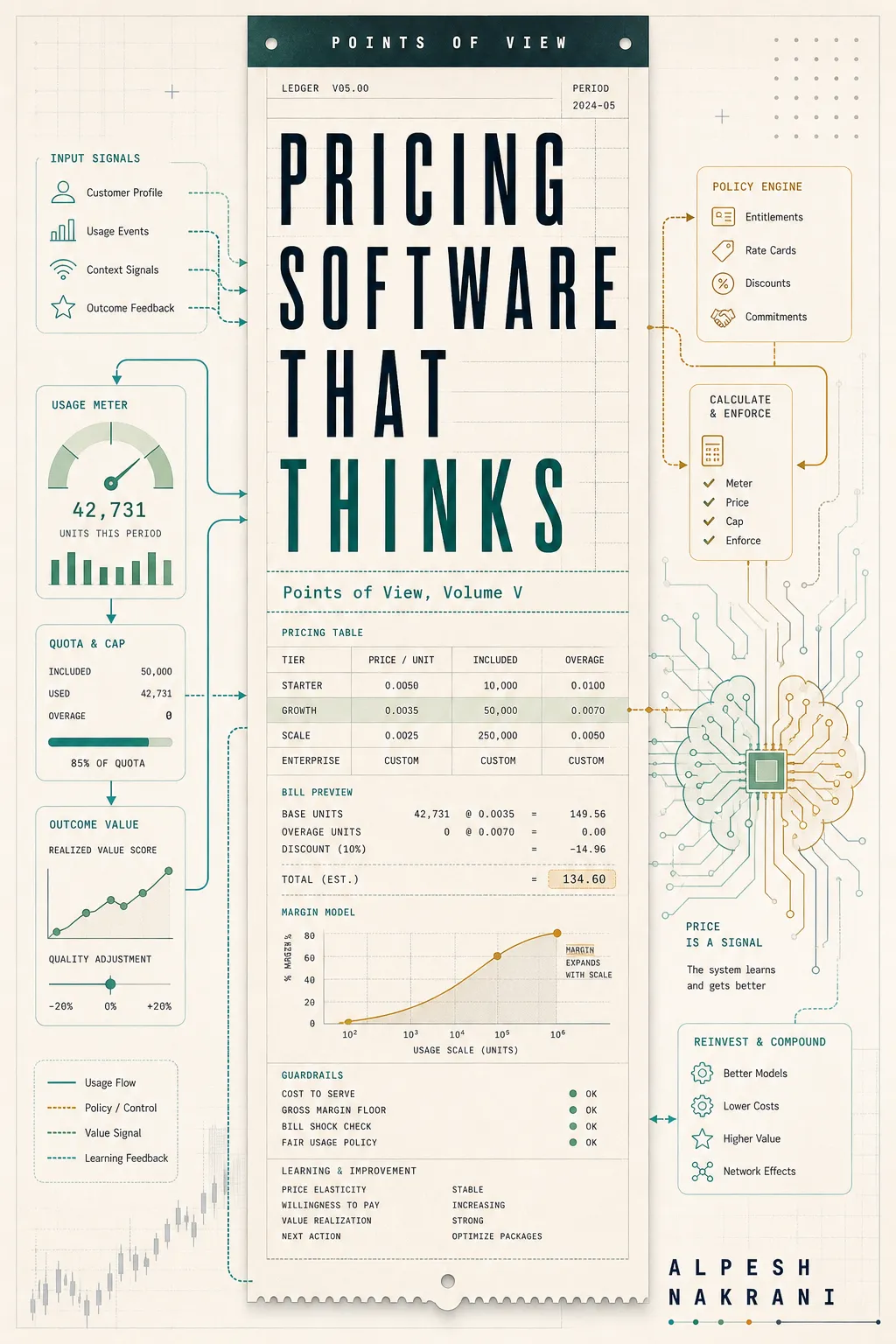
Pricing Software That Thinks
Points of View, Volume V
Access
Free
Chapters
10
Read time
111 min

Alpesh Nakrani
VP of Growth at ViitorCloud · former CTO & COO
Per-seat pricing assumes a human does the work. What you charge for when the software is the one doing it.
This edition is free to read onsite. Each chapter has its own URL, so readers can bookmark, share, and return to the exact section they need.
Table of contents
INT Introduction: The Day Adoption Became a Margin Problem AI pricing fails when vendors charge for access while customers experience work, risk, and outcomes. 8 min 01 Why Seat Pricing Breaks When Software Does the Work The per-seat model assumed humans did the work and usage was nearly free, and AI quietly violates both halves. 10 min 02 The Work Unit: The Thing the Customer Recognizes Price around the work your software performs, named the way the customer already names it, not the model calls underneath. 10 min 03 The AI Cost Stack Nobody Puts on the Pricing Page Token prices are the part of AI cost you can see; the full stack underneath them is what actually decides your margin. 9 min 04 Gross Margin Under Variable Inference When cost moves with usage, a single average margin lies to you; you have to model the distribution and the tail. 9 min 05 Usage and Outcome Pricing: Honest, Dangerous, and Hard to Prove Usage pricing tracks cost but can punish adoption; outcome pricing tracks value but is hard to verify, and both fail in opposite directions. 11 min 06 Credits, Tokens, Tasks, and Why Naming Matters The word you put between the customer and the work is a pricing decision, and the wrong abstraction quietly destroys trust. 9 min 07 Packaging Copilots, Agents, and Automations How much human is in the loop should decide the pricing model, because it decides both the value and who bears the risk. 9 min 08 Quotas, Caps, Overages, and Enterprise Contracts The mechanisms that make variable-cost pricing safe: a ladder of guardrails from included quotas to committed usage and outcome share. 10 min 09 Explaining Price Without Bill Shock Transparency means the customer can predict and understand the bill, not that you itemize every token; bill shock is a design failure, not a billing event. 9 min 10 Migration, Experiments, and What Happens When Costs Fall Pricing is never finished; you have to change models without breaking trust, test changes safely, and decide what to do when inference gets cheaper or usage explodes. 10 min END Conclusion: The Pricing Software That Thinks Checklist Pricing that is transparent enough for trust, flexible enough for value, and disciplined enough for margin. 7 min