Introduction: The Day Adoption Became a Margin Problem
AI pricing fails when vendors charge for access while customers experience work, risk, and outcomes.

Pricing software that thinks starts by pricing units of resolved work against variable inference, review, and risk cost.
I want to start with a meeting I have now sat through, in different rooms, with different logos on the wall, at least a dozen times. The shape is always the same.
A SaaS company ships an AI feature. Maybe it is a writing assistant inside the editor, or a support copilot in the inbox, or a "ask your data" box bolted onto the analytics product. Leadership makes a call that feels generous and modern: include it for everyone, no extra charge, on every plan. The reasoning is sound on the surface. Drive adoption. Make the product stickier. Avoid a pricing fight with the field. Treat AI as table stakes, not a line item.
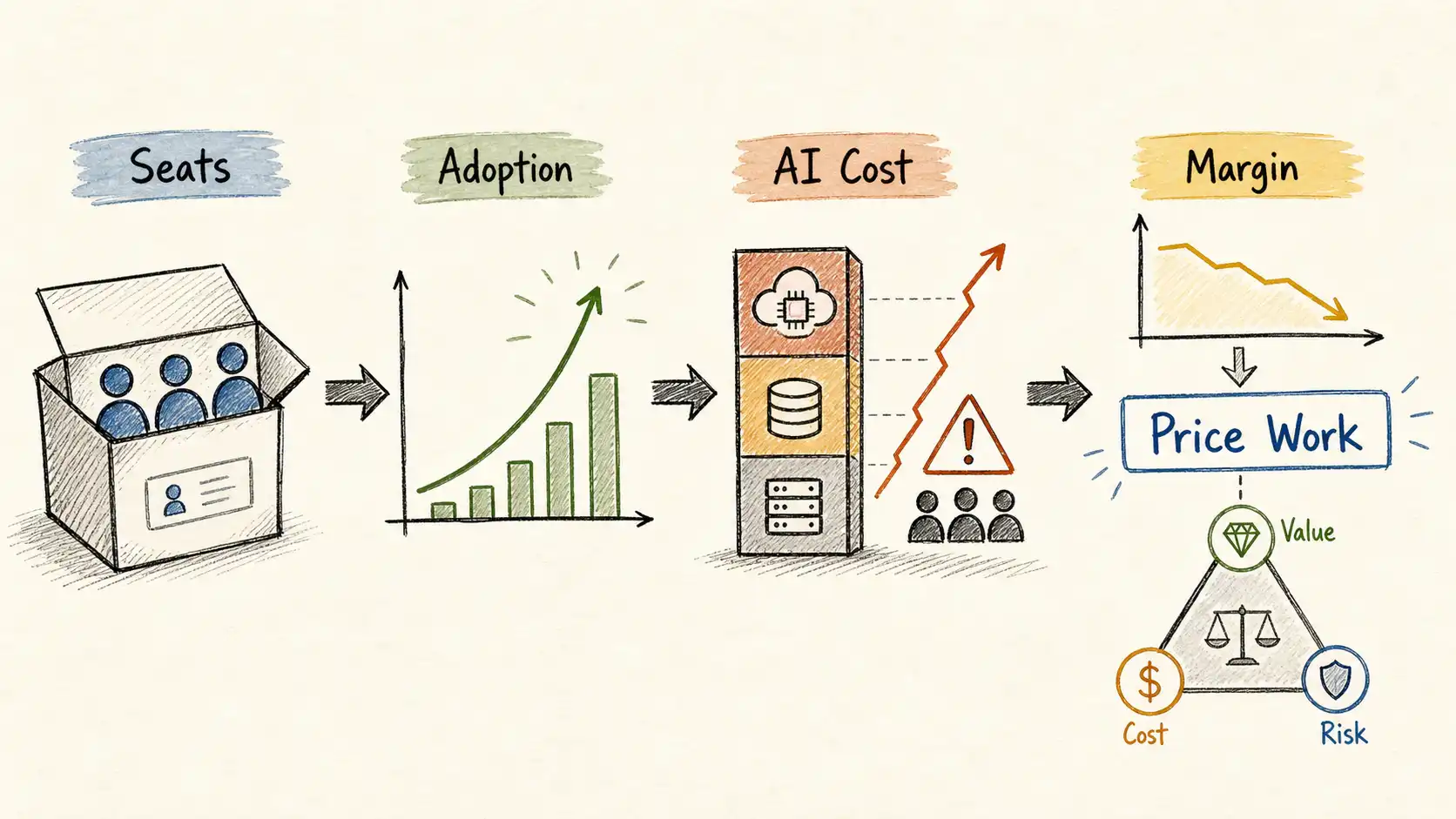
The launch goes well. Adoption charts go up and to the right. The board deck has a new slide. Then, somewhere between week six and the end of the quarter, the finance team walks into the room with a different chart. It is gross margin by cohort, and it is sliding. Not for everyone. For the heavy users. The customers who loved the feature most, who ran it hardest, who told their account manager it changed how their team works. Those customers are now the ones quietly destroying the unit economics of the product they love.
That is the moment this book is about. The moment a company discovers that it priced presence and shipped work.
The enemy
Most software pricing was built for a world where the marginal cost of one more user doing one more thing was effectively zero. You provisioned a server, and whether a seat logged in once a month or hammered the product all day, your cost barely moved. Storage and bandwidth were rounding errors. That is why per-seat subscription pricing won. It was simple, it was predictable, and it matched a cost structure where usage was nearly free. Gross margins of 80 to 90 percent were normal, and the entire valuation logic of cloud software was built on top of that assumption.
AI breaks the assumption. When software generates a contract summary, resolves a support ticket end to end, reconciles a stack of invoices, or writes and runs code, it consumes real, metered, variable cost on every action. Tokens in, tokens out, retrieval, reranking, tool calls, retries, human review when the model is unsure. The cost of one more unit of work is no longer a rounding error. It is the dominant variable in your margin.
The enemy of this book is the reflex that ignores all of that: seat-based pricing instinct paired with a vague "AI premium," charging for access while the customer experiences work, risk, and outcomes. It is the founder who adds twenty dollars to a plan because the product now "has AI." It is the SaaS company that includes inference for free to win the demo and then spends a year trying to claw the margin back. It is the agent vendor who prices per seat for a product that does its best work at 3 a.m. when no human is logged in at all.
The data is no longer ambiguous. ICONIQ's January 2026 snapshot put average AI-product gross margin at 52 percent, up from 41 percent in 2024 but still far below the 75 to 85 percent that defined traditional SaaS, as covered in reporting on AI COGS and margin compression. Bessemer's State of AI work placed LLM-native company margins around 65 percent. For a team bolting an assistant onto an eighty-dollar seat, inference and supporting infrastructure can add roughly fifteen dollars of direct variable cost, dropping gross margin from 80 percent toward 65 percent overnight, as The SaaS CFO has documented. The token tax is real, and it lands on the pricing page whether you put it there or not.
The thesis
Here is the argument the whole book defends:
AI pricing works when the price aligns with the work the software performs, the cost the vendor incurs, and the risk each side carries. It fails when the price tracks how many people can log in.
That is it. Pricing is not a cosmetic layer you apply after the product is built. For software that does work, pricing is part of the architecture. It decides whether your best customers are your most profitable customers or your most dangerous ones. It decides whether usage growth is a tailwind or a fire. And it decides whether your customer trusts the bill that shows up at the end of the month or feels ambushed by it.
The recurring motif I will come back to throughout the book is this:
Seats price presence. AI often creates value by doing work when no one is present.
A seat is a proxy. It assumes that value scales with the number of humans who have access. That proxy held up for decades because humans were the ones doing the work, and you could only do so much work per human per day. AI severs the link. A single automation can process ten thousand documents overnight under one login, or zero. The seat tells you nothing about value or cost anymore. You have to find a better unit, and most of this book is about how.
What this book is not
I want to set expectations honestly, because the AI pricing conversation is crowded with content that does not help.
This is not a generic value-based pricing primer. The phrase "charge based on the value you deliver" is true and nearly useless on its own. I will give you instruments for finding and defending a price, not a slogan.
This is not a gallery of pricing pages. I cite real models from real companies because they teach something, not so you can copy a layout. The right model for your business depends on your cost structure, your buyer, and your risk tolerance, and a screenshot cannot tell you those.
This is not a guide to hiding inference cost. Some advice in this space amounts to "obscure the meter so customers cannot tell what they are paying for." That is a short game. It produces bill shock, churn, and a reputation you do not want. I will show you how to explain price clearly without exposing every internal cost.
This is not an argument that AI justifies charging more. Sometimes it does. Often it does not. "It has AI" is not a value proposition. Resolved tickets, reviewed contracts, and reconciled invoices are.
And this is not a finance textbook. I use gross margin, COGS, and unit economics constantly, but as operating tools. If you can read a P&L you have enough.
Who I am writing for, and how to read this
I am writing for the people who have to make the call: the founder pricing a product for the first time, the product manager deciding how AI slots into existing tiers, the CFO modeling margin under variable inference, the CRO and RevOps team negotiating an enterprise contract that will not blow up in renewal, and the investor trying to tell a durable AI business from one quietly subsidizing its own growth.
The book is built around a small set of frameworks I use in real engagements, and I reuse them deliberately so they become tools rather than trivia:
- The Work Unit Model finds the unit of value your customer actually recognizes, like a resolved ticket or a reviewed contract, and prices around it.
- The AI Cost Stack is the full list of variable costs behind every unit, most of which never make it onto a pricing page.
- The Value-Cost-Risk Triangle is the test that good pricing balances all three corners, not just one.
- The Adoption Penalty Test is one brutal question: does your pricing punish the customers who succeed with your product?
- The Margin Guardrail Ladder is the sequence of mechanisms, from included AI through committed usage and outcome share, that lets you protect margin without killing adoption.
You can read straight through, or jump to the chapter that matches the decision in front of you. The early chapters build the foundation: why seats break, what a work unit is, what AI actually costs, and how margin behaves under variable inference. The middle chapters work through the real model choices: usage, outcomes, packaging, copilots versus agents versus automations, quotas and caps, and enterprise contracts. The late chapters deal with the things that decide whether you survive contact with real customers: explaining price, avoiding bill shock, and what to do when model costs fall or usage explodes.
The closing chapter is a single checklist you can take into a pricing meeting. The goal it describes is the goal of the whole book: pricing that is transparent enough for trust, flexible enough for value, and disciplined enough for margin.
Let me take you back to that room, with the gross margin chart sliding for your best customers, and show you exactly why it happened, and what to do instead.
Key Takeaways
- AI breaks the assumption that one more unit of usage is nearly free, which is the assumption per-seat SaaS pricing was built on.
- The enemy is charging for access while customers experience work, risk, and outcomes.
- AI-product gross margins now cluster in the 50s to mid-60s versus 80 to 90 percent for traditional SaaS, and the gap is mostly variable inference and supporting cost.
- Pricing for software that does work is an architectural decision, not a cosmetic one.
- Five frameworks run through the book: Work Unit Model, AI Cost Stack, Value-Cost-Risk Triangle, Adoption Penalty Test, and Margin Guardrail Ladder.
Internal map
For the larger argument, keep this chapter connected to Pricing Software That Thinks, Revenue, Re-Engineered, the smaller-model margin argument, and The Economics of Inference.