Conclusion: The Pricing Software That Thinks Checklist
Pricing that is transparent enough for trust, flexible enough for value, and disciplined enough for margin.

Research spine
This chapter is grounded in OpenAI API pricing, Anthropic prompt caching documentation, and Stanford HAI, 2025 AI Index Report.
Pricing software that thinks starts by pricing units of resolved work against variable inference, review, and risk cost.
Let me close where I opened, in the room with the gross margin chart sliding for the best customers. The reason that chart slid was never AI itself. It was a pricing model designed for a world that no longer existed, applied reflexively to a product that had quietly changed underneath it. The company priced presence and shipped work. Everything in this book has been an argument that you can do better, and a set of tools for doing it.
If I had to compress the whole argument into one line, it is the motif we started with: seats price presence, and AI creates value by doing work when no one is present. Once you internalize that, the rest follows. You stop counting logins and start counting work. You stop reading one line off a model pricing page and start building the full cost stack. You stop quoting a blended margin and start watching the distribution. You stop charging for access and start aligning price with value, cost, and risk.
The three tensions, held at once
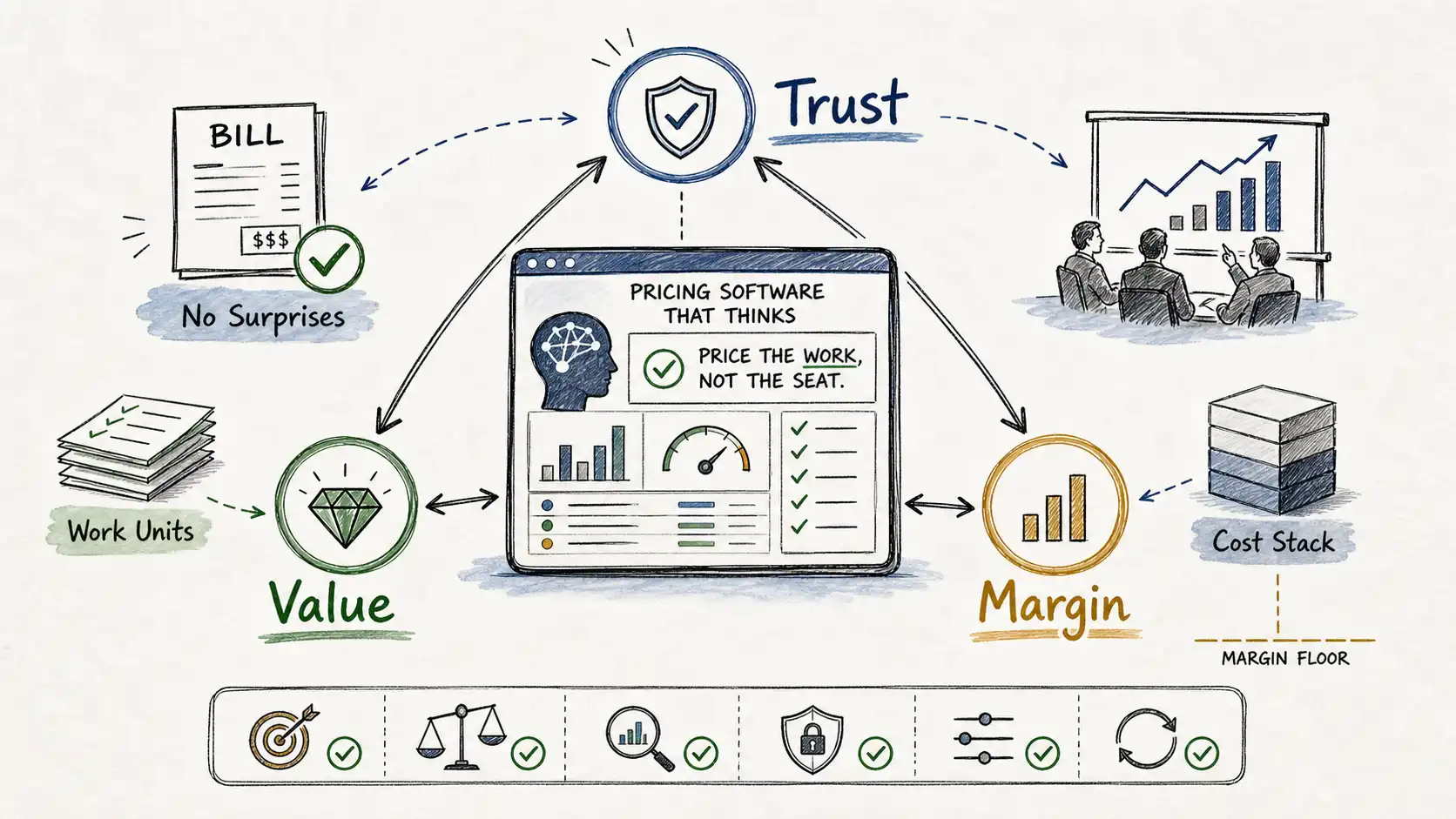
Good AI pricing is not a single right answer. It is the resolution of three tensions that pull against each other, and the goal is to hold all three at once rather than collapse onto one.
Transparent enough for trust. The customer must be able to predict the bill before it arrives and understand it after, in a unit they recognize. This is not the same as exposing your costs; it is the opposite of bill shock. A customer who trusts the bill renews. A customer who feels ambushed leaves and warns others.
Flexible enough for value. The price must track the value the customer actually receives, which means pricing on the work the software performs, not the seats it occupies, and letting the price grow as the value grows. A model that captures none of the expansion AI creates leaves your best outcomes unrewarded and your growth on the table.
Disciplined enough for margin. Every unit must clear a margin floor, every segment must be independently profitable, and every contract must have the guardrails that keep success from becoming a fire. A model that wins deals by selling work below cost is not generous; it is a slow way to lose money on your best logos.
These three pull apart. Maximum transparency tempts you toward exposing costs. Maximum value capture tempts you toward bill-shock-inducing usage pricing. Maximum margin discipline tempts you toward rigid models that leave value uncaptured. The craft is the balance, and the frameworks in this book are how you find it: the Work Unit Model gives you value, the AI Cost Stack and margin floor give you discipline, the bill-shock standard gives you trust, and the Value-Cost-Risk Triangle is the test that all three corners are tolerable at once.
The checklist
Take this into your next pricing meeting. It is the whole book as a sequence of questions, and a model that answers all of them well is one that thinks about pricing the way the software thinks about work.
Work unit
- Do you know your work unit, the recognizable piece of work the customer already counts and values?
- Is your customer-facing price named in that unit, not in tokens or credits?
- Have you resolved the edge cases: partial work, retries, rejected output, duplicates?
Cost
- Have you built the full twelve-layer AI Cost Stack for each work unit, not just the token line?
- Have you accounted for human review, orchestration depth, and retries, the layers that hide?
- Do you know the within-unit cost variance, and have you tiered, capped, or metered the heavy tail?
Margin
- Do you model margin as a distribution by segment, not a single blended number?
- Is each segment, especially your heaviest, independently profitable?
- Have you set an explicit per-unit margin floor, and is it enforced in both pricing and engineering?
Model fit
- Have you read the human-in-the-loop band, copilot, agent, or automation, before picking the model?
- Does your model pass the Adoption Penalty Test, rewarding both sides rather than punishing either?
- Does it pass the Value-Cost-Risk Triangle, with no corner intolerable?
Guardrails
- Have you composed the Margin Guardrail Ladder: quota, soft cap, paid overage, and for enterprise, committed usage?
- Is the quota sized near the 70th to 80th percentile of segment usage?
- Do your enterprise contracts have a defined overage rate, work-unit definition, true-up cadence, cost-decline term, and spike protection?
Trust
- Can the customer predict the bill before it arrives and understand it after, in their unit?
- Does the soft cap warn them before they cross into overage, so the bill is never a surprise?
- Could someone outside the pricing team read a sample bill and explain it?
Operation
- Do you have a pricing owner and a standing quarterly review?
- When model costs fall, have you decided explicitly whether to hold, pass through, or reinvest?
- Do you have a migration process that grandfathers, moves at renewal, and shows customers their bill under both models?
A model that answers these well is transparent enough for trust, flexible enough for value, and disciplined enough for margin. That is the bar. It is demanding, and it is achievable, and the companies that clear it are the ones whose AI economics get better as they grow instead of worse.
What changes tomorrow
If you take one action from this book, make it this: build the three-segment margin table for your own product and look at whether your heaviest customers are independently profitable. Most teams have never looked, and most who look for the first time find the slide the opening company found, just earlier, while there is still time to act. That single table tells you whether you are pricing presence or pricing work, and it points directly at which chapter you need.
If you take a second action, find your work unit, the noun your customer used on the last call, and ask whether your price is named in that unit. The gap between what the customer counts and what you bill is the gap between a model that builds trust and one that erodes it.
And if you take a third, put a margin floor in writing and defend it on your next big deal. The largest deals are where the discipline is hardest and where its absence does the most damage. A floor you hold under pressure is the difference between revenue that compounds and revenue that quietly loses money.
The larger point
Pricing for software that does work is not a finance exercise bolted on after the product is built. It is part of the architecture, as much as the model choice or the retrieval design, because it decides whether the value the software creates flows back to the business that created it or leaks away through a model that no longer fits. The teams that win the AI software era will not be the ones with the cleverest models or the lowest token costs. They will be the ones who figured out how to charge for what their software actually does, fairly enough that customers trust them and disciplined enough that the business compounds.
Seats counted people. The work counts. Price the work, build the cost stack under it, watch the distribution, hold the floor, guard the tail, and explain it all clearly enough that the customer never feels ambushed. Do that, and the gross margin chart in the boardroom slopes the right way, for the customers you love most. That is pricing software that thinks: pricing that understands the work the way the software does.
Key Takeaways
- AI pricing resolves three tensions at once: transparent enough for trust, flexible enough for value, disciplined enough for margin.
- The frameworks combine into a single discipline: Work Unit Model for value, AI Cost Stack and margin floor for discipline, bill-shock standard for trust, Value-Cost-Risk Triangle and Adoption Penalty Test as the checks.
- Use the closing checklist, work unit, cost, margin, model fit, guardrails, trust, operation, as the questions for any pricing decision.
- The three actions that change things tomorrow: build the three-segment margin table, find and price on your work unit, and put a defended margin floor in writing.
- Pricing for software that does work is architecture, not afterthought; it decides whether the value the software creates flows back to the business or leaks away.
Internal map
For the larger argument, keep this chapter connected to Pricing Software That Thinks, Revenue, Re-Engineered, the smaller-model margin argument, and The Economics of Inference.