Why Seat Pricing Breaks When Software Does the Work
The per-seat model assumed humans did the work and usage was nearly free, and AI quietly violates both halves.

Pricing software that thinks starts by pricing units of resolved work against variable inference, review, and risk cost.
Pull up the pricing page of almost any successful SaaS company from the last fifteen years and you will see the same architecture. A few tiers. A per-user price. Maybe an annual discount and an enterprise "contact us." It is so familiar that it reads as the natural shape of software pricing, the way a steering wheel reads as the natural shape of a car. It is not natural. It is an artifact of a specific cost structure, and that cost structure is changing under the floor.
To understand why seat pricing breaks, you have to understand why it worked, because the failure is the mirror image of the success.
Two assumptions holding up the seat
Per-seat subscription pricing rests on two assumptions, and for most of cloud software's history both were true enough to ignore.
The first assumption is that value scales with the number of people who have access. A CRM is more valuable to a company with fifty salespeople than to one with five, roughly proportionally, because each salesperson uses it to do their job. The seat is a proxy for the unit of value, which is "a person doing their work in the tool." That proxy is not perfect, but it is close enough, and it has a wonderful property: the buyer can predict the bill. Headcount changes slowly and is known in advance. Finance can budget it. Procurement can approve it. The salesperson selling it can forecast it. Predictability is not a minor virtue in pricing. It is most of why a model survives renewal.
The second assumption is that the marginal cost of serving one more seat is approximately zero. When a new user logs in, you are not provisioning a new server for them. The infrastructure is shared, mostly fixed, and amortized across the base. Storage and bandwidth per user are rounding errors. This is the assumption that produced the famous SaaS gross margins. When your cost of goods sold barely moves with usage, almost all of incremental revenue falls to gross profit, and you can post 80 to 90 percent margins while spending heavily on sales and R&D. The entire valuation logic of SaaS, the high revenue multiples, the willingness to fund growth ahead of profit, sits on top of that near-zero marginal cost.
Both assumptions are about to be violated, and the violation is not subtle.
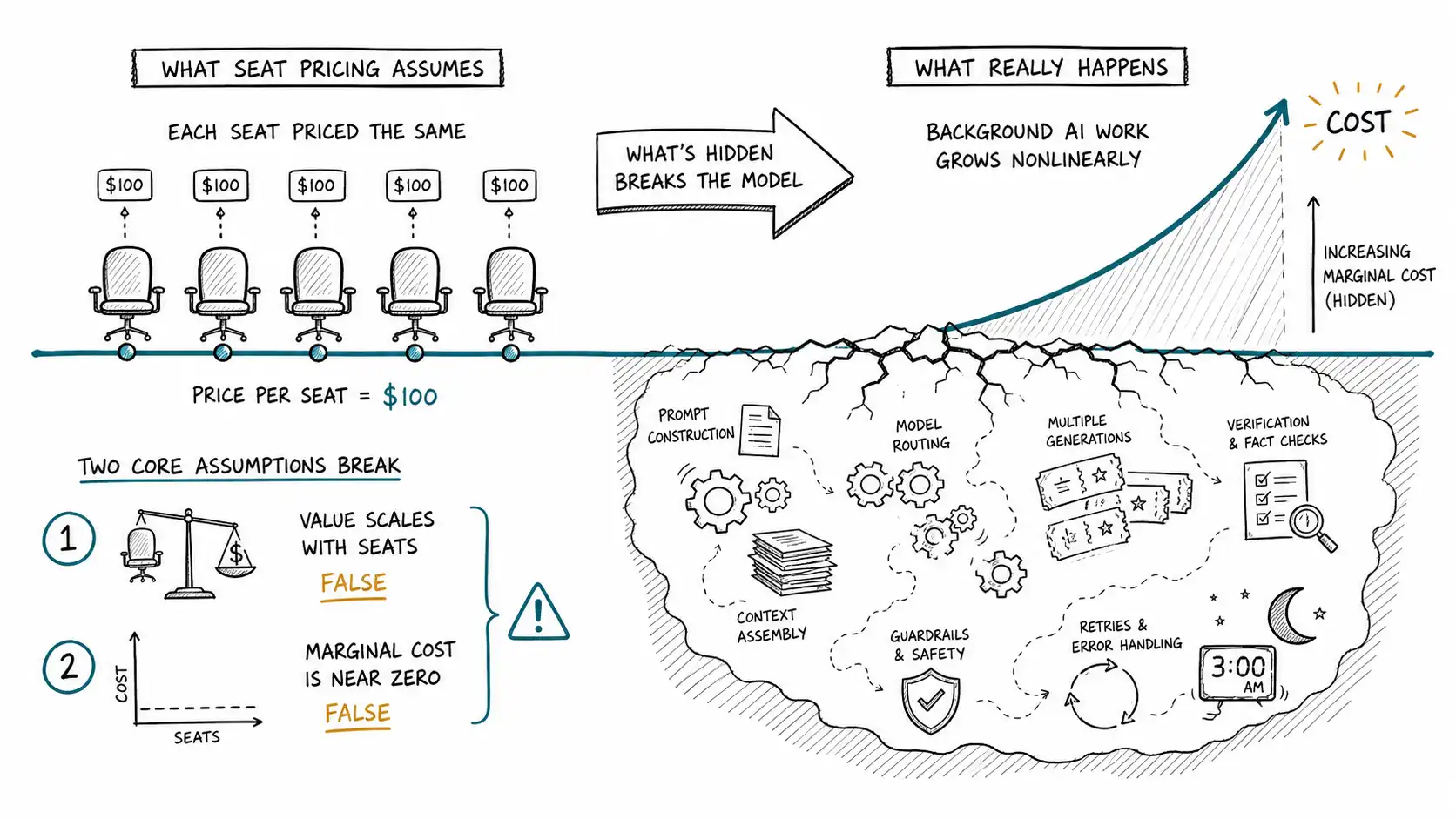
What AI does to assumption two
Start with cost, because it is the more concrete failure.
When software performs work using a large language model, every action has a real, variable, metered cost. I will go deep on the full structure in the AI Cost Stack chapter, but the headline is simple: you pay per token, in and out, on every call. As of mid-2026, Claude Sonnet 4.6 runs roughly three dollars per million input tokens and fifteen dollars per million output tokens, and the flagship Opus 4.8 runs five and twenty-five, per Anthropic's published API pricing. OpenAI's GPT-4.1 sits around two dollars input and eight dollars output per million, with GPT-4o grandfathered at $2.50 and $10. Those numbers feel small until you multiply them by real workloads with retrieval context, long outputs, and retries.
Here is the part that quietly destroys seat economics. Under per-seat pricing, two customers paying the same price can impose wildly different costs on you. Consider two teams on the same eighty-dollar-per-seat plan with an included AI assistant.
| Light team | Heavy team | |
|---|---|---|
| Seats | 10 | 10 |
| Monthly revenue | $800 | $800 |
| AI actions / month | 200 | 40,000 |
| Avg cost / action | $0.04 | $0.04 |
| Monthly AI COGS | $8 | $1,600 |
| Other COGS (~10%) | $80 | $80 |
| Gross margin | 89% | negative |
Same revenue. The light team is a beautiful 89 percent gross margin business. The heavy team costs you eight hundred dollars more than it pays you. And the heavy team is, by every product metric you track, your best customer. They are engaged, they are getting value, they will tell the analyst they cannot live without you. They are also, under this pricing, a loss-making account that gets worse the more they love you. ICONIQ's 2026 data showing AI-product gross margins compressed into the low 50s is this dynamic playing out across hundreds of companies at once, documented in coverage of the AI COGS problem.
The near-zero marginal cost assumption did not erode gently. It inverted. With AI in the product, your heaviest users are now your most expensive users, and per-seat pricing gives you no mechanism to charge them more for the cost they create. You have decoupled price from cost completely, and you have done it in the direction that hurts.
What AI does to assumption one
Now the subtler failure, and the one I think founders underestimate: AI breaks the link between value and seats.
Recall the motif. Seats price presence. AI often creates value by doing work when no one is present. The seat counts how many humans can log in. But the most valuable AI use cases are precisely the ones where the value does not come from a human logging in. An automation that processes the overnight queue of inbound documents creates enormous value and is associated with exactly one service-account seat, or zero. A support agent that resolves tickets at 3 a.m. while the team sleeps generates value with no human present at all. A code agent that runs a fleet of parallel tasks does the work of ten engineers under one login.
In all of these, the seat count is no longer even a rough proxy for value. The value scales with work performed, not with people present. A customer might derive ten times the value from your product this year with the same headcount, because the AI does more work per person. Under per-seat pricing, you capture none of that. You have built a product whose value grows with usage and priced it as if value grows with headcount. The two curves diverge, and the gap is revenue you will never see.
This is the deeper reason seat pricing breaks, and it is worse than the cost problem in one sense. The cost problem makes your good customers unprofitable. The value problem makes you leave money on the table even with your profitable ones. You are simultaneously overcharging the light users who barely touch the AI, undercharging the heavy users who depend on it, and capturing none of the expansion that AI-driven productivity creates. A single model misaligned in three directions at once.
The "AI premium" trap
The first instinct, when a team realizes the included-for-free model is bleeding margin, is to add an "AI premium." Keep the seat model, but charge more for the AI-enabled tier. Twenty dollars more per seat. A "Pro AI" plan.
This is better than free, and it is still wrong, for a reason worth being precise about: a flat per-seat premium does not track cost or value any better than the base seat did. It is a constant added to a number that was already disconnected from the thing that matters. The light team and the heavy team both pay the premium, but the heavy team still costs forty times more to serve. You have raised the floor; you have not changed the slope. The heavy user is slightly less unprofitable and the light user is now overpaying for AI they barely use, which gives them a reason to churn or downgrade.
"It has AI" is not a value proposition, and "AI tier" is not a pricing model. It is a seat model wearing a new hat. The chapter on packaging will deal with the legitimate version of this, where AI is genuinely a tier-differentiator, but the flat premium as a margin fix is a trap.
Run the Adoption Penalty Test
Here is the first appearance of a framework I will use throughout the book, the Adoption Penalty Test. It is a single question you apply to any pricing model:
When a customer succeeds with your product and uses it more, does your pricing reward that, punish you, or punish them?
There are three failure modes, and seat pricing with included AI hits the worst one:
- Pricing punishes the vendor. The customer uses more, the vendor's cost rises, and revenue does not. This is included-AI-on-a-seat. Success bleeds margin. Unsustainable.
- Pricing punishes the customer. The customer uses more, the bill spikes, and they feel penalized for adopting. This is naive usage pricing, and I will treat it carefully later because it has its own dangers.
- Pricing rewards both. The customer uses more, gets more value, pays somewhat more, and the vendor keeps a healthy margin on the incremental work. This is the target.
Seat pricing fails the test in the first mode for any product where usage drives cost. That is the diagnosis. The rest of the book is the treatment.
Why the field will fight you
I want to be honest about the organizational reality, because pricing changes do not happen on a whiteboard. They happen against the resistance of a sales team that has a working motion and a customer base that has a working budget.
The field loves seats for the same reason finance loves them: predictability. A salesperson can forecast a seat deal. A customer's procurement can approve a seat deal. When you propose moving to usage or work-unit pricing, the first objection you will hear is not about fairness or value. It is "I cannot forecast my commission" and "the customer cannot predict their bill." Both are real, and both are solvable with the mechanisms in later chapters: committed usage, quotas, caps, predictable bundles. But you should expect the resistance, and you should not mistake it for a signal that seat pricing is correct. It is a signal that seat pricing is comfortable. Those are different things.
The companies that handled the transition well, the usage-based public SaaS companies that posted 120-plus percent net revenue retention versus around 110 for subscription peers as usage-pricing benchmarks report, did not abandon predictability. They engineered it back in on top of a model that tracks value and cost. That is the move. Not seats forever because they are comfortable, and not raw usage because it is "honest." Something built deliberately.
A worksheet: is your seat model already broken?
Before you redesign anything, measure whether the problem is real for you. Pull the data and answer these:
- Cost dispersion. Across customers on the same plan, what is the ratio of AI COGS for your 90th-percentile user to your median user? If it is above roughly 5 to 1, per-seat pricing is hiding a large cross-subsidy.
- Margin by cohort. Compute gross margin for your top decile of AI usage separately. If it is more than 15 points below your blended margin, your best customers are subsidized by your lightest ones, which is fragile.
- Value-seat decoupling. Ask whether a customer could double the work your product does for them without adding seats. If yes, your price cannot follow your value.
- The 3 a.m. test. What fraction of the work your product performs happens with no human logged in? If it is meaningful and growing, the seat is no longer measuring anything.
- Adoption Penalty mode. Which of the three modes does your current model land in? Be honest.
If you answered uncomfortably to three or more of these, the rest of this book is for you specifically. The seat is not wrong because it is old. It is wrong because the cost structure and the value structure it was built to track have both moved, and a proxy that no longer tracks what it proxies is just a number you bill.
The next step is to find the thing it should track instead. That thing is the work unit, and it is where we go next.
Key Takeaways
- Per-seat pricing rested on two assumptions: value scales with users, and marginal cost per user is near zero. AI violates both.
- AI inverts the cost assumption: your heaviest, happiest users become your least profitable accounts under included-on-a-seat pricing.
- AI breaks the value link because the best AI work happens when no human is present, so seats stop proxying value.
- A flat "AI premium" on a seat raises the floor without changing the slope; it is a seat model in disguise.
- The Adoption Penalty Test asks whether success punishes the vendor, punishes the customer, or rewards both. Seat-plus-included-AI punishes the vendor.
- Expect field and finance resistance rooted in predictability, and solve for predictability deliberately rather than defaulting to seats.
Internal map
For the larger argument, keep this chapter connected to Pricing Software That Thinks, Revenue, Re-Engineered, the smaller-model margin argument, and The Economics of Inference.