Explaining Price Without Bill Shock
Transparency means the customer can predict and understand the bill, not that you itemize every token; bill shock is a design failure, not a billing event.

Research spine
This chapter is grounded in OpenAI API pricing, Anthropic prompt caching documentation, and Stanford HAI, 2025 AI Index Report.
Pricing software that thinks starts by pricing units of resolved work against variable inference, review, and risk cost.
The angriest customer call I ever sat in on was not about a high price. It was about a price the customer did not see coming. They had budgeted one number, the bill came in at three times that, and no amount of explaining that the charges were "accurate" calmed them down, because accuracy was never the problem. Predictability was. They felt ambushed, and a customer who feels ambushed does not hear your math. They hear betrayal.
That call taught me the distinction this chapter is built on. Bill shock is not a billing event. It is a design failure that happened weeks earlier, in how the pricing was explained and how the usage was made visible. By the time the shocking bill arrives, the failure is already complete. So this chapter is about two things that sound similar and are not: explaining price honestly without exposing your cost stack, and designing the experience so the bill is never a surprise.
Transparency is not itemization
There is a confused idea in AI pricing that transparency means showing the customer your costs: here are the tokens, here is the markup, here is what you owe. That is not transparency. That is itemization, and it usually makes things worse, for the reasons the credits-and-tokens chapter laid out: it exposes your cost structure, makes the customer pay attention to your inefficiency, and turns every bill into a forensic exercise.
Real transparency is different and more useful: the customer can predict the bill before it arrives and understand it after. Those are the two tests. Can they forecast roughly what they will pay this month, and when the bill comes, does it match the model in their head? A bill can be perfectly itemized down to the token and still fail both tests, because a list of tokens is not a forecast and is not understandable. A bill priced in reviewed contracts at a clear rate passes both tests while exposing nothing about your costs.
The restaurant analogy holds. A restaurant prices a dish at a number you can read before you order and understand when the check comes. It does not itemize the cost of the flour, the gas, the dishwasher's hourly wage, and its margin. You would not feel more fairly treated if it did; you would feel like you were being asked to audit a kitchen. The dish price is honest because you know it before you order and it matches what arrives. That is the standard for AI pricing too: price the work unit, show it clearly before consumption, and make the bill match.
The two-test standard, operationalized
Turn the two tests into product and pricing requirements.
Predictable before it arrives requires:
- A unit the customer can forecast, the work unit from earlier chapters, not tokens.
- Visible usage in real time, so the customer can watch consumption against quota as the month progresses, not discover it at invoice time.
- A clear quota and a defined overage rate, so the customer knows exactly where "included" ends and "you pay more" begins, and what crossing that line costs.
- Alerts before thresholds, the soft cap from the guardrail ladder, so the customer is warned at 50, 80, and 100 percent of quota and is never surprised by crossing a line.
Understandable after it arrives requires:
- A bill in the customer's unit, "1,240 reviewed contracts," not "14.2 million tokens."
- A bill that reconciles against what the customer can see, so they can check it against their own records, the count of contracts they know they sent.
- A clear breakdown of included versus overage, so the customer understands which part was the bundle and which part was the cost of their heavy month, and can act on it next month.
A pricing model that meets both standards can charge a high price and still feel fair. A model that fails either can charge a low price and still feel like a scam. The angry call I described was a low effective price that failed the predictability test, and the customer's rage was entirely about the surprise.
The bill shock curve
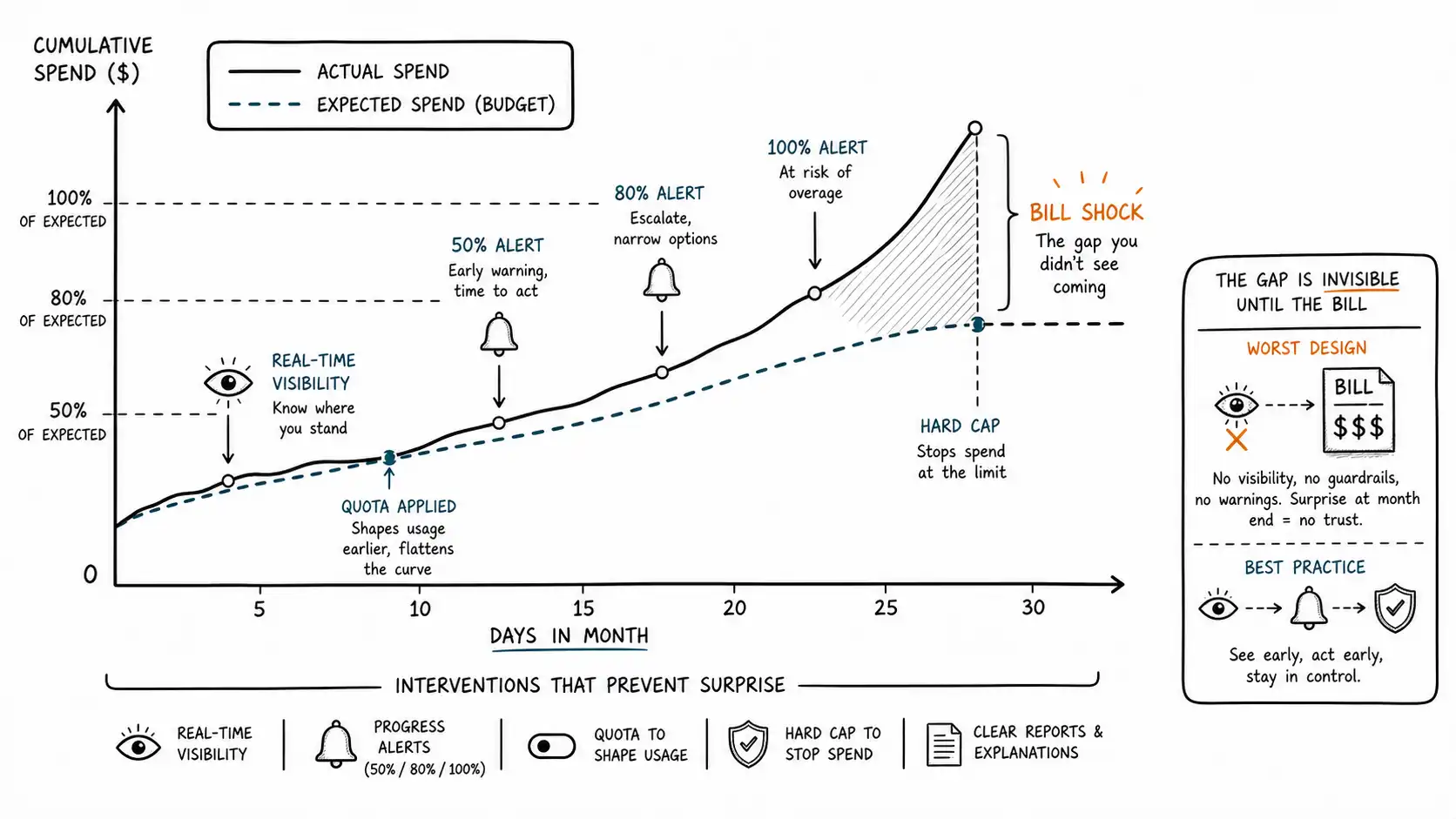
Bill shock has a shape, and understanding it tells you where to intervene. Plot the customer's cumulative spend over the month against their expectation. Early in the month, actual and expected track together. Then, for a heavy-usage customer, actual starts to diverge above expected, and the gap widens. Bill shock is the size of that gap at month end, and the customer's anger is proportional not to the absolute bill but to the gap between bill and expectation.
This tells you the interventions, in order of when they help:
- Flatten the curve before it diverges: quotas and caps that bound how far actual can exceed expected.
- Show the divergence as it happens: real-time usage visibility, so the customer sees the gap opening and can react, rather than discovering it at month end when the gap is maximal.
- Warn at the inflection: alerts at quota thresholds, so the moment actual is about to exceed the comfortable zone, the customer knows.
- Cap the gap entirely: for the most risk-averse customers, a hard cap that makes the gap impossible by stopping consumption at a ceiling.
The worst possible design is the one that produced my angry call: no quota, no visibility, no alerts, just a meter running invisibly all month and a bill at the end. The customer's expectation and actual diverged silently, the gap grew unwatched, and the first time the customer learned the gap existed was the invoice. Everything in good bill-shock design is about making that gap visible early, when it is small and the customer can still act on it.
The bill shock risk checklist
Run any pricing model through this before you ship it. Each unchecked box is a place a customer can be ambushed.
- Can the customer forecast their bill within a reasonable band before the month starts?
- Can the customer see real-time usage against their quota in the product?
- Are there alerts before the customer crosses into overage?
- Is there a defined, visible overage rate the customer agreed to in advance?
- Is there an option for a hard cap for budget-constrained customers?
- Does the bill arrive in the customer's work unit, not in tokens or credits?
- Can the customer reconcile the bill against their own records?
- Is there a clear, fast path to dispute a charge the customer thinks is wrong?
- When usage spikes unexpectedly, does the customer get notified during the spike, not after?
- Has someone outside the pricing team read the bill and understood it without help?
That last one is the cheapest and most revealing test. Hand a sample bill to someone who did not design the pricing, an engineer, a support rep, a friend, and ask them to explain what the customer would pay and why. If they cannot, your customer cannot either, and you have a bill-shock risk regardless of how accurate the charges are.
Explaining the price on the page and in the room
Predictability is mostly a product problem; understandability starts on the pricing page and in the sales conversation. A few principles for how to explain AI pricing without either exposing your costs or confusing the buyer:
Anchor on the work unit and its value. Lead with what the customer gets and what it costs them: "resolve a support ticket for under a dollar," not "we charge for inference at a markup." The price story should be a value story in the customer's own unit.
Explain the model, not the cost. It is honest and helpful to explain how you charge, the quota, the overage, the tiers, so the customer can predict their bill. It is neither necessary nor wise to explain what it costs you, the token rates and margins. The first builds trust; the second invites a negotiation about your margin you do not want to have.
Be explicit about where included ends. The most common avoidable surprise is a customer who thought the AI was "included" and did not realize there was a quota. Say it plainly, on the page and in the room: this much is included, beyond that you pay this rate, here is how you will know you are approaching the line. Customers do not resent a quota they were told about; they resent discovering one they were not.
Use predictability as a feature, not an apology. Committed usage, quotas, and caps are not concessions you make grudgingly. They are features the customer wants, because their finance team wants a predictable bill. Sell the predictability. The pricing-psychology research on fairness is consistent: customers prefer a predictable, understandable price to a lower but volatile one, and a vendor who proactively offers predictability reads as trustworthy, not stingy.
When you do have to raise the effective price
Sometimes costs rise, or you mispriced, and you need to charge more. The temptation, from the credits chapter, is to do it invisibly by re-rating credits or shrinking a quota quietly. Do not. The bill-shock principle applies doubly to price changes: a price increase the customer was warned about and understands is tolerable; a price increase they discover by noticing their money buys less is a betrayal that costs you the account. The migration chapter handles the mechanics; the principle here is that even bad news, delivered with enough notice and clarity that the customer can predict and understand it, does far less damage than good math delivered as a surprise.
Practical exercise
Pull a real bill from one of your heavier customers, or construct one for a planned model. Hand it to three people who did not build the pricing and ask each: could you have predicted this before the month started, and do you understand it now? Count how many say yes to both. If it is not all three, you have a bill-shock risk on every customer who looks like this one, and the checklist above tells you which box to fix first. Remember that the fix happens weeks before the bill, in visibility and quota design, not on the angry call after.
Key Takeaways
- Bill shock is a design failure that happens weeks before the bill arrives, in how price was explained and usage was made visible, not a billing event.
- Transparency means the customer can predict the bill before it arrives and understand it after, not that you itemize every token; itemization exposes your costs and helps no one.
- The two-test standard, predictable before and understandable after, can make a high price feel fair, while failing either makes a low price feel like a scam.
- The bill shock curve is the gap between actual and expected spend; intervene by flattening it (quotas), showing it as it opens (real-time visibility), warning at the inflection (alerts), and capping it (hard caps).
- Explain how you charge, not what it costs you; be explicit about where included ends; sell predictability as a feature customers want.
- Even a price increase, delivered with notice and clarity so the customer can predict and understand it, does far less damage than accurate charges delivered as a surprise.