Pricing, Margin, and Cost-to-Serve Math
The company celebrated usage growth until finance showed the gross margin curve. The biggest customers were also the least profitable because their workflows triggered long prompts, expensive model calls, and human escalation.

Key Takeaways
- Pricing, Margin, and Cost-to-Serve Math is a chapter about AI revenue engineering, not a generic AI adoption note.
- The operating rule is to sell proved work, measured risk, and margin discipline rather than demo theater.
- The failure mode to watch is polished output without evidence, owner, cost line, or rollback path.
- The useful next step is an artifact a future teammate can replay without folklore.
AI revenue work converts when the seller can prove resolved work, cost, risk, and expansion evidence, not just a polished demo.
The company celebrated usage growth until finance showed the gross margin curve. The biggest customers were also the least profitable because their workflows triggered long prompts, expensive model calls, and human escalation. The sales team had sold value. The product architecture had incurred cost. The pricing model connected neither.
In AI-native revenue, margin must be engineered with the product.
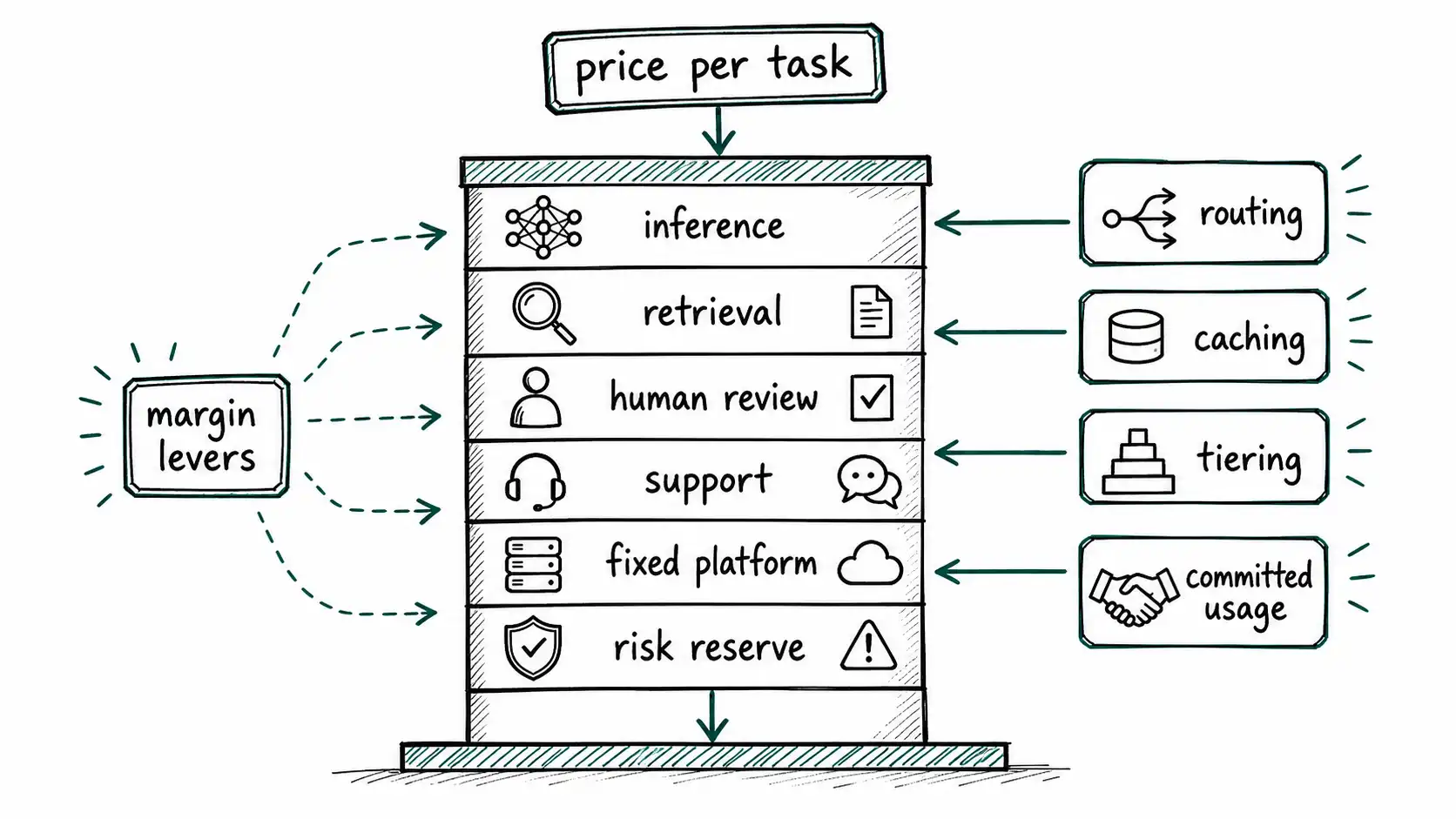
This chapter provides the commercial math leaders need before scaling AI-native products. Price must cover variable inference cost, infrastructure, storage, retrieval, human review, support, implementation, and risk reserves while still mapping to customer value. The answer is not always higher price. It may be routing, caching, model choice, workflow limits, committed usage, tiering, or review thresholds.
Research spine
This chapter uses: OpenView, Usage-Based Pricing; Stripe Billing; Zuora, Quote-to-Cash; Bessemer Venture Partners, State of AI 2025.
The AI COGS stack
Cost of goods sold can include model inference, embeddings, vector search, storage, orchestration, human review, monitoring, vendor fees, support, and success labor. Some costs scale per task, some per customer, some per tenant, and some per incident. A pricing model that ignores the stack may look attractive until the product succeeds.
Margin controls
Margin can be improved through smaller models, caching, routing, batching, context reduction, tiered quality, customer-specific limits, async processing, better retrieval, prompt compression, and escalation design. The CRO does not need to choose the technical method, but must understand that margin is partly an engineering decision.
Commercial packaging
Committed minimums, overage bands, included usage, premium autonomy, human-review tiers, compliance add-ons, and value-based expansion can stabilize revenue. Packaging must prevent both vendor margin surprise and customer bill shock.
Operating table
| Cost component | Scales with | Commercial control |
|---|---|---|
| Inference | Tokens, model choice, latency tier | Usage bands, routing, context limits |
| Human review | Risk class and quality threshold | Premium review tiers |
| Storage/retrieval | Corpus size and queries | Data tiers and indexing limits |
| Support | Customer complexity | Implementation packages and success tiers |
| Risk | Autonomy and customer impact | Contract scope and incident policy |
Artifact example: a cost-to-serve model for AI-native pricing
def ai_native_margin(tasks, price_per_task, inference, retrieval, human_review, support, fixed_platform_cost):
 revenue = tasks * price_per_task
 variable_cogs = tasks * (inference + retrieval + human_review + support)
 total_cogs = variable_cogs + fixed_platform_cost
 margin = (revenue - total_cogs) / revenue
 return round(revenue, 2), round(total_cogs, 2), round(margin, 3)

print(ai_native_margin(
 tasks=50000,
 price_per_task=1.20,
 inference=0.18,
 retrieval=0.03,
 human_review=0.07,
 support=0.04,
 fixed_platform_cost=6000
))
Checklist
- Build a cost-to-serve model before scaling.
- Model heavy users separately from average users.
- Align packaging with technical margin levers.
- Prevent bill shock with bands or commitments.
- Review gross margin by workflow, not only by customer.
Takeaway
AI-native revenue fails when the pricing model sells value but the architecture spends margin invisibly.
Internal map
For the larger argument, keep this chapter connected to Revenue, Re-Engineered, Pricing Software That Thinks, selling AI to burned buyers, and the judgment economy.