Renewal, Expansion, and the AI Revenue Flywheel
The renewal did not depend on whether the customer remembered the demo.

Key Takeaways
- Renewal, Expansion, and the AI Revenue Flywheel is a chapter about AI revenue engineering, not a generic AI adoption note.
- The operating rule is to sell proved work, measured risk, and margin discipline rather than demo theater.
- The failure mode to watch is polished output without evidence, owner, cost line, or rollback path.
- The useful next step is an artifact a future teammate can replay without folklore.
AI revenue work converts when the seller can prove resolved work, cost, risk, and expansion evidence, not just a polished demo.
The renewal did not depend on whether the customer remembered the demo. It depended on whether the product had become part of how the customer worked, whether value was visible, whether incidents had been handled well, whether usage expanded without surprise cost, and whether the customer's data and feedback made the system better.
AI-native revenue compounds only when value proof compounds.
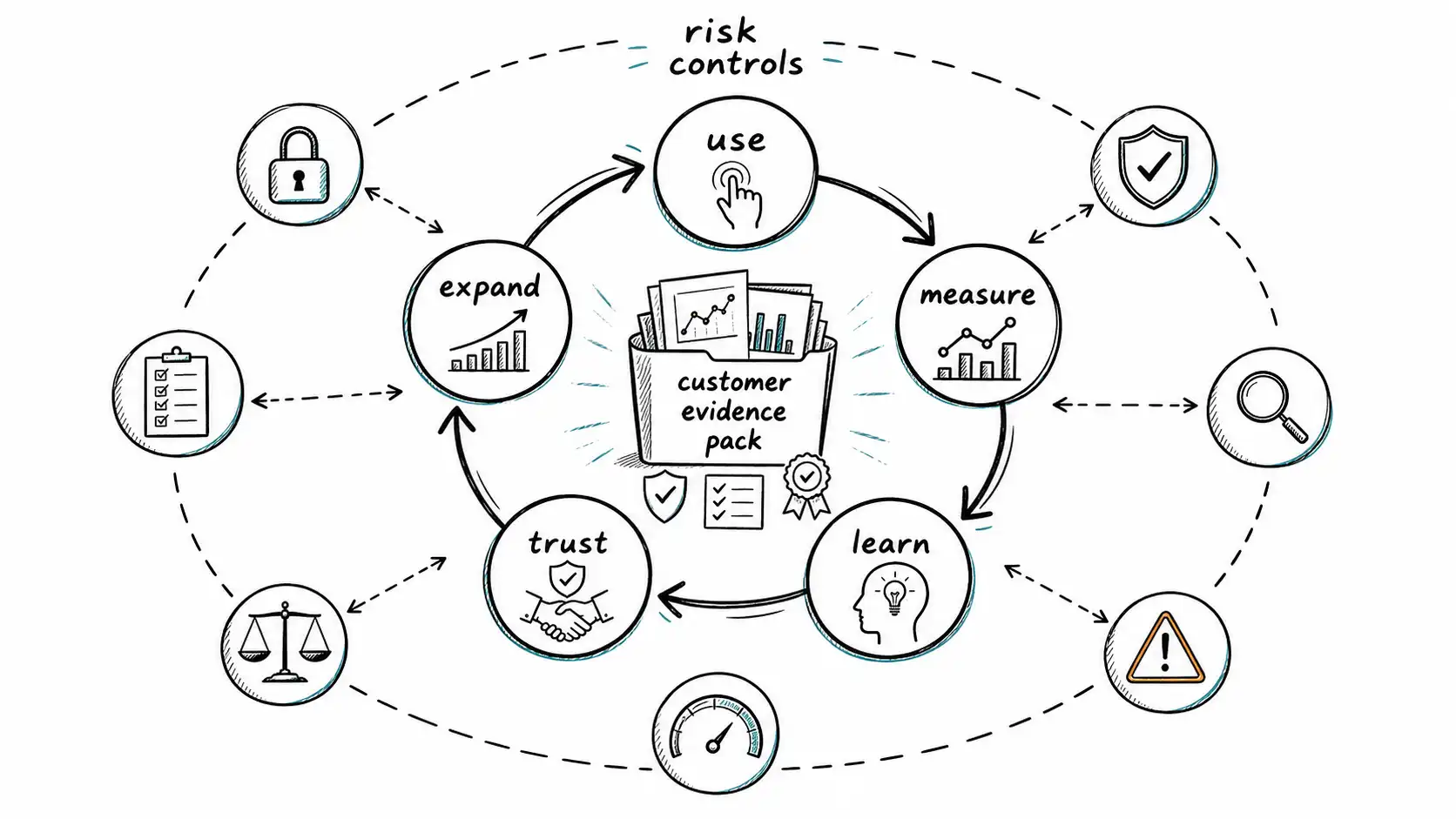
The final chapter connects usage, evidence, product improvement, trust, and expansion into a revenue flywheel. AI-native products should get better from deployment, but that improvement is not automatic. The company must capture feedback, convert it into product quality, show customers the value, and price expansion in a way that feels fair.
Research spine
This chapter uses: Bessemer Venture Partners, State of AI 2025; OpenView, Usage-Based Pricing; Brynjolfsson, Li, Raymond, Generative AI at Work, NBER Working Paper 31161; NIST AI Risk Management Framework.
The renewal evidence pack
Every AI-native account should accumulate a renewal evidence pack: work performed, value metric trend, quality review, user adoption, cost visibility, incidents and resolutions, workflow expansion opportunities, and customer feedback incorporated. This pack should be built continuously, not assembled frantically before renewal.
Expansion paths
Expansion can happen by volume, workflow, department, autonomy level, compliance tier, or premium support. The cleanest expansion path follows trust. A customer starts with draft assistance, moves to recommendation, then bounded automation, then broader workflow coverage. Each step should have evidence and a commercial motion.
The data advantage
Usage can improve AI-native products through better evals, labels, workflow understanding, retrieval quality, routing, and personalization. But data advantage must respect privacy, contracts, tenant isolation, and customer trust. The flywheel is not "use all customer data." It is "turn permitted learning into better outcomes and show the customer the improvement."
Operating table
| Flywheel stage | Input | Output |
|---|---|---|
| Use | Customer workflow activity | Work performed |
| Measure | Outcome and quality signals | Evidence pack |
| Learn | Feedback, labels, failure cases | Product improvement |
| Trust | Visible reliability and incident handling | More autonomy |
| Expand | New workflows or volume | Revenue growth |
Artifact example: a renewal evidence pack
renewal_evidence_pack:
 account: "Acme Health"
 period: "Q2 2026"
 work_performed:
 verified_resolved_cases: 18420
 reviewed_cases: 920
 value:
 handle_time_reduction: "31%"
 reopen_rate_delta: "-8%"
 estimated_cost_avoided: "$142000"
 trust:
 incidents: 2
 median_resolution_time: "5h"
 audit_exports_completed: 1
 expansion_candidates:
 - "claims status workflow"
 - "provider directory updates"
Checklist
- Build renewal evidence continuously.
- Design expansion around earned trust, not only usage growth.
- Show cost and value together.
- Use permitted feedback to improve evals and product quality.
- Treat incident handling as part of renewal trust.
Takeaway
AI-native revenue compounds when every workflow creates evidence, learning, trust, and a credible next expansion step.