CRO/CTO Alignment and Commercial Risk
Sales promised autonomous resolution. Engineering had built assisted drafting.

Key Takeaways
- CRO/CTO Alignment and Commercial Risk is a chapter about AI revenue engineering, not a generic AI adoption note.
- The operating rule is to sell proved work, measured risk, and margin discipline rather than demo theater.
- The failure mode to watch is polished output without evidence, owner, cost line, or rollback path.
- The useful next step is an artifact a future teammate can replay without folklore.
AI revenue work converts when the seller can prove resolved work, cost, risk, and expansion evidence, not just a polished demo.
Sales promised autonomous resolution. Engineering had built assisted drafting. Customer success heard "mostly automatic." Legal heard "human reviewed." The customer heard "you own the outcome." The product had not changed; the commercial interpretation had.
AI-native companies need CRO/CTO alignment because the gap between capability and promise can become the product's largest risk.
Commercial risk in AI-native products includes overpromising, under-instrumenting, mispricing, poor security posture, weak proof, unsupported deployment, and unclear incident ownership. The CRO and CTO must share a language for autonomy level, evidence, cost, risk, and customer promise.
Research spine
This chapter uses: NIST AI Risk Management Framework; OWASP Top 10 for Large Language Model Applications; Zuora, What is Quote-to-Cash?; DORA, State of AI-assisted Software Development 2025.
The promise boundary
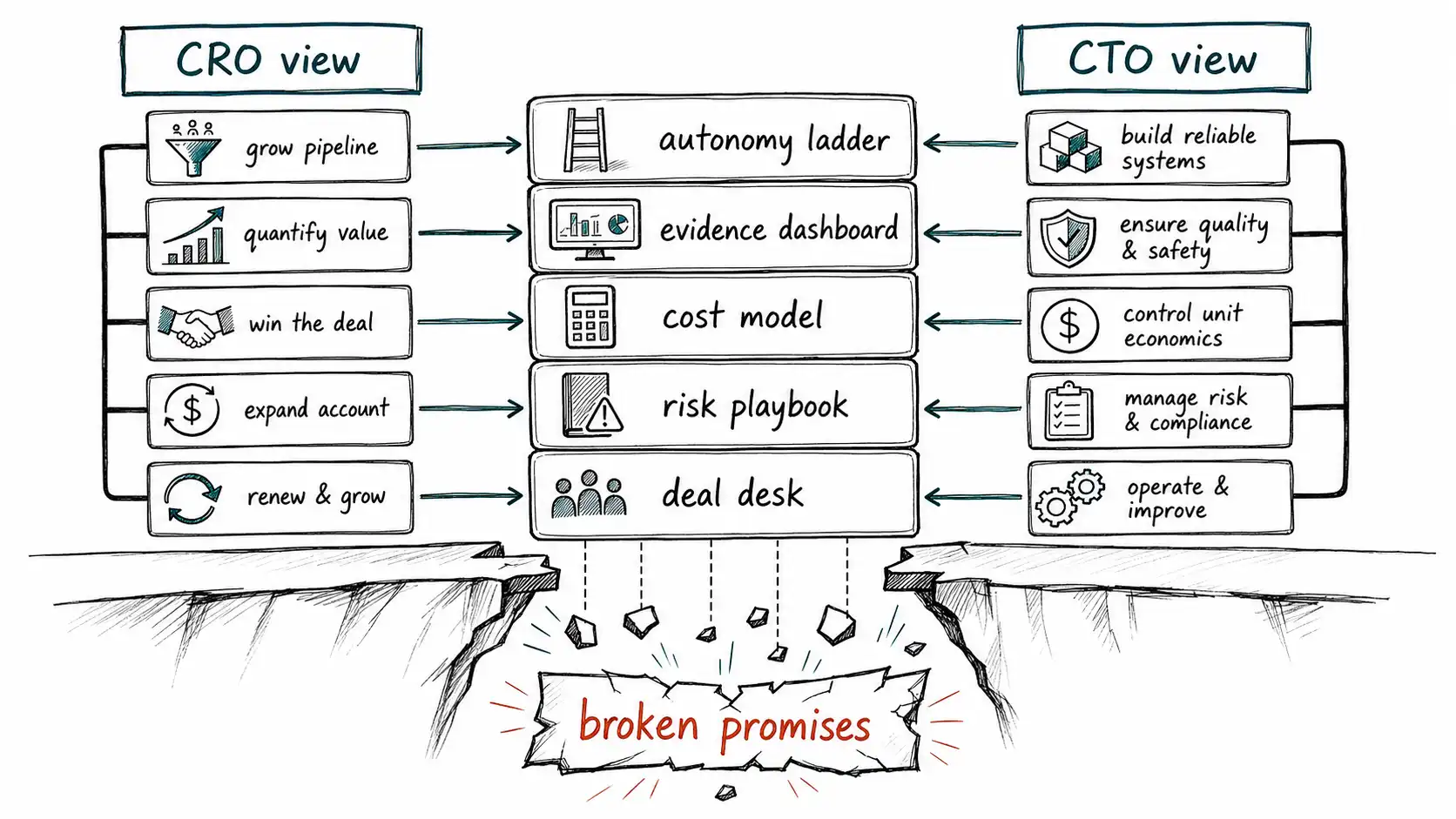
Every AI-native product has a promise boundary: what the system is allowed to claim, decide, automate, or guarantee. Sales needs this boundary in customer language. Engineering needs it in system language. Legal needs it in contract language. Customer success needs it in onboarding language. If these do not match, revenue growth creates future churn or incident risk.
The deal desk for AI
Complex AI deals need an AI-aware deal desk. It should review autonomy promises, data usage, model/vendor dependencies, usage commitments, compliance terms, service levels, support responsibilities, and pricing exceptions. The point is not to slow every deal. It is to prevent non-standard promises that the system cannot safely fulfill.
Shared dashboards
CRO/CTO alignment improves when both teams look at the same dashboards: usage, cost per outcome, quality, incidents, escalations, adoption, value evidence, and expansion readiness. Revenue teams should understand technical constraints; engineering teams should understand commercial proof requirements.
Operating table
| Alignment object | CRO needs | CTO needs |
|---|---|---|
| Autonomy ladder | What can sales promise? | What can the system safely do? |
| Evidence dashboard | What proves value? | What metrics are instrumented? |
| Cost model | What price protects margin? | Which levers control cost? |
| Risk playbook | How are objections answered? | How are incidents handled? |
| Deal desk | What exceptions are allowed? | What exceptions create unsafe work? |
Artifact example: an AI-aware deal desk policy
ai_deal_desk_review:
 required_for:
 - "autonomous customer-facing workflow"
 - "non-standard data retention"
 - "outcome-based pricing"
 - "customer-specific model terms"
 reviewers:
 revenue: "CRO delegate"
 technical: "CTO delegate"
 security: "Security lead"
 legal: "Commercial counsel"
 checks:
 - autonomy_level_matches_contract
 - data_boundary_approved
 - cost_model_reviewed
 - incident_owner_named
 - value_metric_instrumented
Checklist
- Define promise boundaries before sales scales.
- Use autonomy levels in customer-facing language.
- Create deal-desk review for non-standard AI promises.
- Share cost and quality dashboards across revenue and engineering.
- Make incident ownership contract-aware.
Takeaway
AI-native revenue requires the CRO and CTO to co-own the boundary between what the product can do and what the company promises.