The Demo Lies by Omission
The demo worked because the room was arranged for it to work. The dataset was clean.

The demo worked because the room was arranged for it to work. The dataset was clean. The prompt had been tuned. The happy path was chosen. The user knew what to ask. The internet connection was stable. The model provider was available. The security team had not yet asked about permissions. The finance team had not yet asked about cost. The support team had not yet been trained to handle confused users.
The demo did not lie by showing something fake. It lied by omitting the system that would be required for the behavior to survive.
This chapter draws the central distinction of the book: a demo is a behavior sample; a product is an operating system around that behavior. The sample can be real and still be commercially misleading. Durable AI products require scope, evaluation, observability, latency budgets, cost controls, trust boundaries, ownership, rollout, and learning loops.
Research spine
This chapter uses: DORA, State of AI-assisted Software Development 2025; Google SRE Book; NIST AI Risk Management Framework; OpenAI Evals.
The omission list
AI demos tend to omit four categories of work. First, they omit distributional mess: unusual inputs, missing data, ambiguous intent, adversarial prompts, stale documents, and long-tail users. Second, they omit operational constraints: latency, cost, availability, rate limits, retries, escalation, and rollback. Third, they omit trust constraints: permissions, compliance, audit, privacy, security, and customer promises. Fourth, they omit organizational constraints: who owns quality, who answers incidents, who updates evals, who pays inference cost, and who decides when to stop.
A demo that omits these is not dishonest by default. It is incomplete. The danger begins when leaders treat incompleteness as proof of readiness.
Demo-to-durable gap
The gap between demo and durable product can be represented as a sequence of questions. What exact workflow is in scope? What failure modes are unacceptable? What evidence shows the system performs? What human action does the model replace or assist? What does the user do when the answer is wrong? What happens when cost spikes? What data can be used? How is the system monitored? Who can roll it back?
Every unanswered question becomes deferred work. Deferred work is not avoided work; it returns during rollout, incident, renewal, or audit.
The habit of naming omissions
Strong organizations do not shame demos. They use demos as learning artifacts. After every demo, they ask what the demo excluded. The omission list becomes the product hardening backlog. That single habit changes the culture. Instead of arguing whether a demo was "real," the team asks what needs to be true for the behavior to survive real use.
Operating table
| Demo shows | Product must prove | Durable artifact |
|---|---|---|
| Capability | Reliability across cases | Eval suite |
| Happy path | Failure handling | Runbook |
| Fast answer | Latency under load | Latency budget |
| Impressive output | Trust and permission safety | Policy gates |
| User excitement | Adoption and value | Outcome dashboard |
Artifact example: a demo-to-durable review artifact
demo_to_durable_review:
 demo_name: "AI onboarding assistant"
 omissions:
 data_mess:
 - "missing CRM fields"
 - "ambiguous customer intent"
 operations:
 - "no latency budget"
 - "no fallback path"
 trust:
 - "permissions not enforced"
 - "no audit log"
 ownership:
 - "no incident owner"
 - "eval updates undefined"
 decision: "harden before pilot"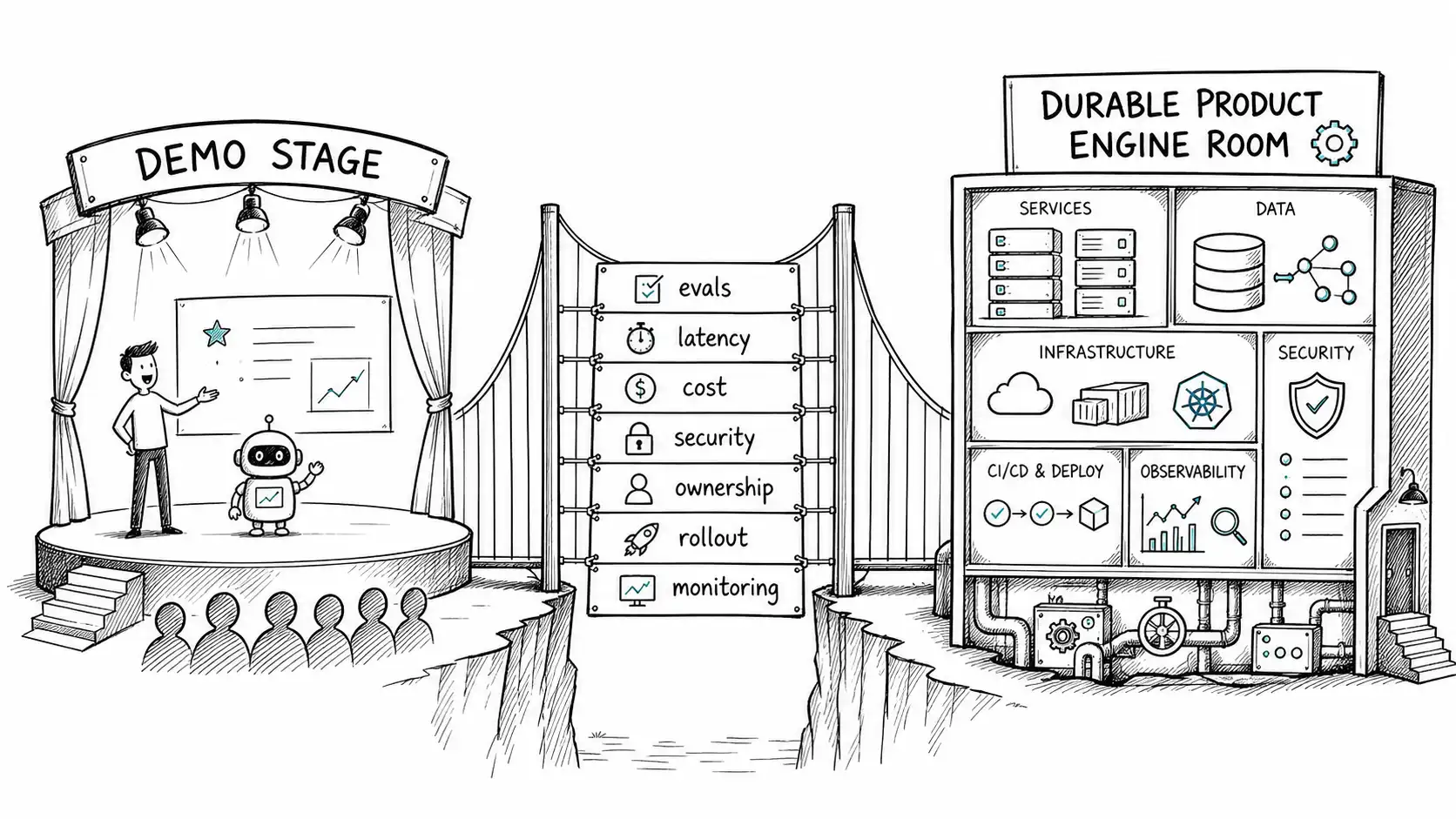
Checklist
- After every demo, write the omission list.
- Do not approve pilot until operational omissions have owners.
- Separate capability proof from readiness proof.
- Turn demo gaps into hardening backlog items.
- Ask who owns failure before user rollout.
Takeaway
A demo is useful when it reveals the system that must be built around it.
Operational note: Omission is not deception until it becomes planning
A demo can be a valid exploration artifact, but it becomes dangerous when treated as a shipping argument. In the context of The Demo Lies by Omission, the practical danger is not that the team lacks effort; it is that effort is aimed at the wrong scarce resource. The durable AI product operations argument says that the old visible unit of work is no longer the safest unit of management. A team can produce more drafts, more code, more messages, more analysis, or more tickets while becoming less reliable at the point where the business needs a decision. The fix is to move the management surface away from raw output and toward evidence: what was decided, by whom, from which inputs, against which criteria, with what rollback path.
A mature implementation treats this as an operating-system concern rather than a personal-performance concern. The artifact should make the judgment visible: the rubric, acceptance gate, cost line, risk boundary, owner, and expiry date. When those fields are missing, the model's speed hides organizational ambiguity. When they are present, AI acceleration becomes tractable because the team can see which decisions deserve automation, which deserve human review, and which deserve rejection before execution begins.
The useful test is whether a new teammate can replay the decision two weeks later without interviewing the original author. If replay requires folklore, the process is still human-memory-bound. If replay can be done from the artifact, the team has converted judgment into infrastructure. That conversion is the recurring discipline throughout this book: not replacing human judgment, but making human judgment explicit enough that machines can safely do more of the surrounding work.
Field expansion: The system is the product
AI behavior without operations, trust, and ownership is only a trick that worked once. In the context of The Demo Lies by Omission, the practical danger is not that the team lacks effort; it is that effort is aimed at the wrong scarce resource. The durable AI product operations argument says that the old visible unit of work is no longer the safest unit of management. A team can produce more drafts, more code, more messages, more analysis, or more tickets while becoming less reliable at the point where the business needs a decision. The fix is to move the management surface away from raw output and toward evidence: what was decided, by whom, from which inputs, against which criteria, with what rollback path.
A mature implementation treats this as an operating-system concern rather than a personal-performance concern. The artifact should make the judgment visible: the rubric, acceptance gate, cost line, risk boundary, owner, and expiry date. When those fields are missing, the model's speed hides organizational ambiguity. When they are present, AI acceleration becomes tractable because the team can see which decisions deserve automation, which deserve human review, and which deserve rejection before execution begins.
The useful test is whether a new teammate can replay the decision two weeks later without interviewing the original author. If replay requires folklore, the process is still human-memory-bound. If replay can be done from the artifact, the team has converted judgment into infrastructure. That conversion is the recurring discipline throughout this book: not replacing human judgment, but making human judgment explicit enough that machines can safely do more of the surrounding work.
Design consequence: Naming gaps changes culture
Teams improve when they can admire a demo and still inspect its missing production surface. In the context of The Demo Lies by Omission, the practical danger is not that the team lacks effort; it is that effort is aimed at the wrong scarce resource. The durable AI product operations argument says that the old visible unit of work is no longer the safest unit of management. A team can produce more drafts, more code, more messages, more analysis, or more tickets while becoming less reliable at the point where the business needs a decision. The fix is to move the management surface away from raw output and toward evidence: what was decided, by whom, from which inputs, against which criteria, with what rollback path.
A mature implementation treats this as an operating-system concern rather than a personal-performance concern. The artifact should make the judgment visible: the rubric, acceptance gate, cost line, risk boundary, owner, and expiry date. When those fields are missing, the model's speed hides organizational ambiguity. When they are present, AI acceleration becomes tractable because the team can see which decisions deserve automation, which deserve human review, and which deserve rejection before execution begins.
The useful test is whether a new teammate can replay the decision two weeks later without interviewing the original author. If replay requires folklore, the process is still human-memory-bound. If replay can be done from the artifact, the team has converted judgment into infrastructure. That conversion is the recurring discipline throughout this book: not replacing human judgment, but making human judgment explicit enough that machines can safely do more of the surrounding work.
Managerial implication: Omission is not deception until it becomes planning
A demo can be a valid exploration artifact, but it becomes dangerous when treated as a shipping argument. In the context of The Demo Lies by Omission, the practical danger is not that the team lacks effort; it is that effort is aimed at the wrong scarce resource. The durable AI product operations argument says that the old visible unit of work is no longer the safest unit of management. A team can produce more drafts, more code, more messages, more analysis, or more tickets while becoming less reliable at the point where the business needs a decision. The fix is to move the management surface away from raw output and toward evidence: what was decided, by whom, from which inputs, against which criteria, with what rollback path.
A mature implementation treats this as an operating-system concern rather than a personal-performance concern. The artifact should make the judgment visible: the rubric, acceptance gate, cost line, risk boundary, owner, and expiry date. When those fields are missing, the model's speed hides organizational ambiguity. When they are present, AI acceleration becomes tractable because the team can see which decisions deserve automation, which deserve human review, and which deserve rejection before execution begins.
The useful test is whether a new teammate can replay the decision two weeks later without interviewing the original author. If replay requires folklore, the process is still human-memory-bound. If replay can be done from the artifact, the team has converted judgment into infrastructure. That conversion is the recurring discipline throughout this book: not replacing human judgment, but making human judgment explicit enough that machines can safely do more of the surrounding work.
Production implication: The system is the product
AI behavior without operations, trust, and ownership is only a trick that worked once. In the context of The Demo Lies by Omission, the practical danger is not that the team lacks effort; it is that effort is aimed at the wrong scarce resource. The durable AI product operations argument says that the old visible unit of work is no longer the safest unit of management. A team can produce more drafts, more code, more messages, more analysis, or more tickets while becoming less reliable at the point where the business needs a decision. The fix is to move the management surface away from raw output and toward evidence: what was decided, by whom, from which inputs, against which criteria, with what rollback path.
A mature implementation treats this as an operating-system concern rather than a personal-performance concern. The artifact should make the judgment visible: the rubric, acceptance gate, cost line, risk boundary, owner, and expiry date. When those fields are missing, the model's speed hides organizational ambiguity. When they are present, AI acceleration becomes tractable because the team can see which decisions deserve automation, which deserve human review, and which deserve rejection before execution begins.
The useful test is whether a new teammate can replay the decision two weeks later without interviewing the original author. If replay requires folklore, the process is still human-memory-bound. If replay can be done from the artifact, the team has converted judgment into infrastructure. That conversion is the recurring discipline throughout this book: not replacing human judgment, but making human judgment explicit enough that machines can safely do more of the surrounding work.