The SHIP-LOOP Operating System
The team stopped asking "is the model ready?" and started asking where the workflow was in SHIP-LOOP. Had scope been narrowed?

The team stopped asking "is the model ready?" and started asking where the workflow was in SHIP-LOOP. Had scope been narrowed? Had the path been hardened? Was behavior instrumented? Was rollout paced? Were failures being learned from? Was ownership explicit? Was trust evidence available? Had weak surfaces been pruned?
The questions changed the product.
SHIP-LOOP is the operating system of this book: Scope, Harden, Instrument, Pace, Learn, Own, Operationalize trust, Prune. It is not a waterfall. It is a loop because production contact changes what the team knows. The loop keeps the organization from confusing initial capability with durable shipping.
Research spine
This chapter uses: DORA, State of AI-assisted Software Development 2025; Google SRE Book; NIST AI Risk Management Framework; March, Exploration and Exploitation in Organizational Learning.
Scope and Harden
Scope names the product boundary. Harden turns that boundary into product behavior: evals, tests, data contracts, fallback paths, cost limits, permission checks, and runbooks. A scoped product that is not hardened is a promise without infrastructure. A hardened product with no scope is expensive chaos.
Instrument and Pace
Instrumentation tells the team what happens when the system meets users. Metrics should include behavior quality, user action, latency, cost, errors, escalations, refusal rate, override rate, and incidents. Pacing controls exposure: dogfood, internal pilot, limited beta, canary, cohort rollout, general availability. Pacing without instrumentation is ceremony. Instrumentation without pacing is a way to watch failure at full blast.
Learn, Own, Operationalize trust, Prune
Learning converts production surprises into updated evals, prompts, specs, policies, or product boundaries. Ownership names who is responsible for the workflow after launch. Operationalizing trust produces the evidence needed by customers, auditors, leaders, and support teams. Pruning removes demos, workflows, prompts, features, and automations that no longer earn their keep.
Operating table
| Step | Main question | Artifact |
|---|---|---|
| Scope | What exactly is allowed? | Scope contract |
| Harden | What prevents known failures? | Eval/test/runbook |
| Instrument | How will we see behavior? | Dashboard and logs |
| Pace | How much exposure is safe? | Rollout plan |
| Learn | How does contact improve the system? | Learning backlog |
| Own | Who carries consequences? | Owner map |
| Operationalize trust | What evidence proves safety/value? | Trust pack |
| Prune | What should be removed? | Pruning decision |
Artifact example: a SHIP-LOOP status artifact
ship_loop_status:
 workflow: "AI customer onboarding assistant"
 scope: "green"
 harden: "yellow"
 instrument: "yellow"
 pace: "not_started"
 learn: "not_started"
 own: "green"
 operationalize_trust: "red"
 prune: "not_started"
 next_actions:
 - "add refusal-rate dashboard"
 - "create trust evidence pack"
 - "run 50-case eval before beta"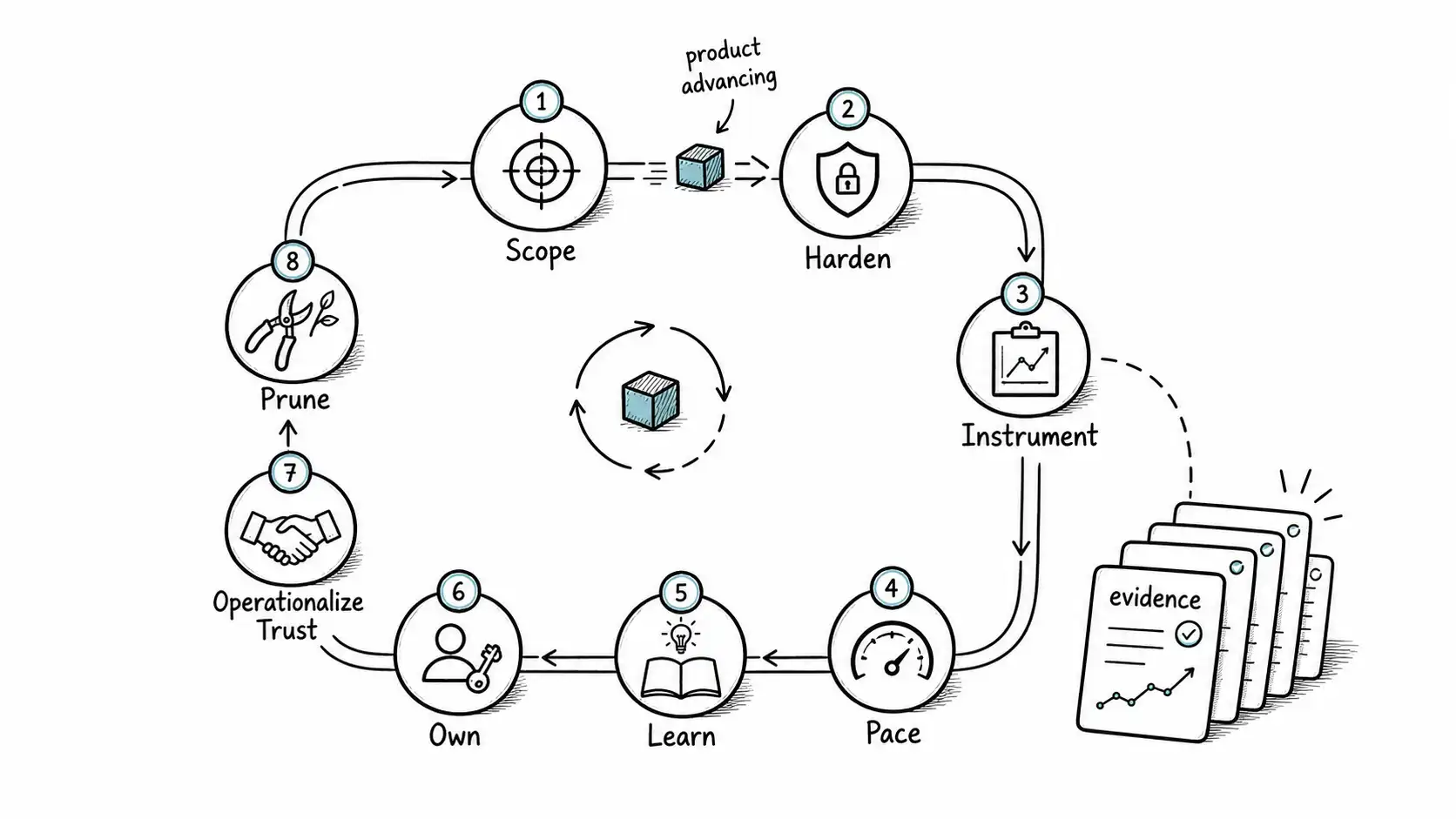
Checklist
- Use SHIP-LOOP as a weekly review for AI workflows.
- Do not move to rollout with red trust or ownership status.
- Treat pruning as part of shipping discipline.
- Make learning updates visible in artifacts.
- Separate hardening work from feature expansion.
Takeaway
Durable AI products ship through an operating loop, not a single launch decision.
Operational note: A loop creates memory
Teams forget lessons when learning is not converted into recurring artifacts. In the context of The SHIP-LOOP Operating System, the practical danger is not that the team lacks effort; it is that effort is aimed at the wrong scarce resource. The durable AI product operations argument says that the old visible unit of work is no longer the safest unit of management. A team can produce more drafts, more code, more messages, more analysis, or more tickets while becoming less reliable at the point where the business needs a decision. The fix is to move the management surface away from raw output and toward evidence: what was decided, by whom, from which inputs, against which criteria, with what rollback path.
A mature implementation treats this as an operating-system concern rather than a personal-performance concern. The artifact should make the judgment visible: the rubric, acceptance gate, cost line, risk boundary, owner, and expiry date. When those fields are missing, the model's speed hides organizational ambiguity. When they are present, AI acceleration becomes tractable because the team can see which decisions deserve automation, which deserve human review, and which deserve rejection before execution begins.
The useful test is whether a new teammate can replay the decision two weeks later without interviewing the original author. If replay requires folklore, the process is still human-memory-bound. If replay can be done from the artifact, the team has converted judgment into infrastructure. That conversion is the recurring discipline throughout this book: not replacing human judgment, but making human judgment explicit enough that machines can safely do more of the surrounding work.
Field expansion: Pacing is a safety feature
Controlled exposure lets a system earn confidence instead of demanding it up front. In the context of The SHIP-LOOP Operating System, the practical danger is not that the team lacks effort; it is that effort is aimed at the wrong scarce resource. The durable AI product operations argument says that the old visible unit of work is no longer the safest unit of management. A team can produce more drafts, more code, more messages, more analysis, or more tickets while becoming less reliable at the point where the business needs a decision. The fix is to move the management surface away from raw output and toward evidence: what was decided, by whom, from which inputs, against which criteria, with what rollback path.
A mature implementation treats this as an operating-system concern rather than a personal-performance concern. The artifact should make the judgment visible: the rubric, acceptance gate, cost line, risk boundary, owner, and expiry date. When those fields are missing, the model's speed hides organizational ambiguity. When they are present, AI acceleration becomes tractable because the team can see which decisions deserve automation, which deserve human review, and which deserve rejection before execution begins.
The useful test is whether a new teammate can replay the decision two weeks later without interviewing the original author. If replay requires folklore, the process is still human-memory-bound. If replay can be done from the artifact, the team has converted judgment into infrastructure. That conversion is the recurring discipline throughout this book: not replacing human judgment, but making human judgment explicit enough that machines can safely do more of the surrounding work.
Design consequence: Pruning protects focus
AI makes it easy to create features; durable organizations remove features that do not earn trust or value. In the context of The SHIP-LOOP Operating System, the practical danger is not that the team lacks effort; it is that effort is aimed at the wrong scarce resource. The durable AI product operations argument says that the old visible unit of work is no longer the safest unit of management. A team can produce more drafts, more code, more messages, more analysis, or more tickets while becoming less reliable at the point where the business needs a decision. The fix is to move the management surface away from raw output and toward evidence: what was decided, by whom, from which inputs, against which criteria, with what rollback path.
A mature implementation treats this as an operating-system concern rather than a personal-performance concern. The artifact should make the judgment visible: the rubric, acceptance gate, cost line, risk boundary, owner, and expiry date. When those fields are missing, the model's speed hides organizational ambiguity. When they are present, AI acceleration becomes tractable because the team can see which decisions deserve automation, which deserve human review, and which deserve rejection before execution begins.
The useful test is whether a new teammate can replay the decision two weeks later without interviewing the original author. If replay requires folklore, the process is still human-memory-bound. If replay can be done from the artifact, the team has converted judgment into infrastructure. That conversion is the recurring discipline throughout this book: not replacing human judgment, but making human judgment explicit enough that machines can safely do more of the surrounding work.
Managerial implication: A loop creates memory
Teams forget lessons when learning is not converted into recurring artifacts. In the context of The SHIP-LOOP Operating System, the practical danger is not that the team lacks effort; it is that effort is aimed at the wrong scarce resource. The durable AI product operations argument says that the old visible unit of work is no longer the safest unit of management. A team can produce more drafts, more code, more messages, more analysis, or more tickets while becoming less reliable at the point where the business needs a decision. The fix is to move the management surface away from raw output and toward evidence: what was decided, by whom, from which inputs, against which criteria, with what rollback path.
A mature implementation treats this as an operating-system concern rather than a personal-performance concern. The artifact should make the judgment visible: the rubric, acceptance gate, cost line, risk boundary, owner, and expiry date. When those fields are missing, the model's speed hides organizational ambiguity. When they are present, AI acceleration becomes tractable because the team can see which decisions deserve automation, which deserve human review, and which deserve rejection before execution begins.
The useful test is whether a new teammate can replay the decision two weeks later without interviewing the original author. If replay requires folklore, the process is still human-memory-bound. If replay can be done from the artifact, the team has converted judgment into infrastructure. That conversion is the recurring discipline throughout this book: not replacing human judgment, but making human judgment explicit enough that machines can safely do more of the surrounding work.
Production implication: Pacing is a safety feature
Controlled exposure lets a system earn confidence instead of demanding it up front. In the context of The SHIP-LOOP Operating System, the practical danger is not that the team lacks effort; it is that effort is aimed at the wrong scarce resource. The durable AI product operations argument says that the old visible unit of work is no longer the safest unit of management. A team can produce more drafts, more code, more messages, more analysis, or more tickets while becoming less reliable at the point where the business needs a decision. The fix is to move the management surface away from raw output and toward evidence: what was decided, by whom, from which inputs, against which criteria, with what rollback path.
A mature implementation treats this as an operating-system concern rather than a personal-performance concern. The artifact should make the judgment visible: the rubric, acceptance gate, cost line, risk boundary, owner, and expiry date. When those fields are missing, the model's speed hides organizational ambiguity. When they are present, AI acceleration becomes tractable because the team can see which decisions deserve automation, which deserve human review, and which deserve rejection before execution begins.
The useful test is whether a new teammate can replay the decision two weeks later without interviewing the original author. If replay requires folklore, the process is still human-memory-bound. If replay can be done from the artifact, the team has converted judgment into infrastructure. That conversion is the recurring discipline throughout this book: not replacing human judgment, but making human judgment explicit enough that machines can safely do more of the surrounding work.
Operational note: Pruning protects focus
AI makes it easy to create features; durable organizations remove features that do not earn trust or value. In the context of The SHIP-LOOP Operating System, the practical danger is not that the team lacks effort; it is that effort is aimed at the wrong scarce resource. The durable AI product operations argument says that the old visible unit of work is no longer the safest unit of management. A team can produce more drafts, more code, more messages, more analysis, or more tickets while becoming less reliable at the point where the business needs a decision. The fix is to move the management surface away from raw output and toward evidence: what was decided, by whom, from which inputs, against which criteria, with what rollback path.
A mature implementation treats this as an operating-system concern rather than a personal-performance concern. The artifact should make the judgment visible: the rubric, acceptance gate, cost line, risk boundary, owner, and expiry date. When those fields are missing, the model's speed hides organizational ambiguity. When they are present, AI acceleration becomes tractable because the team can see which decisions deserve automation, which deserve human review, and which deserve rejection before execution begins.
The useful test is whether a new teammate can replay the decision two weeks later without interviewing the original author. If replay requires folklore, the process is still human-memory-bound. If replay can be done from the artifact, the team has converted judgment into infrastructure. That conversion is the recurring discipline throughout this book: not replacing human judgment, but making human judgment explicit enough that machines can safely do more of the surrounding work.