Pace the Rollout and Own the System
The beta doubled overnight because the launch email went to the wrong segment. The model held up.

The beta doubled overnight because the launch email went to the wrong segment. The model held up. Support did not. The on-call path was unclear, customers asked questions success had not rehearsed, and product did not know whether to pause or push forward. The technical system survived; the operating system did not.
Rollout pace is an ownership test.
Pacing controls blast radius while ownership controls recovery. A durable AI rollout defines exposure stages, success metrics, stop conditions, escalation paths, support readiness, communication, and rollback. It names the owner who can make the call when the data is ambiguous.
Research spine
This chapter uses: Google SRE Book; DORA, State of AI-assisted Software Development 2025; Team Topologies, Key Concepts; NIST AI Risk Management Framework.
Rollout ladders
A rollout ladder might move from internal dogfood to supervised pilot, limited beta, customer cohort, canary expansion, and general availability. Each rung should have entry criteria and exit criteria. The criteria should include quality, cost, latency, incident rate, user adoption, support burden, and trust evidence.
Ownership map
Ownership must cover product outcome, technical operation, data quality, eval maintenance, support response, customer communication, cost, and risk. The map should be visible before launch. If a team cannot name who owns a category, the category is not ready.
Stop conditions
AI teams often define success criteria and forget stop conditions. Stop conditions are pre-agreed reasons to pause, roll back, or reduce autonomy: quality below threshold, cost over budget, severity incident, complaint spike, suspicious behavior, evaluation regression, or support overload. Pre-agreed stop conditions reduce launch politics.
Operating table
| Rollout stage | Exposure | Exit evidence |
|---|---|---|
| Dogfood | Internal users | Basic usefulness and safety |
| Supervised pilot | Selected users with review | Quality and workflow fit |
| Limited beta | Small customer cohort | Support and trust readiness |
| Canary expansion | Growing traffic | Metrics stable under load |
| GA | Broad availability | Operational ownership proven |
Artifact example: a rollout plan with owners and stop conditions
rollout_plan:
 workflow: "AI renewal-risk assistant"
 stages:
 dogfood:
 users: "customer-success managers only"
 exit: ["80 reviewed recommendations", "no severity-1 errors"]
 limited_beta:
 accounts: 20
 exit: ["precision_at_top_10 >= 0.85", "support_load <= planned"]
 canary:
 traffic_percent: 25
 stop_conditions:
 - "cost_per_account > $1.50"
 - "false_positive_rate > 0.20"
 - "customer_complaint_count >= 3"
 owners:
 product: "CS Product Lead"
 technical: "AI Platform On-call"
 support: "CS Ops"
 risk: "Trust Steward"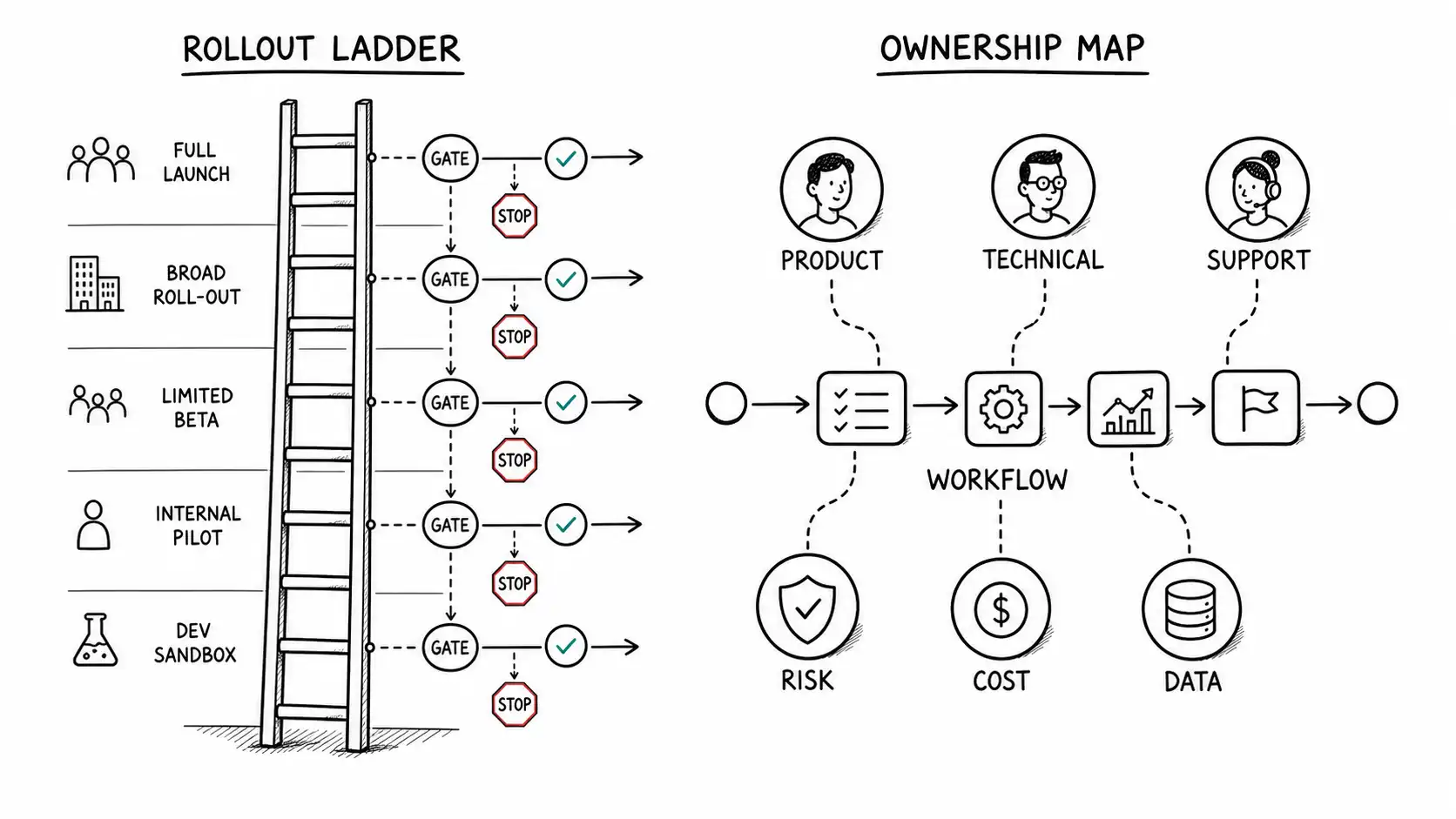
Checklist
- Define rollout stages with entry and exit criteria.
- Name owners for product, technical, support, data, eval, cost, and risk.
- Write stop conditions before launch pressure begins.
- Rehearse support and rollback.
- Do not increase exposure faster than learning can be absorbed.
Takeaway
A paced rollout lets the organization learn at a rate it can own.
Operational note: Exposure is a scarce resource
Every additional user creates learning and risk; rollout pace decides whether the team can process both. In the context of Pace the Rollout and Own the System, the practical danger is not that the team lacks effort; it is that effort is aimed at the wrong scarce resource. The durable AI product operations argument says that the old visible unit of work is no longer the safest unit of management. A team can produce more drafts, more code, more messages, more analysis, or more tickets while becoming less reliable at the point where the business needs a decision. The fix is to move the management surface away from raw output and toward evidence: what was decided, by whom, from which inputs, against which criteria, with what rollback path.
A mature implementation treats this as an operating-system concern rather than a personal-performance concern. The artifact should make the judgment visible: the rubric, acceptance gate, cost line, risk boundary, owner, and expiry date. When those fields are missing, the model's speed hides organizational ambiguity. When they are present, AI acceleration becomes tractable because the team can see which decisions deserve automation, which deserve human review, and which deserve rejection before execution begins.
The useful test is whether a new teammate can replay the decision two weeks later without interviewing the original author. If replay requires folklore, the process is still human-memory-bound. If replay can be done from the artifact, the team has converted judgment into infrastructure. That conversion is the recurring discipline throughout this book: not replacing human judgment, but making human judgment explicit enough that machines can safely do more of the surrounding work.
Field expansion: Ownership must be multidimensional
A technical owner alone cannot handle customer communication, support burden, or risk decisions. In the context of Pace the Rollout and Own the System, the practical danger is not that the team lacks effort; it is that effort is aimed at the wrong scarce resource. The durable AI product operations argument says that the old visible unit of work is no longer the safest unit of management. A team can produce more drafts, more code, more messages, more analysis, or more tickets while becoming less reliable at the point where the business needs a decision. The fix is to move the management surface away from raw output and toward evidence: what was decided, by whom, from which inputs, against which criteria, with what rollback path.
A mature implementation treats this as an operating-system concern rather than a personal-performance concern. The artifact should make the judgment visible: the rubric, acceptance gate, cost line, risk boundary, owner, and expiry date. When those fields are missing, the model's speed hides organizational ambiguity. When they are present, AI acceleration becomes tractable because the team can see which decisions deserve automation, which deserve human review, and which deserve rejection before execution begins.
The useful test is whether a new teammate can replay the decision two weeks later without interviewing the original author. If replay requires folklore, the process is still human-memory-bound. If replay can be done from the artifact, the team has converted judgment into infrastructure. That conversion is the recurring discipline throughout this book: not replacing human judgment, but making human judgment explicit enough that machines can safely do more of the surrounding work.
Design consequence: Stop conditions protect trust
Pausing under pre-agreed rules is easier than debating failure in the middle of pressure. In the context of Pace the Rollout and Own the System, the practical danger is not that the team lacks effort; it is that effort is aimed at the wrong scarce resource. The durable AI product operations argument says that the old visible unit of work is no longer the safest unit of management. A team can produce more drafts, more code, more messages, more analysis, or more tickets while becoming less reliable at the point where the business needs a decision. The fix is to move the management surface away from raw output and toward evidence: what was decided, by whom, from which inputs, against which criteria, with what rollback path.
A mature implementation treats this as an operating-system concern rather than a personal-performance concern. The artifact should make the judgment visible: the rubric, acceptance gate, cost line, risk boundary, owner, and expiry date. When those fields are missing, the model's speed hides organizational ambiguity. When they are present, AI acceleration becomes tractable because the team can see which decisions deserve automation, which deserve human review, and which deserve rejection before execution begins.
The useful test is whether a new teammate can replay the decision two weeks later without interviewing the original author. If replay requires folklore, the process is still human-memory-bound. If replay can be done from the artifact, the team has converted judgment into infrastructure. That conversion is the recurring discipline throughout this book: not replacing human judgment, but making human judgment explicit enough that machines can safely do more of the surrounding work.
Managerial implication: Exposure is a scarce resource
Every additional user creates learning and risk; rollout pace decides whether the team can process both. In the context of Pace the Rollout and Own the System, the practical danger is not that the team lacks effort; it is that effort is aimed at the wrong scarce resource. The durable AI product operations argument says that the old visible unit of work is no longer the safest unit of management. A team can produce more drafts, more code, more messages, more analysis, or more tickets while becoming less reliable at the point where the business needs a decision. The fix is to move the management surface away from raw output and toward evidence: what was decided, by whom, from which inputs, against which criteria, with what rollback path.
A mature implementation treats this as an operating-system concern rather than a personal-performance concern. The artifact should make the judgment visible: the rubric, acceptance gate, cost line, risk boundary, owner, and expiry date. When those fields are missing, the model's speed hides organizational ambiguity. When they are present, AI acceleration becomes tractable because the team can see which decisions deserve automation, which deserve human review, and which deserve rejection before execution begins.
The useful test is whether a new teammate can replay the decision two weeks later without interviewing the original author. If replay requires folklore, the process is still human-memory-bound. If replay can be done from the artifact, the team has converted judgment into infrastructure. That conversion is the recurring discipline throughout this book: not replacing human judgment, but making human judgment explicit enough that machines can safely do more of the surrounding work.
Production implication: Ownership must be multidimensional
A technical owner alone cannot handle customer communication, support burden, or risk decisions. In the context of Pace the Rollout and Own the System, the practical danger is not that the team lacks effort; it is that effort is aimed at the wrong scarce resource. The durable AI product operations argument says that the old visible unit of work is no longer the safest unit of management. A team can produce more drafts, more code, more messages, more analysis, or more tickets while becoming less reliable at the point where the business needs a decision. The fix is to move the management surface away from raw output and toward evidence: what was decided, by whom, from which inputs, against which criteria, with what rollback path.
A mature implementation treats this as an operating-system concern rather than a personal-performance concern. The artifact should make the judgment visible: the rubric, acceptance gate, cost line, risk boundary, owner, and expiry date. When those fields are missing, the model's speed hides organizational ambiguity. When they are present, AI acceleration becomes tractable because the team can see which decisions deserve automation, which deserve human review, and which deserve rejection before execution begins.
The useful test is whether a new teammate can replay the decision two weeks later without interviewing the original author. If replay requires folklore, the process is still human-memory-bound. If replay can be done from the artifact, the team has converted judgment into infrastructure. That conversion is the recurring discipline throughout this book: not replacing human judgment, but making human judgment explicit enough that machines can safely do more of the surrounding work.
Operational note: Stop conditions protect trust
Pausing under pre-agreed rules is easier than debating failure in the middle of pressure. In the context of Pace the Rollout and Own the System, the practical danger is not that the team lacks effort; it is that effort is aimed at the wrong scarce resource. The durable AI product operations argument says that the old visible unit of work is no longer the safest unit of management. A team can produce more drafts, more code, more messages, more analysis, or more tickets while becoming less reliable at the point where the business needs a decision. The fix is to move the management surface away from raw output and toward evidence: what was decided, by whom, from which inputs, against which criteria, with what rollback path.
A mature implementation treats this as an operating-system concern rather than a personal-performance concern. The artifact should make the judgment visible: the rubric, acceptance gate, cost line, risk boundary, owner, and expiry date. When those fields are missing, the model's speed hides organizational ambiguity. When they are present, AI acceleration becomes tractable because the team can see which decisions deserve automation, which deserve human review, and which deserve rejection before execution begins.
The useful test is whether a new teammate can replay the decision two weeks later without interviewing the original author. If replay requires folklore, the process is still human-memory-bound. If replay can be done from the artifact, the team has converted judgment into infrastructure. That conversion is the recurring discipline throughout this book: not replacing human judgment, but making human judgment explicit enough that machines can safely do more of the surrounding work.