The Cadence That Keeps Shipping
The company did not become good at AI because of a hackathon. The hackathon produced ideas.

The company did not become good at AI because of a hackathon. The hackathon produced ideas. The cadence produced products. Every week, teams reviewed scope, hardening, instrumentation, rollout, learning, ownership, trust evidence, and pruning. The questions were repetitive by design. Repetition turned judgment into organizational muscle.
Durable shipping is a cadence.
The final chapter gives the operating cadence for systems that ship. It combines weekly workflow review, monthly trust review, quarterly portfolio pruning, and incident-driven updates. The cadence keeps AI products from drifting into unowned, unevaluated, expensive, and overbroad surfaces.
Research spine
This chapter uses: DORA, State of AI-assisted Software Development 2025; Google SRE Book; Team Topologies, Key Concepts; Forsgren et al., The SPACE of Developer Productivity; March, Exploration and Exploitation in Organizational Learning.
Weekly workflow review
Weekly review asks: what changed, what did users do, what failed, what cost more than expected, what eval cases were added, what scope pressure appeared, what owner is overloaded, and what decision is needed? This review should be close to the team that owns the workflow.
Monthly trust review
Monthly trust review looks across workflows. It asks whether evidence is sufficient, incidents are recurring, controls are consistent, customer commitments are aligned with product behavior, and support teams are ready. This review should involve product, engineering, security, legal where relevant, support, and revenue.
Quarterly portfolio review
Quarterly review decides where to invest, scale, narrow, or prune. It should examine value, adoption, quality, margin, strategic fit, risk, and owner capacity. The organization should leave with a portfolio decision, not a status recital.
The habit behind the habit
Cadence works only when leaders are willing to make decisions. A meeting that records red status without changing scope, ownership, or investment is theater. The point of the cadence is to convert evidence into action.
Operating table
| Cadence | Scope | Decision |
|---|---|---|
| Weekly | Single workflow | Fix, escalate, or continue |
| Monthly | Trust and operational controls across workflows | Standardize, harden, or pause |
| Quarterly | Portfolio | Invest, scale, narrow, prune |
| Incident-driven | Failure class | Update artifact and owner |
Artifact example: a weekly review agenda
# Weekly AI Product Review

1. Which workflow changed this week?
2. What user behavior did we observe?
3. Which eval, incident, or review case changed our understanding?
4. Which cost or latency signal surprised us?
5. Which scope boundary was pressured?
6. Which owner is overloaded?
7. What artifact must change before next week?
8. What decision do we need today?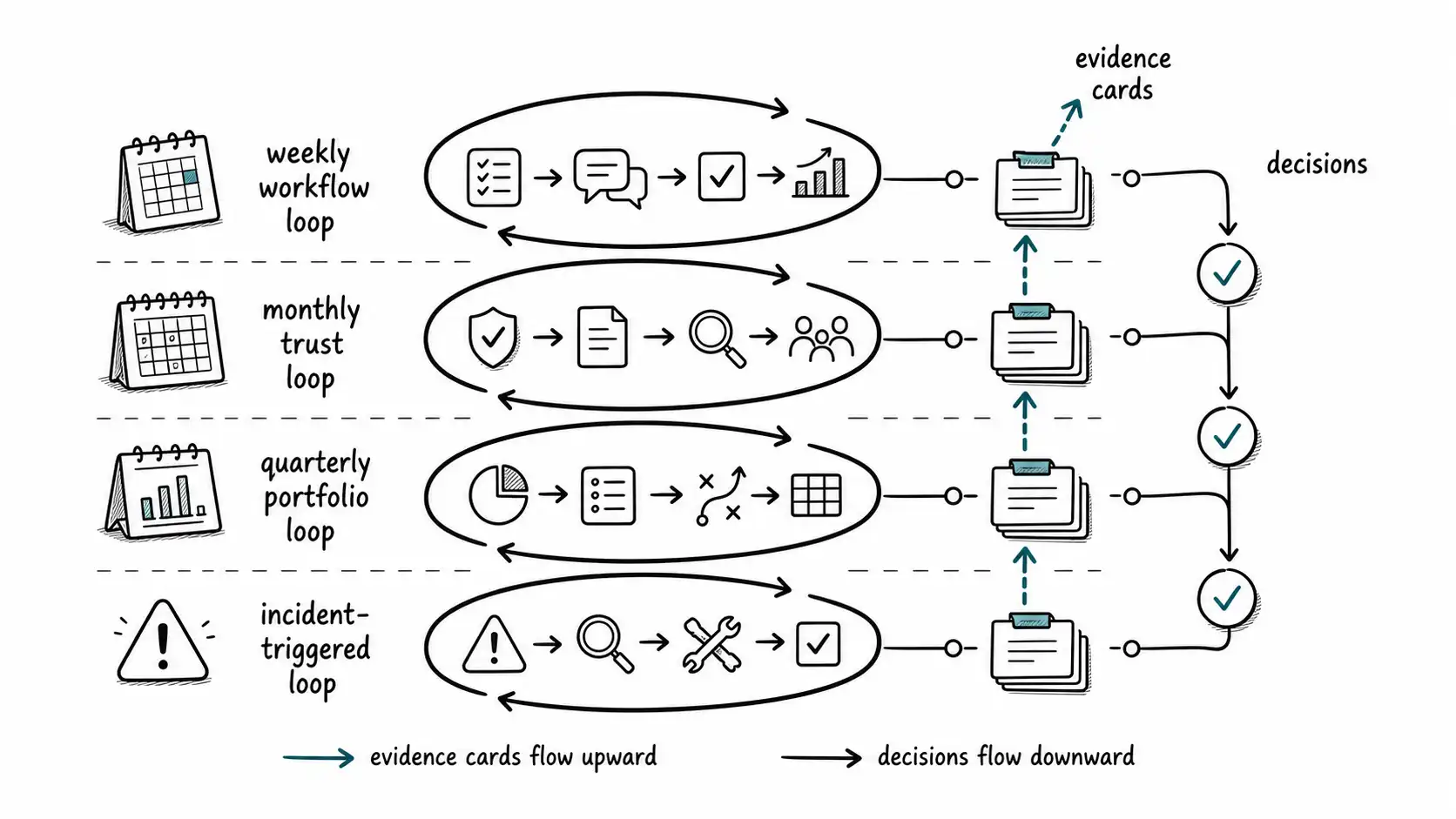
Checklist
- Run weekly reviews near the workflow owner.
- Run monthly trust reviews across functions.
- Run quarterly portfolio reviews with pruning power.
- Let incidents interrupt the normal cadence when needed.
- Make every review produce a decision or artifact update.
Takeaway
The organization that ships durable AI products is the organization that turns evidence into decisions on a reliable cadence.
Operational note: Repetition creates reliability
The questions should become familiar because the organization needs a stable way to inspect unstable systems. In the context of The Cadence That Keeps Shipping, the practical danger is not that the team lacks effort; it is that effort is aimed at the wrong scarce resource. The durable AI product operations argument says that the old visible unit of work is no longer the safest unit of management. A team can produce more drafts, more code, more messages, more analysis, or more tickets while becoming less reliable at the point where the business needs a decision. The fix is to move the management surface away from raw output and toward evidence: what was decided, by whom, from which inputs, against which criteria, with what rollback path.
A mature implementation treats this as an operating-system concern rather than a personal-performance concern. The artifact should make the judgment visible: the rubric, acceptance gate, cost line, risk boundary, owner, and expiry date. When those fields are missing, the model's speed hides organizational ambiguity. When they are present, AI acceleration becomes tractable because the team can see which decisions deserve automation, which deserve human review, and which deserve rejection before execution begins.
The useful test is whether a new teammate can replay the decision two weeks later without interviewing the original author. If replay requires folklore, the process is still human-memory-bound. If replay can be done from the artifact, the team has converted judgment into infrastructure. That conversion is the recurring discipline throughout this book: not replacing human judgment, but making human judgment explicit enough that machines can safely do more of the surrounding work.
Field expansion: Portfolio pruning is leadership work
Teams rarely remove their own demos without executive permission and a cadence that makes pruning normal. In the context of The Cadence That Keeps Shipping, the practical danger is not that the team lacks effort; it is that effort is aimed at the wrong scarce resource. The durable AI product operations argument says that the old visible unit of work is no longer the safest unit of management. A team can produce more drafts, more code, more messages, more analysis, or more tickets while becoming less reliable at the point where the business needs a decision. The fix is to move the management surface away from raw output and toward evidence: what was decided, by whom, from which inputs, against which criteria, with what rollback path.
A mature implementation treats this as an operating-system concern rather than a personal-performance concern. The artifact should make the judgment visible: the rubric, acceptance gate, cost line, risk boundary, owner, and expiry date. When those fields are missing, the model's speed hides organizational ambiguity. When they are present, AI acceleration becomes tractable because the team can see which decisions deserve automation, which deserve human review, and which deserve rejection before execution begins.
The useful test is whether a new teammate can replay the decision two weeks later without interviewing the original author. If replay requires folklore, the process is still human-memory-bound. If replay can be done from the artifact, the team has converted judgment into infrastructure. That conversion is the recurring discipline throughout this book: not replacing human judgment, but making human judgment explicit enough that machines can safely do more of the surrounding work.
Design consequence: Cadence is where culture becomes observable
A company can claim to value trust, but its recurring meetings reveal whether trust changes decisions. In the context of The Cadence That Keeps Shipping, the practical danger is not that the team lacks effort; it is that effort is aimed at the wrong scarce resource. The durable AI product operations argument says that the old visible unit of work is no longer the safest unit of management. A team can produce more drafts, more code, more messages, more analysis, or more tickets while becoming less reliable at the point where the business needs a decision. The fix is to move the management surface away from raw output and toward evidence: what was decided, by whom, from which inputs, against which criteria, with what rollback path.
A mature implementation treats this as an operating-system concern rather than a personal-performance concern. The artifact should make the judgment visible: the rubric, acceptance gate, cost line, risk boundary, owner, and expiry date. When those fields are missing, the model's speed hides organizational ambiguity. When they are present, AI acceleration becomes tractable because the team can see which decisions deserve automation, which deserve human review, and which deserve rejection before execution begins.
The useful test is whether a new teammate can replay the decision two weeks later without interviewing the original author. If replay requires folklore, the process is still human-memory-bound. If replay can be done from the artifact, the team has converted judgment into infrastructure. That conversion is the recurring discipline throughout this book: not replacing human judgment, but making human judgment explicit enough that machines can safely do more of the surrounding work.
Managerial implication: Repetition creates reliability
The questions should become familiar because the organization needs a stable way to inspect unstable systems. In the context of The Cadence That Keeps Shipping, the practical danger is not that the team lacks effort; it is that effort is aimed at the wrong scarce resource. The durable AI product operations argument says that the old visible unit of work is no longer the safest unit of management. A team can produce more drafts, more code, more messages, more analysis, or more tickets while becoming less reliable at the point where the business needs a decision. The fix is to move the management surface away from raw output and toward evidence: what was decided, by whom, from which inputs, against which criteria, with what rollback path.
A mature implementation treats this as an operating-system concern rather than a personal-performance concern. The artifact should make the judgment visible: the rubric, acceptance gate, cost line, risk boundary, owner, and expiry date. When those fields are missing, the model's speed hides organizational ambiguity. When they are present, AI acceleration becomes tractable because the team can see which decisions deserve automation, which deserve human review, and which deserve rejection before execution begins.
The useful test is whether a new teammate can replay the decision two weeks later without interviewing the original author. If replay requires folklore, the process is still human-memory-bound. If replay can be done from the artifact, the team has converted judgment into infrastructure. That conversion is the recurring discipline throughout this book: not replacing human judgment, but making human judgment explicit enough that machines can safely do more of the surrounding work.
Production implication: Portfolio pruning is leadership work
Teams rarely remove their own demos without executive permission and a cadence that makes pruning normal. In the context of The Cadence That Keeps Shipping, the practical danger is not that the team lacks effort; it is that effort is aimed at the wrong scarce resource. The durable AI product operations argument says that the old visible unit of work is no longer the safest unit of management. A team can produce more drafts, more code, more messages, more analysis, or more tickets while becoming less reliable at the point where the business needs a decision. The fix is to move the management surface away from raw output and toward evidence: what was decided, by whom, from which inputs, against which criteria, with what rollback path.
A mature implementation treats this as an operating-system concern rather than a personal-performance concern. The artifact should make the judgment visible: the rubric, acceptance gate, cost line, risk boundary, owner, and expiry date. When those fields are missing, the model's speed hides organizational ambiguity. When they are present, AI acceleration becomes tractable because the team can see which decisions deserve automation, which deserve human review, and which deserve rejection before execution begins.
The useful test is whether a new teammate can replay the decision two weeks later without interviewing the original author. If replay requires folklore, the process is still human-memory-bound. If replay can be done from the artifact, the team has converted judgment into infrastructure. That conversion is the recurring discipline throughout this book: not replacing human judgment, but making human judgment explicit enough that machines can safely do more of the surrounding work.
Operational note: Cadence is where culture becomes observable
A company can claim to value trust, but its recurring meetings reveal whether trust changes decisions. In the context of The Cadence That Keeps Shipping, the practical danger is not that the team lacks effort; it is that effort is aimed at the wrong scarce resource. The durable AI product operations argument says that the old visible unit of work is no longer the safest unit of management. A team can produce more drafts, more code, more messages, more analysis, or more tickets while becoming less reliable at the point where the business needs a decision. The fix is to move the management surface away from raw output and toward evidence: what was decided, by whom, from which inputs, against which criteria, with what rollback path.
A mature implementation treats this as an operating-system concern rather than a personal-performance concern. The artifact should make the judgment visible: the rubric, acceptance gate, cost line, risk boundary, owner, and expiry date. When those fields are missing, the model's speed hides organizational ambiguity. When they are present, AI acceleration becomes tractable because the team can see which decisions deserve automation, which deserve human review, and which deserve rejection before execution begins.
The useful test is whether a new teammate can replay the decision two weeks later without interviewing the original author. If replay requires folklore, the process is still human-memory-bound. If replay can be done from the artifact, the team has converted judgment into infrastructure. That conversion is the recurring discipline throughout this book: not replacing human judgment, but making human judgment explicit enough that machines can safely do more of the surrounding work.