Scope Is a Trust Mechanism
The first version tried to answer every employee question. It failed constantly.

The first version tried to answer every employee question. It failed constantly. The second version answered only benefits policy questions from the approved HR corpus. It worked well enough to ship. The model did not become smarter between versions. The scope became honest.
Scope is not a product-management compromise. In AI systems, scope is a trust mechanism.
Narrow scope creates reliable evaluation, clearer user expectation, stronger security boundaries, easier cost modeling, and better ownership. Broad scope creates impressive demos and fragile products. The discipline of durable AI shipping begins with deciding what the system will not do.
Research spine
This chapter uses: NIST AI Risk Management Framework; OWASP Top 10 for Large Language Model Applications; OpenAI Evals; Team Topologies, Key Concepts.
The scope rectangle
A product scope should define user, task, data, action, and consequence. User: who is allowed to use it? Task: what job can it perform? Data: which sources can it use? Action: can it suggest, draft, decide, or act? Consequence: what happens if it is wrong? When these five edges are visible, the system can be evaluated and governed.
Many AI failures come from scope leakage. A tool built for internal suggestions becomes customer-facing. A system intended to summarize approved policies retrieves drafts. A workflow designed for low-risk actions starts handling exceptions. Scope leakage is autonomy drift by another name.
Refusal as a feature
A scoped AI product should refuse out-of-scope work gracefully. Refusal is not failure; it is part of the product contract. A legal assistant should refuse HR policy questions. An HR assistant should refuse legal advice. A support bot should escalate billing disputes outside policy. Users trust systems that know their boundaries.
Evaluability
Scope makes evaluation possible. A universal assistant is difficult to test because the space of possible requests is enormous. A narrow workflow can have a golden set, failure taxonomy, acceptance criteria, and regression suite. This is why early AI-native products should often start narrower than the demo ambition suggests.
Operating table
| Scope edge | Question | Example |
|---|---|---|
| User | Who can use this? | Internal support agents only |
| Task | What job is allowed? | Draft refund responses under policy |
| Data | Which sources are allowed? | Approved refund policy and ticket text |
| Action | Suggest, draft, decide, or act? | Draft only |
| Consequence | What if wrong? | Agent reviews; escalates exceptions |
Artifact example: a scope contract
scope_contract:
 product: "HR policy assistant"
 allowed_users: ["employees"]
 allowed_tasks:
 - "answer benefits-policy questions"
 - "link approved source documents"
 forbidden_tasks:
 - "legal advice"
 - "manager performance guidance"
 - "immigration advice"
 allowed_sources:
 - "approved_hr_policy_corpus"
 action_level: "answer_with_citation"
 refusal_message: "I can answer benefits-policy questions from approved HR sources. For this topic, contact HR."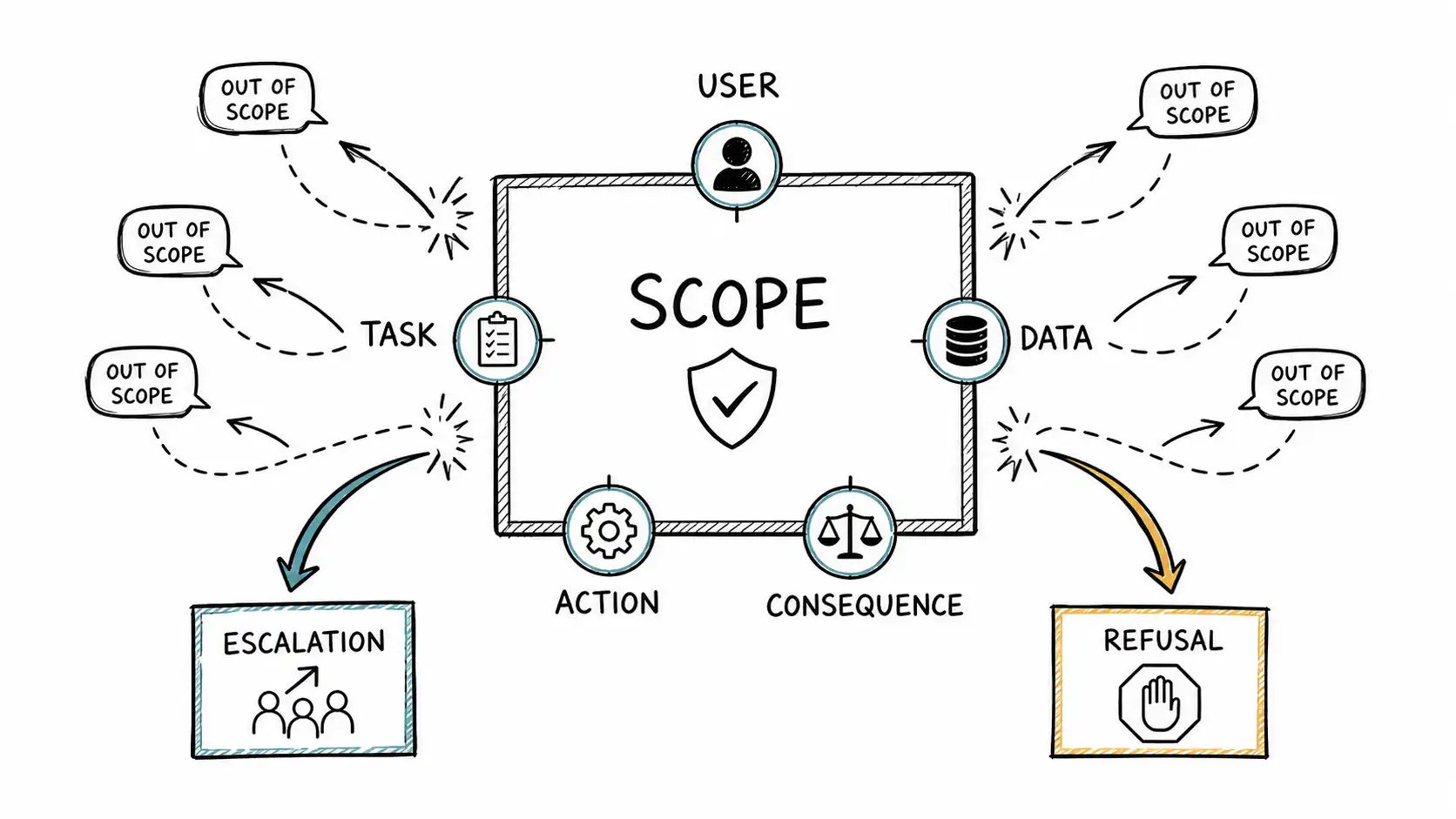
Checklist
- Define user, task, data, action, and consequence.
- Create explicit refusal behavior.
- Evaluate scope leakage in testing.
- Start with the narrowest workflow that can prove value.
- Revisit scope whenever autonomy increases.
Takeaway
A scoped AI product is easier to trust because it has fewer ways to pretend it knows everything.
Operational note: Narrow beats vague
A narrow product can earn trust; a vague assistant inherits every possible user expectation. In the context of Scope Is a Trust Mechanism, the practical danger is not that the team lacks effort; it is that effort is aimed at the wrong scarce resource. The durable AI product operations argument says that the old visible unit of work is no longer the safest unit of management. A team can produce more drafts, more code, more messages, more analysis, or more tickets while becoming less reliable at the point where the business needs a decision. The fix is to move the management surface away from raw output and toward evidence: what was decided, by whom, from which inputs, against which criteria, with what rollback path.
A mature implementation treats this as an operating-system concern rather than a personal-performance concern. The artifact should make the judgment visible: the rubric, acceptance gate, cost line, risk boundary, owner, and expiry date. When those fields are missing, the model's speed hides organizational ambiguity. When they are present, AI acceleration becomes tractable because the team can see which decisions deserve automation, which deserve human review, and which deserve rejection before execution begins.
The useful test is whether a new teammate can replay the decision two weeks later without interviewing the original author. If replay requires folklore, the process is still human-memory-bound. If replay can be done from the artifact, the team has converted judgment into infrastructure. That conversion is the recurring discipline throughout this book: not replacing human judgment, but making human judgment explicit enough that machines can safely do more of the surrounding work.
Field expansion: Refusal protects the promise
A system that refuses outside its domain is keeping faith with the user. In the context of Scope Is a Trust Mechanism, the practical danger is not that the team lacks effort; it is that effort is aimed at the wrong scarce resource. The durable AI product operations argument says that the old visible unit of work is no longer the safest unit of management. A team can produce more drafts, more code, more messages, more analysis, or more tickets while becoming less reliable at the point where the business needs a decision. The fix is to move the management surface away from raw output and toward evidence: what was decided, by whom, from which inputs, against which criteria, with what rollback path.
A mature implementation treats this as an operating-system concern rather than a personal-performance concern. The artifact should make the judgment visible: the rubric, acceptance gate, cost line, risk boundary, owner, and expiry date. When those fields are missing, the model's speed hides organizational ambiguity. When they are present, AI acceleration becomes tractable because the team can see which decisions deserve automation, which deserve human review, and which deserve rejection before execution begins.
The useful test is whether a new teammate can replay the decision two weeks later without interviewing the original author. If replay requires folklore, the process is still human-memory-bound. If replay can be done from the artifact, the team has converted judgment into infrastructure. That conversion is the recurring discipline throughout this book: not replacing human judgment, but making human judgment explicit enough that machines can safely do more of the surrounding work.
Design consequence: Evaluation depends on boundaries
You cannot meaningfully test a system whose job is to do anything. In the context of Scope Is a Trust Mechanism, the practical danger is not that the team lacks effort; it is that effort is aimed at the wrong scarce resource. The durable AI product operations argument says that the old visible unit of work is no longer the safest unit of management. A team can produce more drafts, more code, more messages, more analysis, or more tickets while becoming less reliable at the point where the business needs a decision. The fix is to move the management surface away from raw output and toward evidence: what was decided, by whom, from which inputs, against which criteria, with what rollback path.
A mature implementation treats this as an operating-system concern rather than a personal-performance concern. The artifact should make the judgment visible: the rubric, acceptance gate, cost line, risk boundary, owner, and expiry date. When those fields are missing, the model's speed hides organizational ambiguity. When they are present, AI acceleration becomes tractable because the team can see which decisions deserve automation, which deserve human review, and which deserve rejection before execution begins.
The useful test is whether a new teammate can replay the decision two weeks later without interviewing the original author. If replay requires folklore, the process is still human-memory-bound. If replay can be done from the artifact, the team has converted judgment into infrastructure. That conversion is the recurring discipline throughout this book: not replacing human judgment, but making human judgment explicit enough that machines can safely do more of the surrounding work.
Managerial implication: Narrow beats vague
A narrow product can earn trust; a vague assistant inherits every possible user expectation. In the context of Scope Is a Trust Mechanism, the practical danger is not that the team lacks effort; it is that effort is aimed at the wrong scarce resource. The durable AI product operations argument says that the old visible unit of work is no longer the safest unit of management. A team can produce more drafts, more code, more messages, more analysis, or more tickets while becoming less reliable at the point where the business needs a decision. The fix is to move the management surface away from raw output and toward evidence: what was decided, by whom, from which inputs, against which criteria, with what rollback path.
A mature implementation treats this as an operating-system concern rather than a personal-performance concern. The artifact should make the judgment visible: the rubric, acceptance gate, cost line, risk boundary, owner, and expiry date. When those fields are missing, the model's speed hides organizational ambiguity. When they are present, AI acceleration becomes tractable because the team can see which decisions deserve automation, which deserve human review, and which deserve rejection before execution begins.
The useful test is whether a new teammate can replay the decision two weeks later without interviewing the original author. If replay requires folklore, the process is still human-memory-bound. If replay can be done from the artifact, the team has converted judgment into infrastructure. That conversion is the recurring discipline throughout this book: not replacing human judgment, but making human judgment explicit enough that machines can safely do more of the surrounding work.
Production implication: Refusal protects the promise
A system that refuses outside its domain is keeping faith with the user. In the context of Scope Is a Trust Mechanism, the practical danger is not that the team lacks effort; it is that effort is aimed at the wrong scarce resource. The durable AI product operations argument says that the old visible unit of work is no longer the safest unit of management. A team can produce more drafts, more code, more messages, more analysis, or more tickets while becoming less reliable at the point where the business needs a decision. The fix is to move the management surface away from raw output and toward evidence: what was decided, by whom, from which inputs, against which criteria, with what rollback path.
A mature implementation treats this as an operating-system concern rather than a personal-performance concern. The artifact should make the judgment visible: the rubric, acceptance gate, cost line, risk boundary, owner, and expiry date. When those fields are missing, the model's speed hides organizational ambiguity. When they are present, AI acceleration becomes tractable because the team can see which decisions deserve automation, which deserve human review, and which deserve rejection before execution begins.
The useful test is whether a new teammate can replay the decision two weeks later without interviewing the original author. If replay requires folklore, the process is still human-memory-bound. If replay can be done from the artifact, the team has converted judgment into infrastructure. That conversion is the recurring discipline throughout this book: not replacing human judgment, but making human judgment explicit enough that machines can safely do more of the surrounding work.
Operational note: Evaluation depends on boundaries
You cannot meaningfully test a system whose job is to do anything. In the context of Scope Is a Trust Mechanism, the practical danger is not that the team lacks effort; it is that effort is aimed at the wrong scarce resource. The durable AI product operations argument says that the old visible unit of work is no longer the safest unit of management. A team can produce more drafts, more code, more messages, more analysis, or more tickets while becoming less reliable at the point where the business needs a decision. The fix is to move the management surface away from raw output and toward evidence: what was decided, by whom, from which inputs, against which criteria, with what rollback path.
A mature implementation treats this as an operating-system concern rather than a personal-performance concern. The artifact should make the judgment visible: the rubric, acceptance gate, cost line, risk boundary, owner, and expiry date. When those fields are missing, the model's speed hides organizational ambiguity. When they are present, AI acceleration becomes tractable because the team can see which decisions deserve automation, which deserve human review, and which deserve rejection before execution begins.
The useful test is whether a new teammate can replay the decision two weeks later without interviewing the original author. If replay requires folklore, the process is still human-memory-bound. If replay can be done from the artifact, the team has converted judgment into infrastructure. That conversion is the recurring discipline throughout this book: not replacing human judgment, but making human judgment explicit enough that machines can safely do more of the surrounding work.