Moats, Trust, and the Price of Responsibility
"Models are not moats" is true often enough to be useful and vague enough to be lazy.

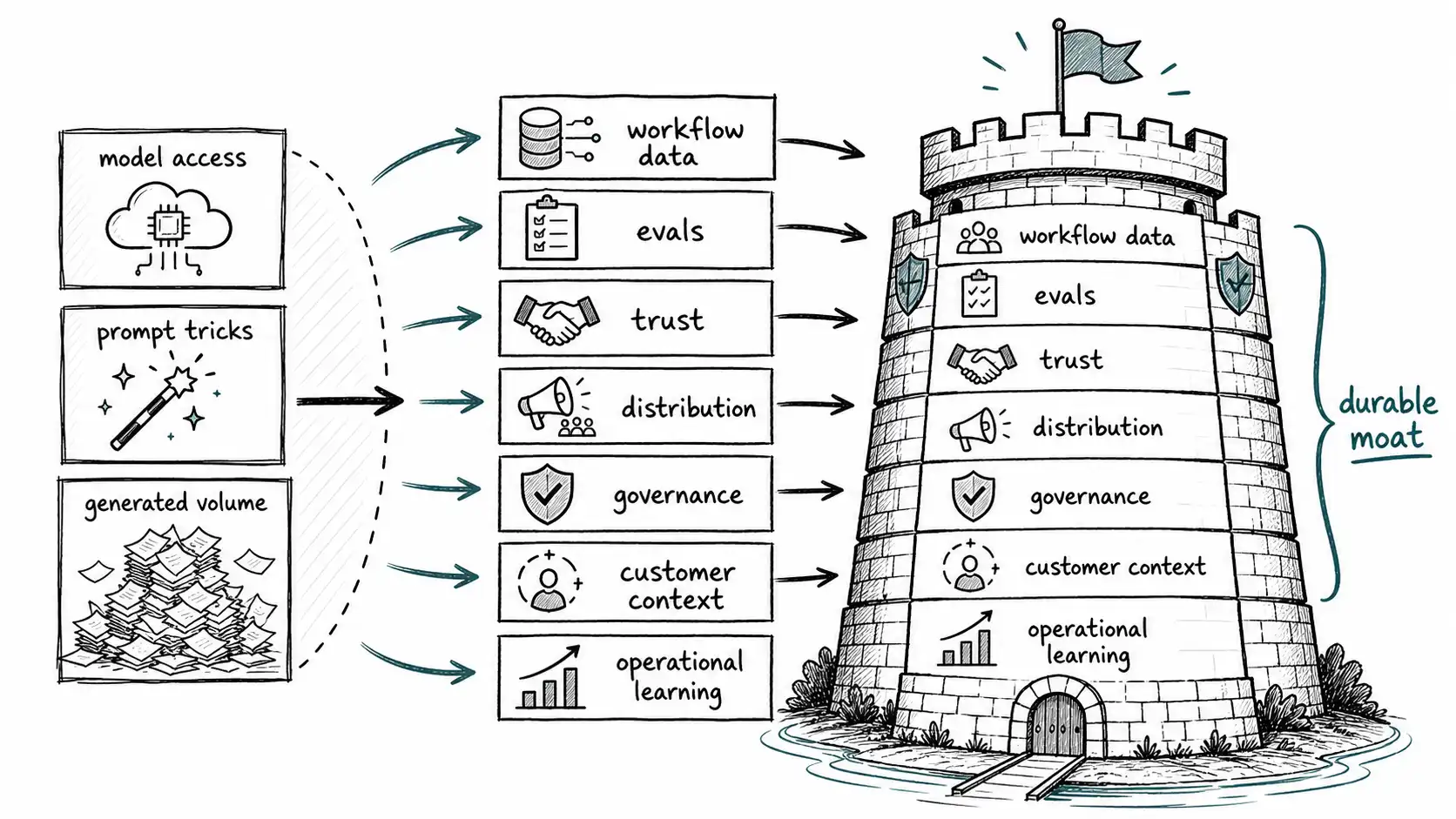
Research spine: this chapter stays grounded in NIST AI Risk Management Framework and NIST Secure Software Development Framework, then applies that evidence to the operating judgment in the book. "Models are not moats" is true often enough to be useful and vague enough to be lazy. A model can be a moat when capability is rare, deployment is difficult, data access is constrained, inference economics are superior, or regulatory approval attaches to a specific system. But in many AI-native products, raw model capability becomes available to competitors faster than product teams can build durable differentiation around it. The strategic question is not whether models are moats. It is where defensibility migrates when model capability diffuses.
The judgment economy points to five compounding assets: workflow data, trust, distribution, operational learning, and responsibility-bearing infrastructure.
Workflow data is not generic training data. It is the record of real decisions, real edge cases, real review outcomes, and real customer context inside a particular workflow. A support company that knows which AI answers resolved cases, which were reopened, which required escalation, and which policy ambiguity caused failure is building workflow data. A coding platform that knows which generated changes were accepted, reverted, edited, or later associated with incidents is building workflow data. A sales platform that knows which generated proposal claims improved win rate without discount leakage is building workflow data.
Trust is the customer's willingness to let the system move closer to consequence. A buyer may tolerate an AI tool drafting internal notes with little evidence. They will demand traceability before allowing it to send customer communications, approve refunds, or recommend legal positions. Trust is not sentiment; it is permission to operate at higher-value decision points. Governance, audit logs, evals, policy controls, and human escalation are therefore not overhead. They are moat-building infrastructure.
Distribution remains powerful because AI features are often embedded into existing workflows. A model capability inside the system of record, ticketing queue, IDE, CRM, billing platform, or data warehouse may beat a stronger standalone tool because it sits where the decision happens. Distribution is not merely go-to-market reach. It is proximity to judgment.
Operational learning compounds when the company turns production failures into better specs, evals, policies, training data, and user experience. This is where many AI demos fail to become products. They show capability once. They do not build the machinery to learn from every miss. A durable AI-native system has an incident-to-improvement loop: failure becomes labeled case, labeled case becomes eval, eval becomes release gate, release gate changes product behavior.
Responsibility-bearing infrastructure is the ability to make credible promises. In regulated or high-stakes domains, buyers pay for systems that can be audited, explained, limited, and recovered. NIST's AI RMF and similar governance frameworks matter commercially because they provide language and structure for trust (https://www.nist.gov/itl/ai-risk-management-framework). OECD's AI Principles similarly emphasize human-centered values, transparency, robustness, and accountability (https://oecd.ai/en/ai-principles). A vendor that can map its product controls to buyer risk requirements can sell deeper autonomy.
A moat migration map:
| Old advantage | Why it weakens | New compounding version |
|---|---|---|
| Model access | Competitors can buy similar APIs or open models | Model selection plus eval-grounded routing |
| Prompt tricks | Easy to copy or reverse-engineer | Workflow-specific specs and acceptance data |
| Generated output volume | Output becomes abundant | Accepted outcome quality |
| Feature parity | AI features diffuse across SaaS | Embedded workflow, data, and trust |
| Data lake | Raw data without labels is underused | Decision-labeled workflow data |
| Brand claim | Buyers get burned by hype | Evidence-backed reliability and governance |
| Integration checklist | Shallow API connections are common | Deep operational integration at decision points |
The strategic mistake is to build a product that stops at generation. A document generator, proposal generator, code generator, or analysis generator can be copied by any competitor with model access and a UI. A workflow system that knows what should be generated, when it should be blocked, how it should be reviewed, who can accept it, how value is measured, and how failures become improvements is harder to copy because it embeds judgment.
This is why evaluation is strategic. An eval suite is not only a quality tool. It is a representation of what the company has learned about its domain. A support eval suite containing thousands of real failure patterns, policy exceptions, edge cases, tone problems, and resolution outcomes is a proprietary judgment asset. A coding eval suite representing the company's architecture, security constraints, and migration risks is a software moat. A sales evaluation rubric that correlates messaging with win rate, margin, and churn is commercial knowledge.
The moat is not the eval file alone. It is the loop that keeps it alive.
A compounding judgment loop:
Production interaction
-> AI output
-> acceptance/rejection/review
-> outcome observed
-> failure or success labeled
-> eval/rubric/policy/spec updated
-> future model or workflow gated
-> better accepted outcomes
-> more trust and more usage
-> richer production interaction data
If any arrow is missing, compounding weakens. If outputs are not traced, the system cannot learn. If review labels are not captured, human judgment evaporates after being spent. If outcomes are not joined back, the company cannot distinguish fluent output from valuable output. If evals do not gate releases, learning remains documentation. If customers do not trust the system enough to use it on consequential work, the data remains shallow.
Trust also changes pricing power. A tool that drafts can charge for convenience. A tool that resolves can charge for work. A tool that makes auditable recommendations in a high-stakes workflow can charge for risk reduction. But each higher pricing tier requires stronger responsibility. Buyers are not irrational when they resist paying for AI outcomes. They have been sold demos that fail in production. They know polished output can hide errors. They need evidence.
That evidence has a shape:
| Trust requirement | Product evidence |
|---|---|
| "Will it be right?" | Task-specific evals, regression history, confidence/error reporting |
| "Can we control it?" | Policies, thresholds, permissions, escalation paths |
| "Can we audit it?" | Trace logs, source evidence, decision records, version history |
| "Can we recover?" | Rollback, human override, incident process |
| "Can we prove value?" | Outcome metrics, baselines, accepted-output reporting |
| "Will it improve?" | Feedback loop, failure-to-eval process, roadmap linked to production learning |
These artifacts are not decorative enterprise features. They are what allow the product to move from low-value assistance to high-value delegation.
Regulation will amplify this pattern. The EU AI Act and sector-specific rules place heavier obligations on high-risk systems, and even where regulation does not directly apply, enterprise procurement increasingly asks similar questions: data handling, human oversight, risk management, monitoring, audit, transparency. A company that treats governance as bureaucracy will move slowly. A company that builds governance into the product can turn buyer caution into advantage.
The final strategic point is that moats move to the place where judgment compounds. In some markets, that will be proprietary data. In others, it will be distribution. In regulated markets, it may be compliance and trust. In developer tools, it may be deep integration with code review, tests, and deployment. In support, it may be resolution learning and policy control. In vertical AI services, it may be the vendor's willingness to price against outcomes because it can measure and manage risk better than competitors.
The executive checklist:
- What generated output do competitors already offer?
- What accepted outcome do customers actually value?
- What decision point sits between output and value?
- What proprietary data is created when that decision is reviewed?
- Does the product capture that data with permission and usefulness?
- Does the data improve future judgment?
- Does the product's governance increase trust enough to move closer to consequence?
- Does pricing capture the value of accepted outcomes, not just access?
- Does distribution place the product where the decision happens?
- Does the company learn faster from production than competitors can copy features?
The chapter's conclusion, and the book's strategic spine, is that AI lowers the cost of doing but raises the premium on trusted deciding. The winning companies will not be the ones that generate the most work. They will be the ones that own the judgment loops that turn generated work into decisions customers trust enough to pay for.
Key Takeaways
- "Models are not moats" is true often enough to be useful and vague enough to be lazy.
- The practical test is whether a team can name the evidence, owner, and failure mode before it changes behavior.
- Read this with The Judgment Economy and the adjacent chapters when you need the wider Judgment Economy and AI Strategy frame.
The trust gradient
A useful strategic model is the trust gradient. Customers begin by allowing AI into low-consequence internal assistance. If the system performs well and evidence is available, they allow it into reviewed customer-facing work. Later they may allow constrained auto-action. Eventually, in narrow domains, they may pay for autonomous outcomes. Each step up the gradient creates more value and demands more proof.
The gradient looks like this:
| Trust level | Allowed behavior | Evidence required |
|---|---|---|
| Private draft | Suggest, summarize, brainstorm | Basic usefulness and privacy controls |
| Reviewed output | Prepare work for human acceptance | Sources, diffs, rubrics, review history |
| Constrained action | Act within policy and thresholds | Evals, monitoring, rollback, audit |
| Accountable outcome | Deliver measurable result | Attribution, quality guardrails, contract terms |
| Delegated judgment | Own a decision class | Governance, liability model, deep trust |
Most vendors want to sell at the top while building at the bottom. Buyers notice. The route upward is not louder marketing; it is accumulated evidence. A company can move faster up the gradient when it captures review data, measures outcomes, handles incidents transparently, and improves controls. Trust compounds through operational memory.
This is also why switching costs can become real. If a customer's policies, review labels, escalation paths, evals, and workflow history live inside the product, the product is not just a model wrapper. It is part of the customer's judgment infrastructure. But this kind of switching cost must be earned ethically. Lock-in without value creates resentment. Embedded judgment that improves outcomes creates defensibility.
Responsibility is expensive, but it is also where margin lives. A vendor unwilling to stand behind anything will be priced like a tool. A vendor able to stand behind a narrow outcome with evidence can be priced like a capability. The moat is the credible ability to accept responsibility where competitors can only generate output.
The same logic applies internally. A team can build an internal moat around judgment even if it never sells software. A finance team that turns every forecast miss into a better assumptions library, every board question into a reusable analysis pattern, and every AI-generated scenario into a calibrated decision record becomes more valuable to the company over time. A legal team that turns every contract-review edge case into a clause playbook and eval case reduces future review cost. An engineering team that turns every AI-generated bug into a property test or spec update strengthens the system.
Moats are often discussed as external competitive barriers, but the first moat is internal learning speed. If two competitors have access to similar models, the one that learns faster from accepted and rejected outputs will move ahead. Learning speed depends less on model cleverness than on instrumentation and discipline. Capture the decision. Capture the rationale. Capture the outcome. Convert the learning. Repeat. That is the boring machinery of durable advantage.
The strategic question for each AI initiative is therefore: after six months of use, what do we know that a competitor cannot buy? If the answer is nothing, the initiative may still save cost, but it is not a moat. If the answer is a richer map of customer edge cases, better risk thresholds, stronger workflow data, trusted buyer evidence, or a faster path from incident to eval, then the initiative is building strategic memory. Strategic memory is judgment made durable.