The Machine Took the Work, Not the Responsibility
The first serious incident did not look like an AI incident.

AI responsibility design means naming who owns outcome, constraint, context, system behavior, acceptance, and repair before machine-produced work shapes a real decision. The model can draft, summarize, recommend, or act inside a workflow, but the organization still owns the consequence.
The first serious incident did not look like an AI incident.
A customer success team at a B2B platform had started using an AI assistant to draft renewal-risk summaries. The workflow looked harmless. The model gathered account notes, recent support tickets, usage metrics, and meeting transcripts. It produced a short summary for the customer success manager before a renewal call. The CSM could edit the summary. Nothing was sent directly to the customer. There was no autonomous action.
One account summary said the customer had "low adoption across the executive team" and recommended a discount-led renewal strategy. The CSM accepted the summary quickly because it matched a plausible pattern. The renewal call went poorly. The customer's executive sponsor had, in fact, been highly engaged, but most of that engagement happened in private Slack channels and executive QBR notes that were not available to the model. The proposed discount signaled weakness and damaged a negotiation that should have been framed around expansion.
Nobody knew where to assign the failure. The model had not "acted." The CSM had approved the summary. RevOps had configured the data sources. Customer success leadership had encouraged AI-assisted prep. Product had shipped the internal assistant. Legal was not involved because there was no external claim. The team initially called it user error.
That was too easy.
The real failure was responsibility design. The system produced decision-shaping material without making visible what context was missing, what confidence was appropriate, who owned acceptance, and what kind of downstream risk the summary could create. The machine took part of the work, but the organization had not reassigned responsibility for the changed workflow.
AI-native systems must treat responsibility as architecture.
Key Takeaways
- The first serious incident did not look like an AI incident.
- The practical test is whether a team can name the evidence, owner, and failure mode before it changes behavior.
- Read this with AI-Native and the adjacent chapters when you need the wider AI-Native Engineering frame.
Accountability does not follow the artifact automatically
In human-only workflows, accountability often follows craft. The person who wrote the sales email owns it. The engineer who authored the patch owns the first explanation. The support agent who sent the answer owns the customer interaction. The product manager who wrote the requirement owns the tradeoff. The analyst who wrote the memo owns the assumptions.
Machine-produced work breaks that intuitive ownership link. The output may be produced by a model, prompted by one person, configured by another, retrieved from data owned by a third team, accepted by a fourth, and consumed by a fifth. If the organization does not define responsibility, the artifact enters a fog.
That fog is tolerable for low-stakes drafting. It is dangerous for decisions.
When an AI system drafts a refund decision, who owns the decision? The support agent who clicked accept? The manager who approved automation? The policy owner? The product team that built the assistant? The vendor that supplied the model? The operations team that integrated the CRM? The answer depends on the system design, but the worst answer is discovered after the failure.
AI-native organizations make the chain explicit before deployment. They separate responsibility for:
- The business outcome the workflow serves.
- The policy or constraint the workflow must obey.
- The data and context supplied to the machine.
- The model/tool behavior and monitoring.
- The human acceptance decision.
- The escalation path for uncertainty.
- The repair process after harm.
This is less glamorous than a demo, and much more important.
Human oversight is not the same as human responsibility
Regulatory and governance discussions often use the phrase "human oversight." The phrase matters, but it can mislead operational teams if it becomes a checkbox. A person placed near an automated system does not automatically provide meaningful oversight.
The EU AI Act's Article 14 frames human oversight for high-risk AI systems as a way to prevent or minimize risks to health, safety, and fundamental rights, including by enabling humans to monitor, interpret, and intervene in system operation (Article 14 summary, EU AI Act service desk). NIST's AI Risk Management Framework similarly treats AI risk as socio-technical, requiring governance, contextual mapping, measurement, and management rather than model accuracy alone (NIST AI RMF). ISO/IEC 42001 provides an AI management-system standard for establishing and improving organizational processes around AI systems, risks, and opportunities (ISO/IEC 42001). The OECD AI Principles emphasize human-centered values, transparency, robustness, safety, and accountability (OECD AI Principles).
These sources point in the same direction: responsibility is not solved by adding a human reviewer. It is solved by designing governance into the workflow.
Human-factors research has warned about this for a long time. Lisanne Bainbridge's classic essay, "Ironies of Automation," argued that automation can leave humans responsible for monitoring systems while reducing their ability to understand and intervene effectively. When automation handles normal operations, humans are left with exceptions, but exceptions are exactly where skill, context, and situation awareness matter most. Endsley's work on situation awareness reaches a similar operational lesson: people cannot supervise complex systems well if they do not understand the system state, meaning, and future implications.
AI-native workflows create a modern version of this old irony. The model handles routine production. Humans are asked to intervene when the case is ambiguous, risky, or outside the model's competence. But if the workflow has removed humans from the routine context too aggressively, the human reviewer may lack the situation awareness needed to judge the exception.
Oversight must therefore be designed as a capability, not assigned as a label.
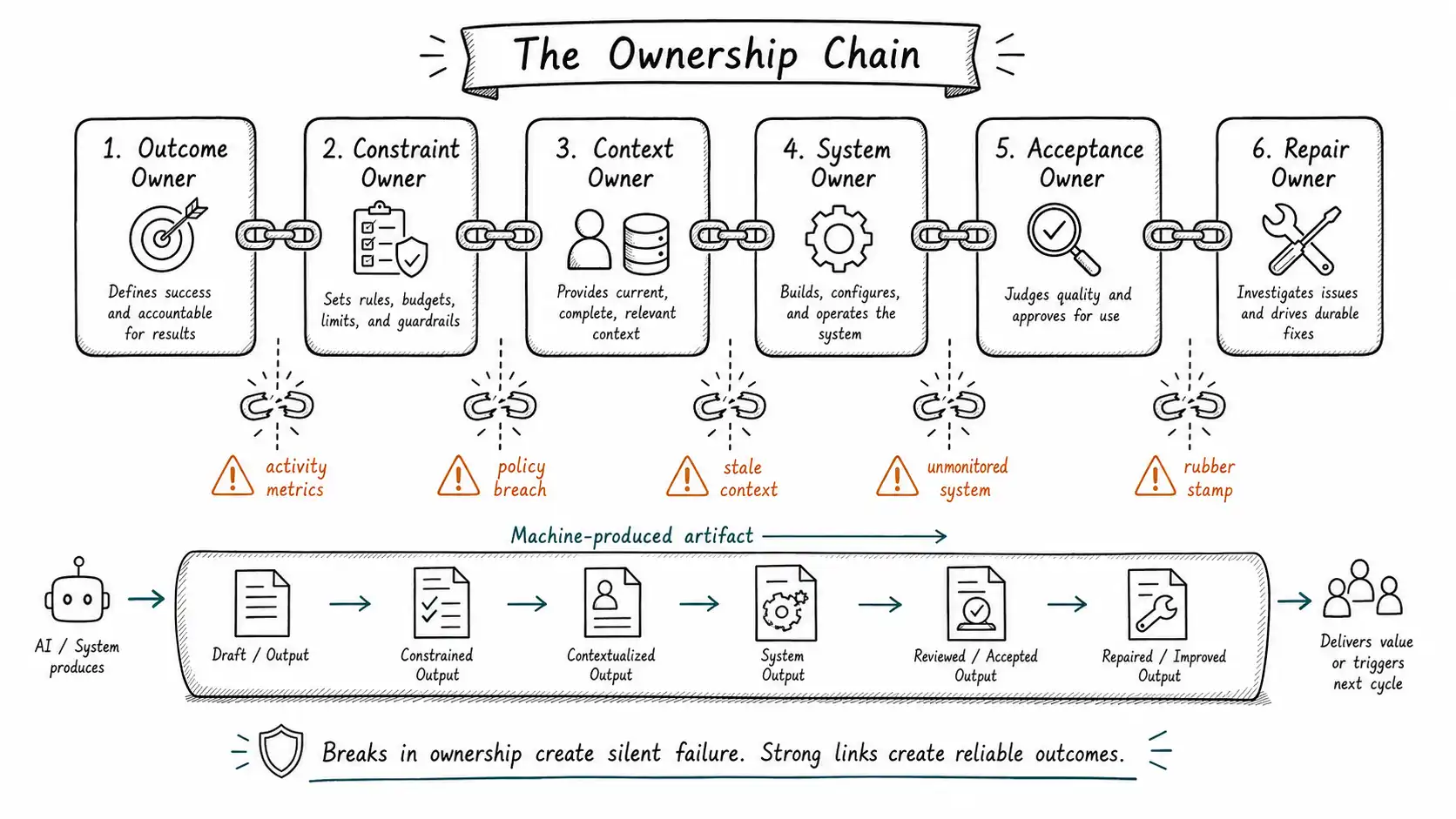
The responsibility chain
A useful responsibility chain has six links.
| Responsibility link | What it owns | Failure mode if absent |
|---|---|---|
| Outcome owner | Business/customer result the workflow exists to improve | AI success measured as activity rather than value |
| Constraint owner | Policies, legal boundaries, security, brand, architecture, ethics | Machine output violates non-negotiable rules |
| Context owner | Data sources, freshness, completeness, access, meaning | Output ignores missing or stale facts |
| System owner | Model/tool configuration, prompts/specs, evaluation, monitoring | Nobody knows whether the system is behaving acceptably |
| Acceptance owner | Final human or automated gate that approves use/action | Approval becomes casual, unclear, or impossible to audit |
| Repair owner | What happens after wrong output causes harm or rework | Incidents become blame games instead of learning loops |
The chain should be visible in design documents and operating reviews. It should not live inside one person's head. In small teams, one person may hold multiple links. In regulated or large organizations, each link may belong to a different role. What matters is that the links exist.
A simple RACI-style version can be used for any AI-native workflow:
| Decision / activity | Outcome owner | Constraint owner | Context owner | System owner | Acceptance owner | Repair owner |
|---|---|---|---|---|---|---|
| Define workflow objective | A | C | C | C | C | C |
| Approve data/context sources | C | C | A | C | C | I |
| Approve generation spec/prompt | C | C | C | A | C | I |
| Define acceptance criteria | A | C | C | C | A | C |
| Release workflow to users | A | C | C | A | C | I |
| Approve high-risk output | C | C | C | C | A | I |
| Investigate failure | C | C | C | A | C | A |
| Update workflow after failure | A | C | C | A | C | A |
A = accountable. C = consulted. I = informed. The exact letters should change by workflow. The discipline is that the table exists before the workflow scales.
Policy-as-workflow, not policy-as-PDF
Most companies already have policies that look relevant to AI: data-use policy, security policy, code-review policy, brand policy, support refund policy, customer communication policy, regulatory policy. The problem is that policies written as documents are weak controls when machine-produced work moves quickly.
AI-native responsibility requires turning policies into workflow constraints. Not every policy can become code, but every relevant policy should become at least one of the following:
- A generation constraint.
- A retrieval/data-access constraint.
- An automated check.
- A required human approval.
- An escalation condition.
- An audit-log field.
- An evaluation case.
- A runbook step.
For example, a support refund policy should not only exist in a knowledge base. It should shape which cases the model can resolve automatically, which cases require supervisor approval, which customer segments have exceptions, what language can be used in customer communications, and which accepted outputs are sampled for review.
A lightweight YAML-style control file can make responsibility concrete in technical workflows:
workflow: enterprise_refund_resolution
outcome_owner: vp_customer_operations
system_owner: ai_operations_lead
constraint_owners:
 legal_policy: legal_ops_director
 finance_policy: revenue_controller
 customer_policy: head_of_customer_success
context_sources:
 - crm_account_tier
 - contract_entitlements
 - support_ticket_history
 - product_incident_status
machine_actions:
 draft_response: allowed
 approve_refund: conditional
 issue_refund: not_allowed
acceptance_rules:
 auto_accept:
 max_refund_usd: 50
 account_tier: standard
 confidence_min: 0.92
 no_open_incident: true
 human_required:
 - enterprise_account
 - refund_usd_over_50
 - active_legal_hold
 - policy_exception_requested
logging:
 record_prompt_version: true
 record_context_snapshot: true
 record_acceptance_owner: true
 record_escalation_reason: true
repair:
 owner: customer_operations_quality_lead
 review_sample_rate: 0.05
 incident_threshold: reopened_ticket_rate_gt_0.08
This is not meant to be a universal format. It illustrates the shift: responsibility becomes part of the workflow configuration. The policy is not only something a human might remember during review. It becomes an operating surface the system can enforce, log, and improve.
The vendor cannot own your judgment
AI vendors can provide models, tools, safety features, documentation, logs, evaluation frameworks, and contractual assurances. They cannot own your business judgment. They do not know your customer promise, risk appetite, regulatory posture, brand tolerance, margin structure, account politics, architectural constraints, or escalation culture unless you encode and operate those things.
This matters because vendor sophistication can create false confidence. A tool may have excellent generic safeguards and still be unsafe for a specific workflow. A model may be strong at writing and weak at knowing which promise your sales team is allowed to make. A coding assistant may write syntactically correct code and still violate the architectural constraints of your service. A retrieval system may produce relevant documents and still surface information the current user should not see if permissions are handled after retrieval rather than before.
The organization that says "the vendor handles safety" has abdicated the Judgment Stack. The vendor can help with system safety. The organization owns workflow safety.
OWASP's Top 10 for Large Language Model Applications is useful here because it frames LLM risk at the application level: prompt injection, sensitive information disclosure, supply chain issues, excessive agency, insecure output handling, and more. Those risks are not solved by model capability alone. They live in the surrounding system.
AI-native responsibility therefore has two layers: vendor responsibility for the tool and organizational responsibility for the workflow. Mature buyers evaluate both.
Responsibility changes with autonomy level
A machine that drafts creates one responsibility profile. A machine that recommends creates another. A machine that acts creates a third. A machine that acts repeatedly and learns from feedback creates a fourth.
The responsibility chain must strengthen as autonomy increases.
| Machine role | Human responsibility required | Example | Minimum control |
|---|---|---|---|
| Assist | User owns production and acceptance | AI suggests wording for an email | User review, usage guidance |
| Draft | Human accepts or rejects artifact | AI drafts support response | Acceptance criteria, logging |
| Recommend | Human decides based on machine suggestion | AI recommends renewal risk action | Explanation, alternatives, decision owner |
| Conditional action | Machine acts within bounded rules | AI approves small refund | Rule limits, audit logs, sampling |
| Autonomous workflow | Machine handles loop with exception escalation | AI resolves low-risk tickets end to end | Strong evals, monitoring, rollback, repair owner |
| Adaptive system | Workflow changes behavior from feedback | AI updates routing/playbook suggestions | Change control, drift monitoring, governance review |
The table does not say autonomy is bad. It says autonomy changes the burden of design. A workflow that is safe at draft level may be unsafe at action level. A system that can recommend a discount should not automatically offer one. A system that can generate a code patch should not necessarily merge it. A system that can summarize a contract should not be allowed to accept legal risk.
The organization must decide where the machine sits and design responsibility accordingly.
Blame is not a control
When machine-produced work fails, organizations often look for a person to blame. The user trusted the output. The manager pushed the rollout. The product team shipped the assistant. The data team failed to supply context. The vendor model hallucinated. Blame may be emotionally satisfying, but it is a weak operating control.
A better incident review asks:
- Which responsibility link failed?
- Was the acceptance owner clear?
- Did the reviewer have enough context and time?
- Was the machine allowed to operate at the correct autonomy level?
- Were constraints encoded into the workflow?
- Was the output-to-outcome metric aligned?
- Did logging preserve enough evidence to reconstruct the decision?
- What must change so the failure is less likely next time?
This is how AI-native responsibility becomes learnable. The goal is not to eliminate all mistakes. The goal is to prevent mistakes from becoming mysteries.
The machine took part of the work. It did not take the consequence. Organizations that understand that will move slower at first and faster later, because their systems will be trusted. Organizations that do not will move quickly into a fog of plausible output and disputed accountability. Acceptance Is the New Bottleneck shows what happens when responsibility is defined but acceptance infrastructure is not built.