Conclusion: Before You Call It AI-Native
AI native is not the absence of humans. It is the relocation of humans to the decisions that determine whether machine produced work should matter.

Research spine: this chapter stays grounded in "Generative AI at Work" and arXiv:2302.06590, then applies that evidence to the operating judgment in the book. Before you call a workflow AI-native, verify that machine production is connected to human judgment, measurable acceptance, explicit autonomy boundaries, accountable consequence, and systematic learning. A tool rollout can be useful without earning that label.
AI-native is not the absence of humans. It is the relocation of humans to the decisions that determine whether machine-produced work should matter.
That sentence is the book.
A company that understands it will not measure AI transformation by seats purchased, prompts written, drafts generated, or demos shipped. It will look for the harder signs: workflows decomposed, judgment gates named, context sources managed, acceptance criteria defined, evals maintained, autonomy boundaries reviewed, outcomes measured, failures converted into system improvements, and responsibility made explicit.
A company that does not understand it will build first-draft factories. It will generate more artifacts than it can accept. It will overload senior reviewers. It will tell workers to use judgment without designing judgment into the workflow. It will say "human in the loop" while giving the human too little context, too much volume, and unclear authority. It will automate production and discover that the scarce resource was never production alone.
The difference is not intelligence. It is operating design.
Key Takeaways
- AI-native means machine production and human judgment reinforce each other inside a designed workflow.
- The checklist requires outcome, workflow, Judgment Stack, acceptance, autonomy, escalation, repair, and learning evidence.
- Good first workflows are repeated, bounded, measurable, reversible, and owned.
- The human role does not become less important; it becomes more concentrated around intent, context, quality, risk, ownership, and learning.
- This conclusion closes the loop back to The First-Draft Factory and the AI-Native thesis.
The doctrine
The AI-native doctrine can be stated in ten rules.
- Do not confuse output with outcome. Generated work has value only when accepted output improves a real result.
- Decompose the workflow before choosing the tool. Intent, context, production, verification, decision, and consequence must be visible.
- Treat judgment as a stack, not a vibe. Intent, constraint, context, quality, risk, ownership, and change judgment are different responsibilities.
- Put acceptance before generation. Define what good enough means before asking the machine to produce.
- Make responsibility architectural. Every AI-native workflow needs owners for outcome, constraints, context, system behavior, acceptance, and repair.
- Use evaluation to scale judgment. Human review alone collapses under abundant machine output; evals, checks, sampling, and outcome metrics carry part of the load.
- Set autonomy boundaries deliberately. Capability is not permission. Machines may assist, draft, recommend, act conditionally, or operate loops only when evidence supports the role.
- Protect apprenticeship. Do not automate away the practice through which future judgment develops.
- Build an operating cadence. Evals, failures, boundaries, outcomes, and workflow changes must be reviewed on the calendar.
- Let failures improve the system. A rejected output should not disappear. It should teach the workflow.
These rules are simple. They are difficult because they force leaders to change how work is owned.
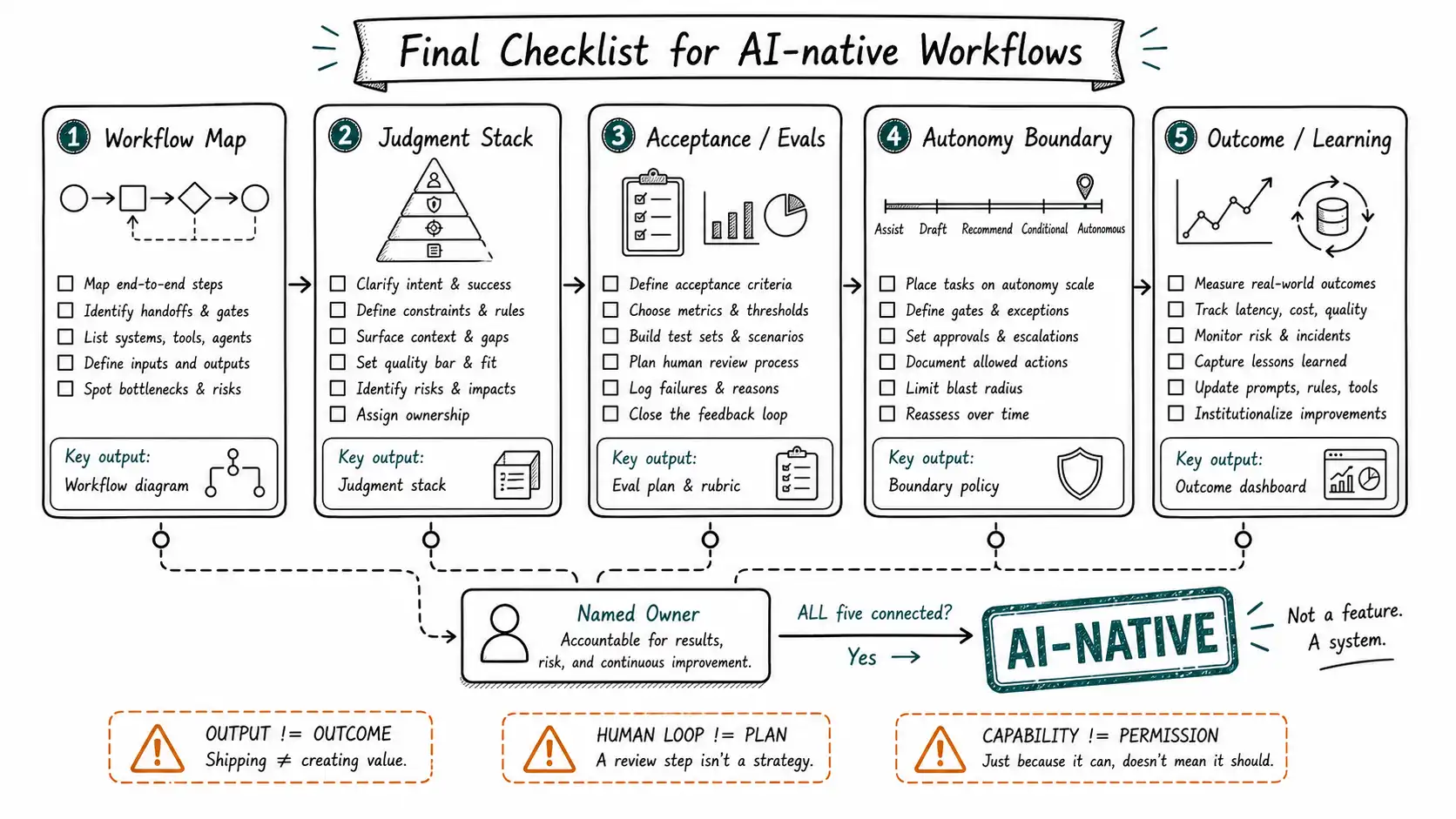
Before you call a workflow AI-native
Use this checklist before labeling any workflow AI-native.
| Question | Yes / No | Evidence |
|---|---|---|
| Have we named the intended outcome, not just the generated artifact? | ||
| Have we decomposed the workflow into intent, context, production, verification, decision, and consequence? | ||
| Have we identified which tasks are machine-first and which remain human-first? | ||
| Have we named the relevant Judgment Stack layers and owners? | ||
| Have we defined acceptance criteria before generation? | ||
| Have we encoded hard constraints into prompts, specs, checks, permissions, or workflow rules? | ||
| Do we know what context the machine needs and how freshness/permissions are maintained? | ||
| Do we have evals or other verification methods that reflect real failures? | ||
| Do we measure accepted outcomes rather than generated volume alone? | ||
| Is the autonomy boundary explicit? | ||
| Is there a clear escalation path for uncertainty or high risk? | ||
| Is an acceptance owner named? | ||
| Is a repair owner named? | ||
| Are rejection reasons captured and used to improve the system? | ||
| Does the operating cadence review outcome, evals, failures, and boundaries? | ||
| Have we protected learning paths for junior people affected by automation? | ||
| Have legal, security, compliance, brand, or architecture constraints been considered where relevant? | ||
| Can we stop, roll back, or narrow the workflow if it behaves badly? |
If the answer is mostly no, the workflow may still be valuable. It may be AI-assisted. It may be a pilot. It may be a useful sidecar. But it is not yet AI-native.
What to redesign first
The best first AI-native workflows are not necessarily the flashiest. Look for work that is repeated, bounded, measurable, context-rich but accessible, reversible, and owned. Support classification, invoice extraction, internal knowledge retrieval, low-risk drafting, release-note generation, test generation under strong review, renewal-risk preparation, and operations triage can be good candidates when designed properly.
Avoid starting with workflows that are high-stakes, ambiguous, adversarial, relationship-sensitive, legally complex, or poorly evaluated. Use AI there, but use it as assistance until the workflow earns more autonomy.
The first workflow should teach the organization how to operate: how to build evals, how to capture rejection reasons, how to review boundaries, how to connect output to outcome, how to assign ownership, how to run failure reviews. The second workflow should be easier because the first built operating muscle. If every AI project starts from scratch, the company is not becoming AI-native; it is collecting experiments.
The human role did not get smaller in importance
It became more concentrated.
That concentration can be good or bad. It is good when humans spend less time on repetitive production and more time on intent, context, quality, risk, ownership, and learning. It is bad when humans are reduced to exhausted reviewers of machine output, blamed for failures they were not equipped to prevent, or denied the learning path that builds future expertise.
AI-native leaders have to make a choice. They can use AI to flood old processes with cheap artifacts. Or they can redesign work so machine production and human judgment reinforce each other.
The second path is slower at the beginning. It requires more honesty. It requires saying no to premature autonomy. It requires retiring vanity metrics. It requires making responsibility visible. It requires managers to manage decision quality, not just activity. It requires senior people to build acceptance systems, not merely approve output. It requires organizations to treat evaluation as infrastructure and apprenticeship as design.
But it is the only path that deserves the name AI-native.
The machine took parts of the work. It left us the judgment. What happens next depends on whether we build organizations worthy of that responsibility.