Seniority After Throughput
The junior engineer was faster than she had ever been and learning less than she expected.

Seniority after AI throughput is less about who can produce the most artifacts and more about who can design judgment, acceptance, risk controls, and apprenticeship into the workflow. If the machine absorbs junior production without preserving practice, the organization borrows speed from its future talent system.
The junior engineer was faster than she had ever been and learning less than she expected.
She could ask the coding assistant to explain files, draft functions, generate tests, and propose fixes. Her first month looked productive. She opened more pull requests than the previous cohort. She shipped small changes quickly. She felt less blocked.
Then the staff engineer asked her to debug a production issue without the assistant's first draft. She struggled to form a hypothesis. She knew how to request code. She had not spent enough time building the internal map of the system: which service owned which behavior, which data path was fragile, which test was meaningful, which errors were symptoms, and which were causes. The assistant had reduced friction, but it had also hidden some of the productive struggle through which judgment develops.
This is one of the hardest AI-native problems: AI changes not only productivity but apprenticeship.
The easy claim is that junior roles disappear. The equally easy counterclaim is that AI will make juniors more powerful. Both are incomplete. AI compresses some entry-level production tasks, amplifies some learning opportunities, and threatens others. The organization's responsibility is to redesign seniority instead of letting the learning path erode accidentally.
Key Takeaways
- The junior engineer was faster than she had ever been and learning less than she expected.
- The practical test is whether a team can name the evidence, owner, and failure mode before it changes behavior.
- Read this with AI-Native and the adjacent chapters when you need the wider AI-Native Engineering frame.
The old ladder was built on production
Many professional ladders teach judgment through production. Junior people perform bounded tasks. They draft the memo, write the test, answer the ticket, build the small feature, prepare the account research, clean the data, write the first version of the brief. Senior people review. Over time, juniors internalize patterns. They learn what good looks like by making mistakes, receiving feedback, and seeing consequences.
This is inefficient in the best way. The organization spends senior time reviewing junior output, but it converts that review into skill development. The junior learns not only the artifact but the reasoning behind acceptance.
AI changes this ladder because the machine can perform many bounded production tasks faster than juniors. That creates a temptation: give the machine the junior work and keep only senior reviewers. The short-term economics look attractive. The long-term talent system breaks.
If nobody writes the first draft, nobody learns why first drafts are wrong. If nobody debugs simple failures, nobody develops debugging instincts. If nobody handles routine support tickets, nobody learns customer language. If nobody writes basic sales research, nobody learns account pattern recognition. If nobody prepares first-pass analysis, nobody learns assumptions.
AI-native organizations need to separate two questions:
- Which production tasks should the machine perform because it improves the workflow?
- Which production tasks should humans still practice because they develop future judgment?
These are not always the same answer.
AI helps unevenly across seniority
The evidence on AI and worker skill is not uniform. In the customer-support setting studied by Brynjolfsson, Li, and Raymond, less experienced and lower-skill workers benefited substantially, suggesting that AI can transfer some tacit patterns from stronger performers into the workflow (NBER: Generative AI at Work). In the GitHub Copilot experiment by Peng et al., participants completed a bounded programming task faster with AI assistance (arXiv:2302.06590). But the METR study on experienced open-source developers working in familiar codebases found a slowdown in that specific setting, despite participants expecting speedups (METR).
Taken together, these results suggest a more nuanced rule: AI is most helpful when it supplies missing patterns, accelerates bounded production, or reduces low-value friction; it is less helpful, and can even become costly, when expert judgment, dense context, high standards, and review burden dominate.
That has direct implications for seniority. Juniors may benefit from AI because it gives them scaffolding. Seniors may benefit less on tasks where they already have deep context and where reviewing AI output creates overhead. But seniors are also the people best equipped to define specs, constraints, evals, and acceptance criteria. Their value shifts from producing every artifact to shaping the system that produces and accepts artifacts.
The danger is that companies will use AI to remove the very tasks through which juniors become seniors, while simultaneously overloading seniors with review.
Seniority becomes judgment architecture
In an AI-native workflow, seniority is less about being the fastest producer of artifacts and more about being the person who can design judgment into the system.
A senior engineer is not simply the person who writes the most code. They define architecture, identify failure modes, write acceptance tests, judge tradeoffs, review machine-authored code, and update the development system after recurring failures. A senior support lead is not simply the fastest ticket resolver. They define resolution standards, detect patterns across escalations, improve the knowledge base, and decide which cases can be automated safely. A senior salesperson is not simply the person with the best email craft. They know account timing, buyer psychology, negotiation risk, and when not to automate. A senior product manager is not simply the clearest PRD writer. They know how to define intent, shape constraints, resolve ambiguity, and make a tradeoff stick.
The AI-native senior is a builder of acceptance systems.
That phrase matters. It prevents a common failure mode where senior people become exhausted editors of machine output. Editing is part of the job, but the senior role should move upstream and downstream: upstream into better specs, constraints, and context; downstream into evals, sampling, failure analysis, and workflow redesign.
A senior person should ask:
- What should the machine not attempt?
- What examples define good and bad output?
- Which constraints must be encoded?
- Which failure modes require escalation?
- What review can be automated?
- What human review requires expertise?
- What feedback should update the workflow?
- How will juniors learn the underlying judgment?
This is not less technical or less professional than production work. It is more use.
The new apprenticeship loop
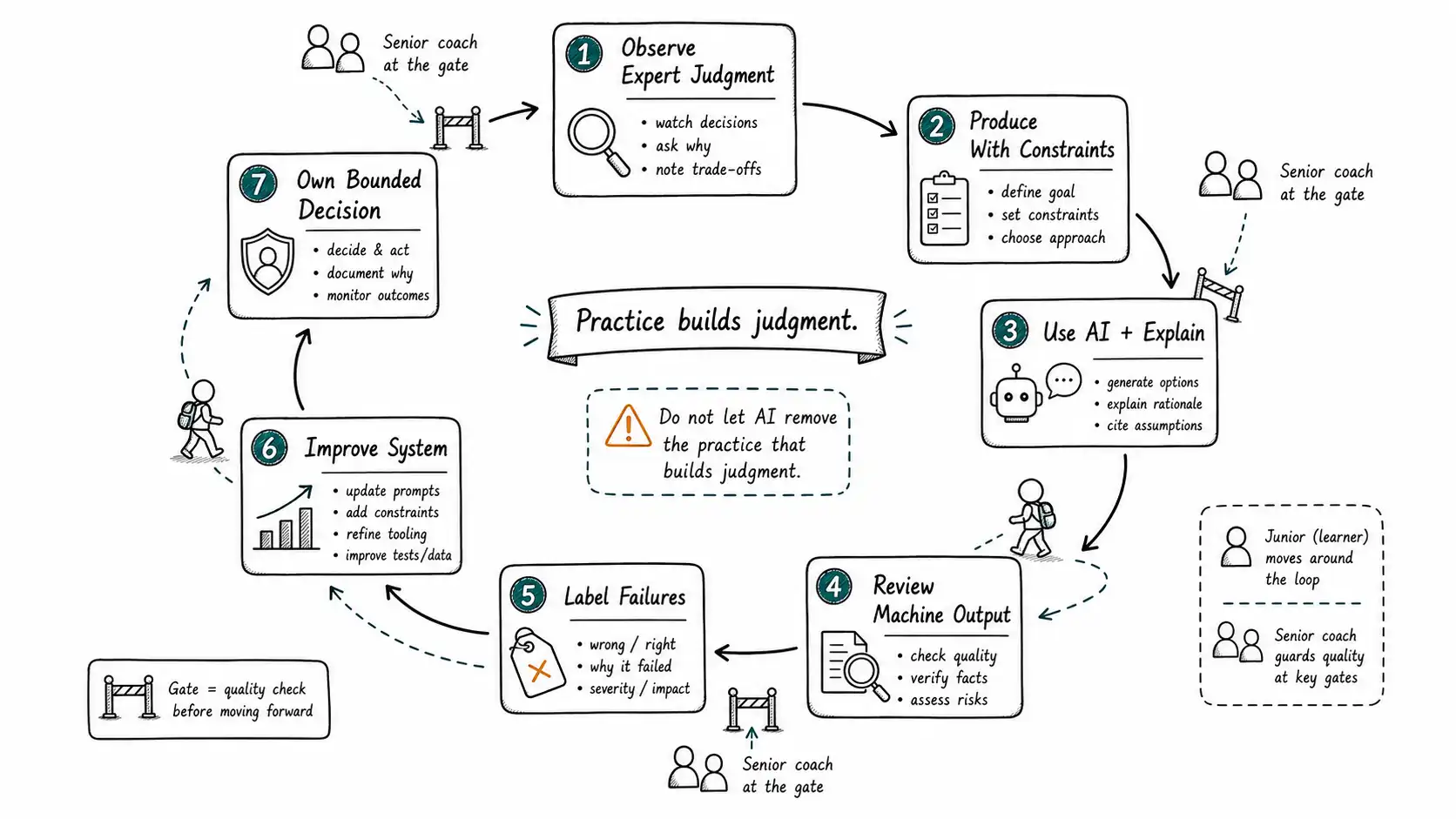
AI-native teams need deliberate apprenticeship loops because production alone no longer guarantees learning. The loop should give junior people exposure to intent, context, production, review, consequence, and system improvement.
A simple loop looks like this:
- Observe expert judgment: Junior reviews accepted and rejected outputs with a senior, focusing on why decisions were made.
- Produce with constraints: Junior writes specs, tests, prompts, or first drafts under clear acceptance criteria, sometimes without AI to build baseline skill.
- Use AI with explanation: Junior uses the machine but must explain what was accepted, rejected, and changed.
- Review machine output: Junior reviews low-risk AI output using a rubric before senior spot-check.
- Label failures: Junior classifies rejection reasons by Judgment Stack layer.
- Improve the system: Junior contributes an eval case, playbook update, knowledge-base correction, test, or workflow rule.
- Own a bounded decision: Junior becomes acceptance owner for a low-risk category after demonstrating judgment.
This loop trains judgment directly. It also creates useful work. The junior is not practicing on artificial exercises alone; they are improving the AI-native workflow.
| Apprenticeship activity | Skill developed | AI-native artifact produced |
|---|---|---|
| Compare accepted vs rejected outputs | Quality and risk judgment | Review examples library |
| Write acceptance criteria | Intent and constraint judgment | Spec/test/prompt requirements |
| Classify failure reasons | Context and quality judgment | Failure taxonomy |
| Add eval cases | Verification design | Regression suite |
| Update knowledge/playbook | Change judgment | Better context source |
| Own low-risk approvals | Ownership judgment | Auditable acceptance record |
Managers manage decision quality
In traditional throughput management, a manager asks: How much did we produce? How fast did we move? Who is blocked? What is the status?
In AI-native management, those questions remain but become insufficient. The manager must also ask: Are the right decisions being made at the right level? Are reviewers overloaded? Are rejection reasons becoming system improvements? Are humans spending time on judgment or cleanup? Are juniors developing judgment? Are outcome metrics improving or only output metrics?
A manager in an AI-native team manages the quality of decision flow.
That means they need new operating signals:
| Signal | What it reveals | Bad pattern |
|---|---|---|
| Acceptance rate by output type | Whether machine output is useful | High generation with low acceptance |
| Rejection reason distribution | Which Judgment Stack layers fail | Repeated context failures not fixed |
| Review time per accepted output | Cost of acceptance | AI output increases senior bottleneck |
| Outcome lift per workflow | Whether accepted output matters | Faster work without better result |
| Escalation precision/recall | Whether autonomy boundary is working | High-risk cases slip through or too many false escalations |
| Junior judgment progression | Whether talent pipeline is developing | Juniors become prompt operators without domain judgment |
| System improvement rate | Whether review becomes learning | Same failures recur weekly |
These metrics are less comfortable than activity counts because they reveal whether the system is actually improving. They also protect workers from becoming invisible cleanup labor.
The seniority compression risk
AI can compress the middle of work. That compression is useful when it removes low-value repetition. It is dangerous when it removes the path from novice to expert.
A company that automates all first drafts may still need experts to review. But where will the next experts come from? A company that eliminates routine support handling may still need humans for escalations. But how will new hires learn customer patterns before they face escalations? A company that lets AI write most code may still need architects. But how will engineers develop architecture judgment if they skip the lower-level decisions that taught consequences?
This does not mean preserving busywork for nostalgia. It means designing practice deliberately.
The old apprenticeship model was accidental: juniors learned by doing whatever work was available. The AI-native apprenticeship model must be intentional: juniors learn by observing expert judgment, producing under constraints, reviewing machine output, labeling failures, and improving the system.
If the company does not design this, it may enjoy a short-term productivity gain and create a long-term seniority shortage.
New roles emerge, but the core shift is broader
AI-native work creates new responsibilities: eval owner, workflow owner, prompt/spec owner, automation boundary reviewer, AI operations lead, context steward, model risk partner, machine-output QA lead. Some companies will make these formal roles. Others will distribute them across existing titles.
The title is less important than the responsibility. Every AI-native workflow needs people who can:
- Define intent and acceptance criteria.
- Encode constraints.
- Manage context sources.
- Evaluate outputs.
- Review exceptions.
- Own risk.
- Improve the workflow after failures.
- Teach others judgment.
Those responsibilities should appear in career ladders. A senior engineer should be rewarded for reducing review burden through better tests, not only for writing code. A support lead should be rewarded for reducing reopened tickets through better automation boundaries, not only for team throughput. A sales manager should be rewarded for message quality and pipeline fit, not only outbound volume.
Compensation systems eventually teach people what the organization really values. If AI-native organizations say judgment matters but reward artifact volume, workers will believe the rewards.
A better promise to people
The humane promise of AI-native work is not that everyone keeps doing the same job with better tools. That promise is false. The better promise is that the organization will stop pretending the machine's output is the human's fault when the workflow was badly designed. It will train people for judgment, not merely demand it. It will remove repetitive production where appropriate without removing the learning needed for responsibility. It will measure outcomes rather than drowning people in review. It will make decision rights visible.
That promise is harder to keep than buying licenses. It requires managers to redesign work, not simply announce adoption.
Seniority after throughput is not about who can produce the most. It is about who can decide what should be produced, what should be accepted, what should be automated, and what the system should learn. The Autonomy Boundary defines the line between what the machine may do and what it may only propose.