Redesign the Workflow, Not the Tooling Budget
The chatbot was not the problem. The unchanged support organization was.

AI-native workflow redesign starts by decomposing the work, choosing the right unit of work, and building context, checks, judgment gates, outcomes, and learning before the tooling budget expands. Buying another assistant preserves the old bottleneck if the workflow itself stays unchanged.
The chatbot was not the problem. The unchanged support organization was.
A SaaS company launched an AI support assistant with the usual promise: customers would get answers faster, agents would spend less time on repetitive tickets, and the knowledge base would become more useful because the assistant could retrieve from it. The pilot was technically competent. The assistant answered common questions, summarized past tickets, and suggested replies. The support team's average first-response time improved.
Resolution did not.
The reason became clear after a month of ticket review. The assistant had been inserted into the old support workflow. Customers still entered through the same forms. The knowledge base still had outdated articles. Escalation rules still depended on agents noticing severity manually. QA still sampled tickets after closure. Product feedback still arrived through a weekly meeting nobody prepared for. Customer success still learned about enterprise escalations too late. The AI assistant made the old workflow faster, but the old workflow was the constraint.
AI-added thinking buys tools and preserves process. AI-native thinking redesigns process and then chooses tools.
This chapter is about the redesign move.
Key Takeaways
- A sidecar assistant can be useful, but it preserves old queues, data gaps, incentives, approvals, and ownership unless the workflow changes.
- The right redesign unit has a clear input, clear intended outcome, repeated volume, observable quality, recoverable failures, and known constraints.
- Support, sales, software, legal, finance, and back-office workflows need different gates because their risks differ.
- The workflow canvas makes intent, context, machine role, acceptance, escalation, outcome, and repair visible before scale.
- This chapter connects the AI-Native thesis to Agents That Actually Work and The AI-Native SDLC.
The sidecar pattern
Most AI adoption begins with a sidecar: an assistant attached to a workflow without changing the workflow's structure. The sidecar helps a human do the existing task. It summarizes, drafts, searches, edits, classifies, or suggests. Sidecars are useful. They are often the right first step because they let people learn where the model helps and where it fails.
The mistake is treating the sidecar as the destination.
A sidecar preserves old handoffs, old queues, old metrics, old approvals, old data problems, and old incentives. If the previous workflow suffered from unclear ownership, stale knowledge, excessive handoffs, weak measurement, or slow escalation, the sidecar accelerates the workflow into those same defects.
An AI-native redesign asks what the workflow would look like if machine execution were assumed from the beginning. That does not mean full autonomy. It means the process is arranged around machine strengths and human judgment gates.
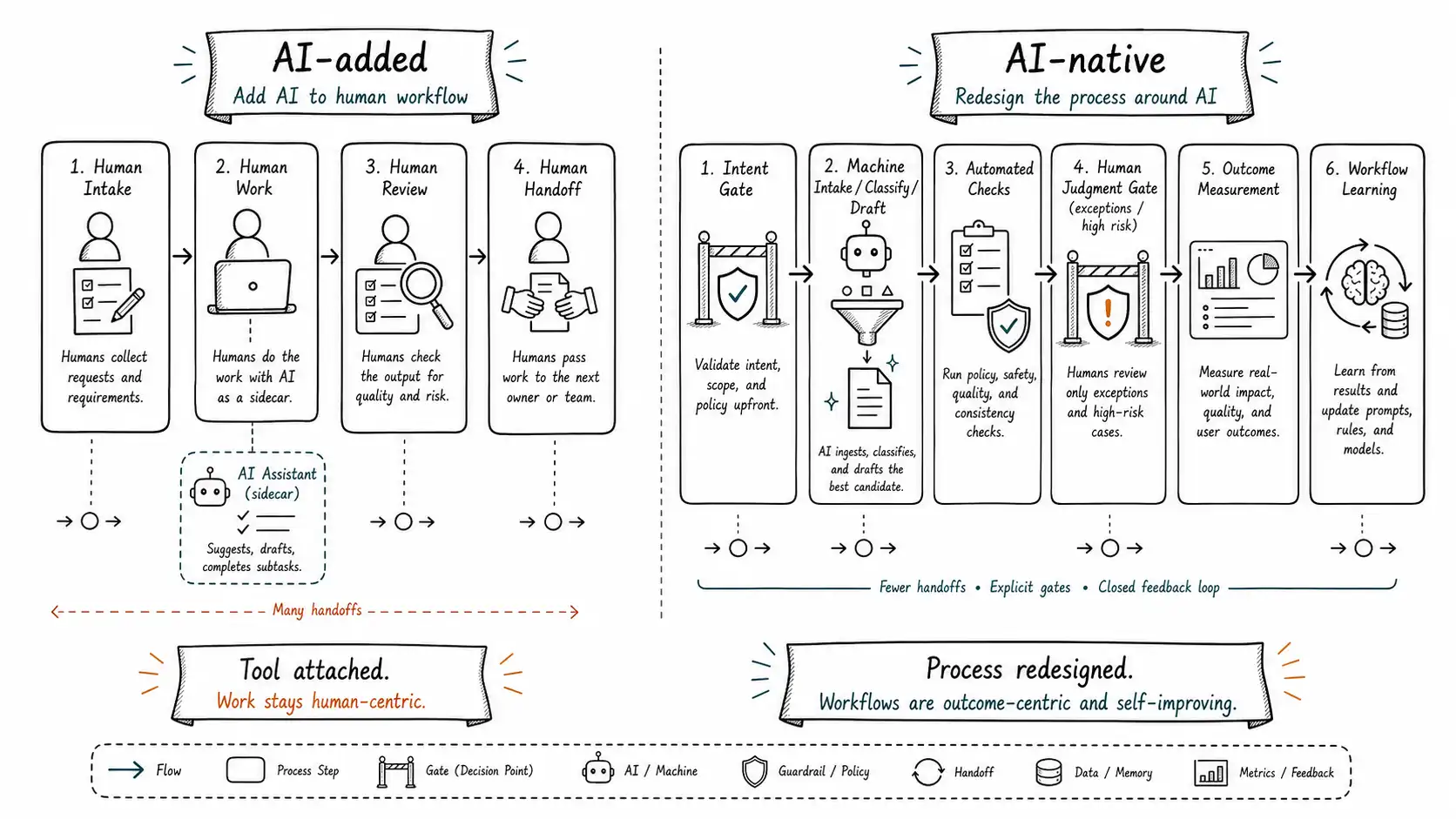
The diagnostic: AI-added or AI-native?
A leader can diagnose the difference with twelve questions.
| Question | AI-added answer | AI-native answer |
|---|---|---|
| What changed? | A tool was added to an existing step | The workflow was decomposed and redesigned |
| What is measured? | Usage, drafts, tokens, artifacts, time saved | Accepted outcomes, quality, risk, review cost, learning |
| Where is the human? | Everywhere, but vaguely | At defined judgment gates |
| What does the machine own? | Assistance | Bounded production, routing, retrieval, checks, recommendations, or actions |
| What happens when uncertain? | User decides ad hoc | Escalation rule triggers |
| Are constraints encoded? | Mostly in policy docs | In prompts/specs/checks/permissions/workflow config |
| Is context managed? | User supplies it manually | Required context sources are explicit and monitored |
| How is quality known? | People inspect examples | Evals, sampling, outcome metrics, regression suites |
| How does the system learn? | Users complain or improve prompts informally | Rejection reasons and failures update workflow artifacts |
| Who owns consequences? | Unclear or assumed | Named owner by workflow and autonomy level |
| What is the unit of improvement? | Better prompt or more usage | Better workflow, better evaluation, better boundary |
| What is the failure mode? | More plausible output | Misaccepted output at scale |
If most answers sit in the left column, the organization is still AI-added. That is not shameful. It may be an honest stage. But calling it AI-native will lead to bad planning.
Redesign begins with the unit of work
AI-native workflow design starts by choosing the right unit of work. Too small, and the system becomes a collection of disconnected automations. Too large, and the organization accidentally attempts autonomy before evaluation and responsibility are ready.
A good unit of work has:
- A clear input.
- A clear intended outcome.
- Repeated volume.
- Observable quality signals.
- Recoverable failure modes.
- Known constraints.
- A natural escalation path.
- A responsible owner.
For support, "answer all tickets" is too broad. "Resolve duplicate-billing tickets under $50 for standard accounts when billing history confirms duplicate charge" is a better unit. For sales, "automate outbound" is too broad. "Draft first-touch account-specific emails for tier-three accounts using approved positioning and requiring rep acceptance" is more workable. For engineering, "let the agent fix bugs" is too broad. "Generate patches for low-risk test failures in isolated modules when acceptance tests exist and code owner approval is required" is a better starting unit.
Anthropic's guidance on building effective agents argues that many successful implementations use simple, composable patterns rather than elaborate agent frameworks (Anthropic: Building Effective AI Agents). That is the right lesson for workflow design. AI-native does not mean maximal autonomy. It means choosing a bounded unit of work, surrounding it with context, checks, escalation, and learning, then expanding only when the system earns trust.
A support redesign
The AI-added version of support adds drafting assistance inside the ticket queue. It is helpful but shallow.
The AI-native redesign changes the flow:
- Intake classification: Machine classifies issue type, urgency, account tier, entitlement, and likely resolution path.
- Context assembly: System retrieves billing history, contract terms, product incident status, and previous tickets.
- Resolution candidate: Machine drafts a proposed resolution or identifies missing information.
- Automated checks: Policy, entitlement, active incident, and high-risk language checks run before human review.
- Acceptance routing: Low-risk, high-confidence cases may be accepted automatically or by junior agents. High-risk cases route to specialist humans.
- Outcome measurement: Reopen rate, CSAT, refund accuracy, escalation correctness, and time-to-resolution are measured.
- Learning loop: Rejection reasons and unresolved patterns update knowledge base, prompts, evals, and product feedback.
The human role changes. Agents handle exceptions, empathy-heavy cases, policy ambiguity, and customer-specific judgment. Team leads design QA sampling and review failure patterns. Product owners receive structured issue clusters instead of anecdotal complaints. Customer success is pulled into enterprise cases before damage.
The metric changes too. The central metric is not "AI response rate." It is resolution quality at acceptable risk and cost.
A sales redesign
Sales teams often adopt AI as message generation. That is the first-draft factory again. The rep receives a prospect, asks the model for a personalized email, edits it, and sends. Activity increases. Buyer trust may not.
An AI-native sales workflow focuses on account judgment:
- Machine researches public account signals, CRM history, product usage, recent support issues, renewal timing, and known stakeholders.
- System classifies the account motion: educate, qualify, reactivate, expand, renew, multi-thread, or pause.
- Machine drafts outreach aligned to the motion and approved claims.
- Automated checks block unsupported claims, discount language, competitive statements, or references to unverified events.
- Rep accepts, edits, or rejects with structured reasons.
- Outcome ledger connects messages to replies, meetings, qualified opportunities, deal quality, and long-term account health.
- Rejection reasons update positioning, segmentation, and data quality.
The human does not vanish. The rep's value moves toward account judgment: whether now is the right moment, whether the message respects the buyer relationship, whether the suggested next step matches the deal, and whether the machine is overfitting to shallow public signals.
Sales leaders should be especially careful with AI-native claims because revenue teams are tempted by activity metrics. More emails can be worse. A buyer who receives a plausible but irrelevant message learns that the vendor is automating attention. AI-native sales must use the machine to improve relevance, not simply to increase reach.
A software redesign
AI-assisted engineering is already common: autocomplete, code chat, test suggestions, pull-request summaries. AI-native engineering requires more than letting models write code. It changes the SDLC around machine-authored work.
The workflow begins with intent and acceptance tests. The human writes or approves the spec, failure cases, architectural constraints, security boundaries, and ownership. The machine proposes implementation. Automated tests, static analysis, security checks, policy checks, and dependency checks run. The reviewer judges not only code correctness but whether the machine stayed inside the intended change. Rejection reasons update the spec, tests, or coding-agent instructions.
A simplified machine-authored change policy might include:
machine_authored_change_policy:
 allowed_without_senior_review:
 - documentation_update
 - low_risk_test_addition
 - isolated_ui_copy_change
 requires_code_owner_review:
 - production_logic_change
 - database_query_change
 - dependency_update
 requires_architecture_review:
 - service_boundary_change
 - data_model_change
 - authentication_or_authorization_change
 hard_blocks:
 - failing_tests
 - missing_rollback_plan_for_migration
 - secrets_or_sensitive_data_in_diff
 - unapproved_new_external_service
acceptance_requirements:
 - linked_spec
 - explicit_non_goals
 - tests_for_changed_behavior
 - reviewer_records_judgment_layer_if_rejected
The point is not to make all engineering bureaucratic. The point is to make machine-authored code legible within the same operational discipline that mature engineering already needs. As AI increases code volume, the cost of weak specs, weak tests, and weak ownership rises.
Legal, finance, and back-office workflows
Some of the highest-value AI-native workflows are not glamorous. Contract review, invoice processing, procurement intake, compliance evidence collection, onboarding, claims processing, and reporting all contain repeated work with clear constraints and real risk.
But these workflows also show why AI-native design is not the same as automation enthusiasm. A model may summarize a contract quickly, but legal risk lives in precise language and negotiation context. A model may classify invoices, but payment errors create financial and vendor issues. A model may draft compliance evidence, but a false statement to an auditor is not a productivity gain.
The redesign pattern is similar:
- Use the machine for extraction, comparison, summarization, routing, and draft preparation.
- Encode hard constraints and escalation triggers.
- Keep human review at risk-bearing decisions.
- Log context, sources, versions, and acceptance.
- Update the workflow after repeated exception patterns.
A legal AI-native workflow might allow the machine to compare a contract against a playbook, produce a risk summary, identify deviations, and suggest fallback positions. It should not allow the machine to accept a non-standard liability clause without human approval. A finance workflow might allow automatic matching of low-value invoices with purchase orders but require human approval for exceptions, new vendors, or unusual payment terms.
The more consequential the workflow, the more explicit the autonomy boundary must be.
The workflow redesign canvas
A practical AI-native redesign session should produce one page before it produces tooling decisions.
| Field | Description |
|---|---|
| Workflow name | The bounded unit of work being redesigned |
| Intended outcome | Business/customer/operational result, not artifact |
| Current bottleneck | Production, context, review, decision, handoff, or risk |
| Machine-first tasks | Tasks the system can perform or draft reliably enough to test |
| Human judgment gates | Where humans must define, accept, decide, or own consequence |
| Required context | Data, documents, history, user state, policy, permissions |
| Hard constraints | Legal, brand, security, architecture, compliance, financial |
| Evaluation method | Offline eval, shadow mode, sampling, tests, outcome tracking |
| Escalation triggers | Low confidence, high risk, missing context, policy exception |
| Autonomy level | Assist, draft, recommend, conditional action, autonomous loop |
| Outcome metric | What proves value improved |
| Repair loop | How failures update the system |
This canvas prevents a tool-first rollout. It also reveals when a workflow is not ready. If the team cannot name the intended outcome, required context, acceptance criteria, or owner, it is premature to automate beyond assistance.
Redesign is political
Workflow redesign changes status. People who used to produce artifacts may become reviewers. Managers who used to measure activity may need to measure decision quality. Teams that owned a step may lose it to a machine or gain responsibility for exceptions. Data owners may become more important because machine output depends on context quality. Legal, security, and compliance may need to move earlier in workflow design. Product may need to own outcomes previously hidden inside operations.
That means AI-native redesign is not only a technical project. It is organizational negotiation. Leaders should expect resistance, not because people hate AI, but because unclear redesign threatens responsibility, learning, identity, and control.
The solution is not to force adoption harder. It is to make the workflow map visible. Show which work shrinks, which moves, which intensifies, and which new responsibilities require authority and training. People are more willing to accept machine production when they understand where human judgment remains meaningful and supported.
The redesign principle
The mature AI-native organization does not ask, "How many AI tools do we have?" It asks, "Which workflows have been redesigned around machine execution, measurable acceptance, clear judgment gates, and accountable learning?"
That question is harder. It produces fewer flashy demos. It also produces systems that survive contact with customers, auditors, production incidents, and revenue targets.
AI-native is not a tooling budget. It is an operating design. Seniority After Throughput examines what that redesign means for how people learn and develop judgment inside AI-native organizations.