The Cost of Strategy Churn
The most expensive thing a hype cycle does to a company is not a bad bet, it is the steady tax of changing direction every time a new claim arrives.

Here is a budget I have actually reconstructed, with the numbers changed to protect the company but the shape kept honest. Over eighteen months, a mid-sized product org chased four AI trends in sequence. Each chase looked reasonable at the time. Each began with a viral release, an executive who said "we need to be on this," a reprioritized quarter, a vendor signed, and an integration started. And each ended quietly: the trend cooled, attention moved to the next thing, the integration was left half-finished, and nobody ever formally killed it because killing it would have meant admitting the chase was a mistake.
The four chases produced, in total, zero shipped features that survived. They also produced four partial integrations that the platform team still maintained, three vendor contracts with another year to run, a codebase with four different ways of calling a model, and a team that had learned, correctly, that any strategy announced this quarter would be gone by the next. The direct cost was perhaps a quarter of the org's engineering capacity for eighteen months. The indirect cost, the learned helplessness, was larger and did not appear on any budget line.
That is strategy churn, and it is the most underpriced cost in the entire hype cycle. A bad bet is a discrete, visible loss you can learn from. Churn is a continuous, invisible tax you pay for the privilege of never committing to anything long enough to learn from it. This chapter is about measuring that tax and refusing to pay it.
The churn flywheel
Churn is self-reinforcing, which is why it is so hard to stop once it starts. The mechanism is a flywheel with five stages, and each turn makes the next turn more likely.
A trend arrives and creates urgency. The roadmap is reprioritized to chase it. The chase generates technical and organizational debt: a half-built integration, a new tool the team half-learned, a process that half-changed. Before the debt is paid down or the bet pays off, the next trend arrives, and because the first chase never reached a result, there is no learning to weigh against the new urgency, so the org reprioritizes again. The debt from chase one is never retired; it is buried under chase two. Around the wheel goes, and with each turn the codebase gets messier, the team gets more cynical, and the org's actual capacity to ship anything declines, which increases the pressure to chase the next trend that might save the quarter.
The cruelest part of the flywheel is the fatigue stage. After enough turns, the team stops believing in any direction. They have seen four strategies die. They reasonably conclude that strategy five will die too, so they invest nothing in it, which guarantees it dies, which confirms their belief. The org has trained its own people to disengage from strategy. You cannot fix this with a motivational all-hands. You fix it by breaking the flywheel, which means changing how trends are allowed to touch the roadmap in the first place.
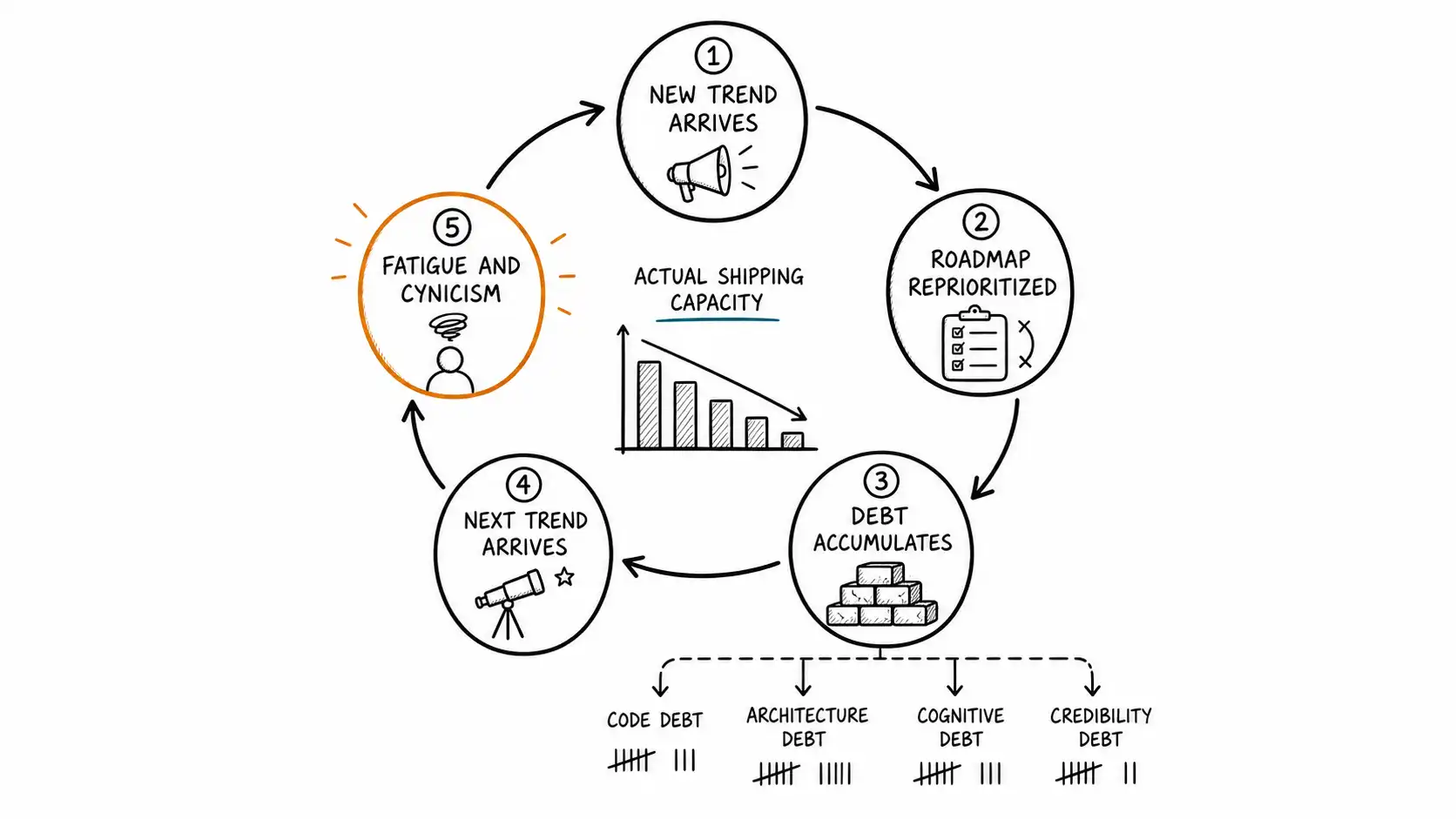
Where the debt actually accumulates
It helps to be specific about what "debt" means here, because it is broader than code, and the non-code debt is usually the larger share.
Code debt is the visible part: the half-finished integrations, the multiple incompatible ways of calling a model, the abandoned feature flags, the dependencies on vendors you are no longer using but cannot fully remove. This is real and it compounds, but it is at least legible. An engineer can point at it.
Architectural debt is heavier: decisions made to accommodate a trend that constrain everything built afterward. You adopted a vector database for a chase that died, and now three other features route through it because it was there, and now you cannot remove it without touching them. Trend-driven architecture choices become load-bearing by accident, and removing them later costs far more than the original chase.
Cognitive debt is the team's depleted capacity to hold context. Every pivot requires people to drop one mental model and load another. Context-switching at the project level has the same cost as at the task level, multiplied by the size of the team and the depth of the abandoned context. A team that has pivoted four times is carrying four half-loaded models and trusting none of them.
Credibility debt is the one leaders pay personally. Every time you announce a direction and abandon it, your next announcement is discounted. After enough cycles, your strategy carries a built-in skepticism tax: the team waits to see if you mean it this time before investing, which slows everything, which makes the strategy more likely to fail, which confirms the skepticism. Credibility, once spent on churn, is expensive to rebuild.
The research on change you do not absorb
There is a useful empirical anchor here from the DORA program, which has spent years measuring what makes software delivery fast and stable. A consistent finding across the Accelerate research is that elite performers are not the teams that change the most or the least, but the teams whose systems absorb change without increasing failure: small, frequent, reversible changes inside strong review and observability (DORA, research program). The 2024 work extended this to AI specifically and found that AI adoption lowered delivery stability unless it landed inside that same well-governed ecosystem.
Translate that to strategy. Churn is the organizational version of a large, infrequent, irreversible change made without the system to absorb it. Each trend-chase is a big-bang reprioritization, the opposite of the small, reversible changes the research associates with high performance. The fix the research implies is not "never change direction." It is "make direction changes small, reversible, and absorbable," which is exactly what a hype budget and a reversibility ladder are for, and which is why those two frameworks come next in the book. Churn is what happens when you let trends drive change in the one mode the evidence says is most damaging: large, sudden, and irreversible.
Escalation of commitment, the engine under the hood
Why do organizations keep chasing instead of stopping? Partly the flywheel, but underneath it sits a well-documented behavioral trap: escalation of commitment, the tendency to invest more in a failing course of action because of what has already been spent (escalation of commitment, behavioral decision research). The classic studies, going back to Barry Staw's work in the 1970s, show that the more a decision-maker has personally committed to a path, the harder it is for them to abandon it even as evidence mounts that it is failing.
In the hype context this shows up as the chase that will not die. The integration is half-built, it is clearly not going to deliver, and yet it is not killed, because killing it means writing off the investment and admitting the chase was wrong. So it limps on, consuming maintenance, occupying a roadmap slot, blocking the architecture, precisely because stopping feels like a bigger loss than the steady bleed of continuing. The sunk cost is doing the deciding, which is exactly backwards: sunk costs are sunk, and the only question that should matter is whether the next dollar of effort is better spent here or elsewhere.
The defense is structural, not heroic. You cannot rely on individuals to override a documented cognitive bias in the moment, under social pressure, with their credibility on the line. You design the system so that chases have predefined kill conditions set before the emotional investment accumulates, and so that killing a chase that hits its kill condition is a normal, blameless event rather than an admission of failure. A pilot that ends because it hit its stop condition is a success of the process, not a failure of the people. Naming that distinction, out loud, repeatedly, is one of the highest-use things a leader can do against churn.
Pricing the churn tax explicitly
You manage what you measure, and most orgs never measure churn because it does not have a budget line. Give it one. Here is the accounting I now run quarterly, and the act of running it is itself a deterrent, because it makes the invisible tax visible to the people authorizing the next chase.
| Churn cost line | How to estimate it | Why it hides |
|---|---|---|
| Capacity spent on chases that shipped nothing | Engineer-weeks on initiatives killed or abandoned | Distributed across many sprints, never summed |
| Maintenance on dead integrations | Ongoing time keeping abandoned code alive | Counted as "platform work," not as chase cost |
| Vendor contracts for tools no longer used | Sum of unexpired contracts for parked tools | Sits in finance, not in the engineering view |
| Context-switch overhead | Estimated productivity loss per pivot times pivots | Considered intangible, so ignored |
| Credibility discount | Slower buy-in on new initiatives (qualitative) | Never measured at all |
The first three lines are countable and usually shocking once summed, because they are normally spread thin enough to be invisible. The fourth is estimable. The fifth is qualitative but real, and naming it in the same table as the hard numbers keeps it from being dismissed. I have watched this single table change behavior, because when an executive proposes the fifth chase of the year and someone shows the running cost of the previous four, the proposal gets a level of scrutiny it would never have faced as a fresh, exciting idea.
Distinguishing churn from healthy change
I have to be careful here, because the cure for churn can curdle into its own disease: the org that never changes direction, dismisses every trend, and gets quietly overtaken. Refusing to churn is not the same as refusing to move. The difference is in the structure of the change, not its frequency.
Healthy change is consequential, evidence-driven, and either reversible or worth the irreversibility. It follows a claim through the SANE Filter and the decomposition sheet, it is sized to its evidence, and when it is made it is committed to long enough to learn from. The org changes direction because a test came back positive, not because a video went viral.
Churn is reactive, evidence-free, and abandoned before it produces learning. It follows the feed, not a test. It is sized to the volume of the hype, not the strength of the case. And it is dropped the moment the next trend arrives, so it never generates the learning that would justify or refute it.
The tell that separates them is simple: ask what test result triggered the change, and ask what result would end it. Healthy change can answer both. Churn can answer neither, because it was never connected to a test in the first place. An organization that can always answer those two questions about its direction changes is, almost by definition, not churning, however fast it moves.
Summary
Strategy churn is the steady tax an organization pays for changing direction with the hype cycle instead of with evidence. It runs as a flywheel: urgency, reprioritization, debt, the next trend, around again, with fatigue and cynicism accumulating each turn. The debt is broader than code, including architecture that becomes load-bearing by accident, depleted team context, and spent leadership credibility. Escalation of commitment keeps dead chases alive, so the defense must be structural: predefined kill conditions and blameless stops. Price the churn tax explicitly to make the invisible visible, and distinguish churn from healthy change by asking what test triggered the move and what result would end it.
Key Takeaways
- A bad bet is a discrete, learnable loss. Churn is a continuous, invisible tax for never committing long enough to learn. Churn is the more expensive of the two.
- Churn runs as a self-reinforcing flywheel: trend, reprioritization, debt, next trend, around again. Each turn adds debt and cynicism and never produces learning to weigh against the next chase.
- The debt is broader than code: architectural choices that become load-bearing by accident, depleted team context, and spent leadership credibility are usually the larger share.
- DORA's research associates high performance with small, frequent, reversible, absorbable change. Churn is the opposite: large, sudden, irreversible change with no system to absorb it.
- Escalation of commitment keeps dead chases alive because stopping feels like writing off sunk cost. The defense is structural: predefined kill conditions and treating a hit kill condition as a process success, not a people failure.
- Price the churn tax in a quarterly table. Summing capacity, dead maintenance, idle contracts, and switch overhead makes the invisible visible and disciplines the next chase.
- Healthy change can name the test result that triggered it and the result that would end it. Churn can name neither. That pair of questions separates the two regardless of speed.