The Hype Budget
Attention and experiment capacity are scarce, so treat them like a budget you allocate on purpose instead of one the feed spends for you.

Money is the resource everyone meters and attention is the resource almost nobody does, which is strange, because in an AI hype cycle attention is the binding constraint, not money. You can usually find budget for a pilot. What you cannot find more of, on demand, is the senior engineering judgment to evaluate it, the leadership focus to decide on it, and the team's finite capacity to learn a new tool without dropping the old work. Those are the scarce inputs, and the hype cycle is engineered to spend them for you, one notification at a time, until your best people are thinly smeared across a dozen half-evaluations and your roadmap is a function of whatever went viral this week.
The fix is to treat attention and experiment capacity as an explicit, finite budget that you allocate on purpose. I call it the Hype Budget. It is the single most behavior-changing framework in this book, because it converts the abstract complaint "we are chasing too many things" into a concrete, enforceable constraint: we have this many experiment slots and this much evaluation attention, and a new claim cannot get any without something else giving it back.
Why attention is the real scarcity
It is worth being precise about why money is the wrong meter here. Three reasons.
First, the marginal cost of trying an AI capability has collapsed. With inference costs down more than 280-fold in two years (Stanford HAI, 2025 AI Index Report), the dollar cost of running an experiment is often trivial. What is not trivial is the human cost of designing the experiment, building the integration, evaluating the results, and deciding what to do. Money got cheap; judgment did not.
Second, attention does not scale and cannot be borrowed. You can move budget between quarters. You cannot move your principal engineer's focus between two simultaneous evaluations without both suffering. The number of things a team can seriously evaluate at once is small, single digits, and it does not grow because the number of trends grew.
Third, attention spent is attention not recovered. An hour your head of product spends reacting to a viral demo is an hour not spent on the work you already decided mattered. The opportunity cost is the thing you stopped doing, and because that thing is invisible in the moment, the reaction always feels free. It is not free. It is the most expensive thing in the building.
There is a body of decision research that explains why we systematically overspend attention on novelty: organizational FOMO and the planning fallacy combine to make new things feel both more urgent and cheaper to pursue than they are (planning fallacy, Kahneman and Tversky). The new claim looks like a quick win because we underestimate its true cost, and it feels urgent because everyone else is talking about it. The hype budget is a structural counterweight to both biases: it forces the true cost into view as a slot that must be vacated, and it makes "everyone is talking about it" insufficient by itself to claim a slot.
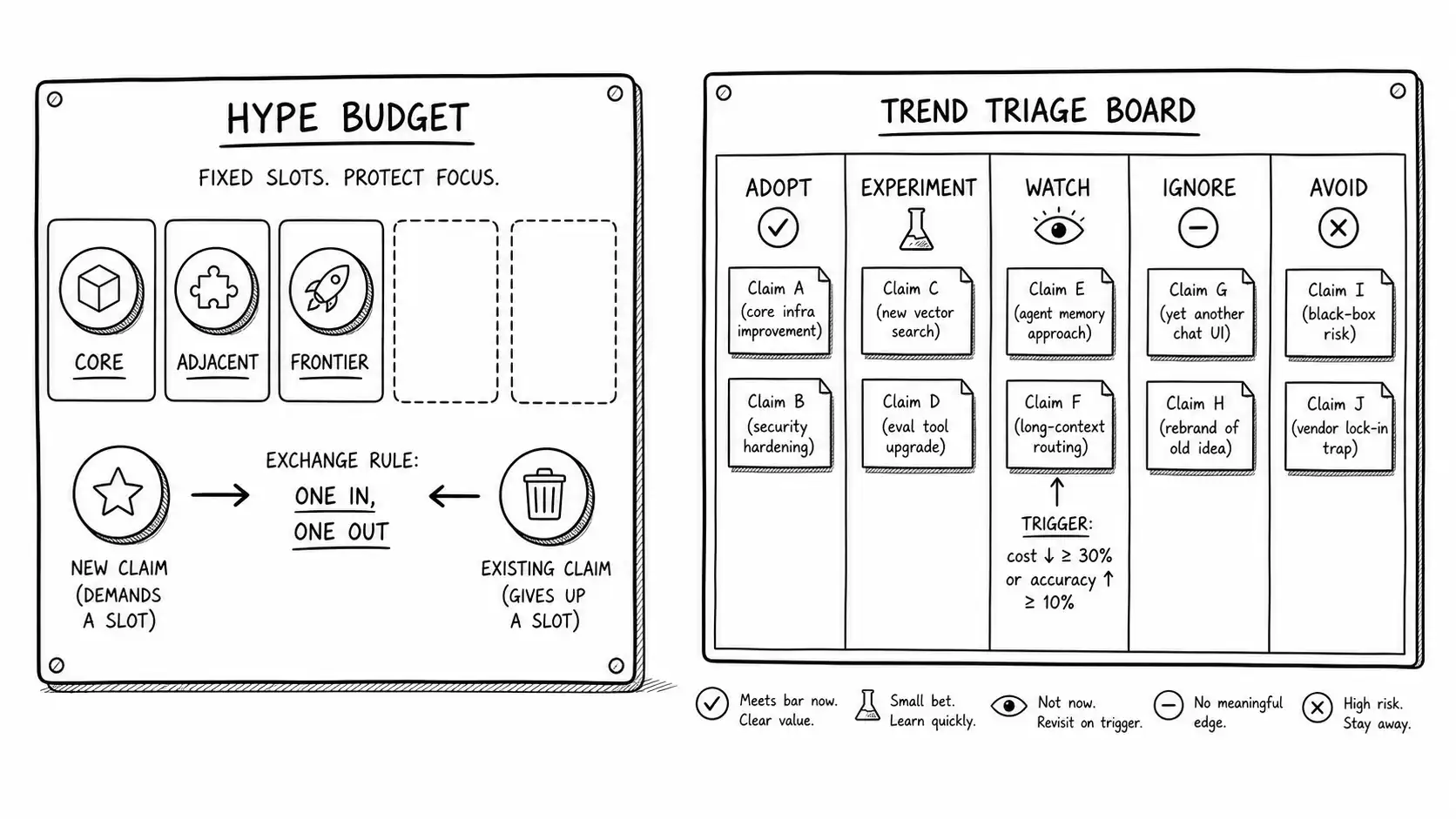
The structure of a hype budget
A hype budget has three components: the slots, the allocation, and the exchange rule.
The slots are your finite experiment and evaluation capacity, named and counted. For a given team this might be three active experiment slots and one ongoing evaluation lane for senior review. The exact numbers depend on your size, but the discipline is to pick a small number and write it down. The number being small and explicit is the entire point. If you have three slots, the org can run three serious AI experiments at once and no more. The fourth interesting trend has to wait for a slot, which means it has to be more interesting than something currently in a slot.
The allocation distributes the slots across categories of bets so that you are not accidentally all-in on one horizon. A budget that is all frontier-chasing is fragile; a budget that is all safe incremental work misses the upside. I allocate roughly along the lines below, and revisit it quarterly.
| Allocation bucket | Share of slots | What goes here |
|---|---|---|
| Core improvements | about half | AI applied to your proven, high-value workflows |
| Adjacent experiments | about a third | Plausible new capabilities near your business |
| Frontier watching | the rest | Genuinely speculative bets, deliberately small |
The exchange rule is the part that actually changes behavior: to put something into a slot, you must take something out. There is no "and also." When the agent demo goes viral and someone wants to chase it, the question is not "should we look at this," it is "which of our three current experiments do you want to stop to make room." That single reframing kills most reactive chases on its own, because when chasing the new thing requires explicitly abandoning a thing already in progress, the new thing has to clear a real bar instead of a free one. Urgency that cannot survive the exchange rule was not urgency, it was novelty.
The Trend Triage Board
The hype budget controls what gets a slot. The Trend Triage Board controls what gets considered at all, by sorting every incoming claim into one of five dispositions, so that the default response to a new trend is a category, not a panic. The five are adopt, experiment, watch, ignore, and avoid.
Adopt: the evidence already exists, from our own replay or from credible deployment elsewhere on a task like ours, and the exposure is acceptable. This is rare for genuinely new trends and that is correct, because adopting on day one means adopting on hype.
Experiment: it might matter to us and we lack the evidence, but the evidence is cheaply gettable and we have a slot. This is where most "pursue" claims from the SANE Filter land. An experiment has a named test, a deadline, and a kill condition.
Watch: it might matter later but not now, or we have no slot, or it is too early to test usefully. We log it with a revisit date and a trigger, the specific thing that would move it to experiment, so that watching is active monitoring rather than passive forgetting.
Ignore: it does not touch our business, or its scope does not apply to us, or the underlying need is one we have already solved adequately. Ignoring is a legitimate, common, healthy disposition, and a board where nothing is ever ignored is not a triage board, it is a to-do list of everyone else's priorities.
Avoid: it is actively risky for us, on governance, security, reliability, or reputational grounds, and we have a positive reason to stay away rather than merely no reason to engage. Avoid is stronger than ignore; it is a decision to say no on the record.
The board is a living artifact, reviewed on a cadence, and its value is partly in the disposition and partly in the discipline of writing the trigger. A trend on "watch" with a written trigger ("revisit when end-to-end agent reliability on a public task like ours crosses 90 percent, or when a peer ships it in production") cannot generate diffuse anxiety, because the anxiety has been converted into a condition. You are not ignoring it. You are waiting for a specific thing, and until that thing happens, the trend has no claim on your attention.
TREND TRIAGE BOARD ---- reviewed: quarterly + on major releases

 TREND DISPOSITION SLOT? TRIGGER / REVISIT
 ------------------ ----------- ----- --------------------------
 support automation EXPERIMENT yes replay >= 45% clean resolve
 coding agents WATCH no e2e reliability > 90% on SWE
 multimodal docs ADOPT yes already passed our replay
 on-device tiny models WATCH no our latency need < 200ms
 autonomous trading AVOID no governance: unacceptable risk
 new vector DB hotness IGNORE no current store meets our needs
Defending the budget in the meeting
Frameworks live or die in the meeting where the founder says "we are behind." So here is how the hype budget actually gets used under pressure, because a budget nobody enforces is just a wish.
When the viral claim arrives, you do not debate its merits first. You go to the board and the budget. Is this trend already on the board? Usually yes, on "watch," with a trigger. Has the trigger fired? Usually no. If the trigger has not fired, the answer is "it is on watch, here is the condition we are waiting for, and that condition has not happened, so it does not get a slot today." That is not dismissal; it is the system working. If the trigger has fired, then it is a candidate for a slot, which means the exchange rule applies: what comes out to make room. Either way, the claim has been handled by a process the team can see, and the process, not the loudest person, made the call.
The thing that makes this stick is that the budget is the team's, not yours alone. When the slots and the board are visible and co-owned, the founder who wants to chase the new thing is not arguing with you, they are arguing with the team's own agreed constraint, and they have to do the unglamorous work of naming what gets cut. Most of the time, faced with that work, the urgency evaporates, because it was never strong enough to justify cutting real work. The budget did not suppress a good idea. It revealed that the idea was not yet good enough to act on, which is different and honest.
What a healthy hype budget looks like over a year
Run this for a year and the texture of the org changes in ways you can feel. The number of simultaneous AI experiments stays small and stable rather than swelling with each news cycle. Most viral trends pass through the board to "watch" or "ignore" without disturbing the roadmap, and the few that earn a slot do so by displacing something explicitly, with the team's eyes open. Experiments end, on their kill conditions, as normal events, which means learning accumulates instead of debt. And the team stops flinching at every release, because they have learned that a release is an input to the board, not an emergency.
The contrast with the churning org from the last chapter is total. The churning org had no budget, so every trend got attention by default, nothing was ever explicitly traded off, chases never ended cleanly, and debt compounded. The org with a hype budget pays attention on purpose, trades off explicitly, ends experiments cleanly, and compounds learning. Same trends arriving, opposite outcomes, and the only difference is whether attention was treated as the scarce, allocatable resource it actually is.
Summary
Attention and experiment capacity, not money, are the binding constraint in a hype cycle, and the cycle is built to spend them for you. The Hype Budget makes that spending deliberate: a small, explicit number of experiment slots, allocated across core, adjacent, and frontier buckets, governed by an exchange rule that says a new claim can only enter a slot by displacing something already in one. The Trend Triage Board sorts every incoming claim into adopt, experiment, watch, ignore, or avoid, converting anxiety into written triggers. Together they let an organization stay current without letting the feed run the roadmap, and they turn "we are behind" from a panic into a question the system can answer.
Key Takeaways
- In a hype cycle attention is the binding constraint, not money. Inference costs collapsed; senior judgment, leadership focus, and team learning capacity did not.
- The Hype Budget is a small, explicit count of experiment and evaluation slots, written down so a new claim cannot enter without something else leaving.
- The exchange rule is the behavior-changing core: to chase a new trend, name which current experiment you will stop. Urgency that cannot survive that question was novelty, not urgency.
- Allocate slots across core improvements, adjacent experiments, and frontier watching so the budget is neither all-speculative nor all-safe.
- The Trend Triage Board sorts every claim into adopt, experiment, watch, ignore, or avoid. Ignore and avoid are legitimate, healthy dispositions, not failures to engage.
- A "watch" item needs a written trigger, the specific condition that would promote it. This converts diffuse anxiety into a wait for a defined event.
- Run for a year, the budget keeps simultaneous experiments small and stable, ends them cleanly on kill conditions, and compounds learning instead of debt, the exact inverse of the churning org.