Introduction: New Claims Are Allowed in the Room
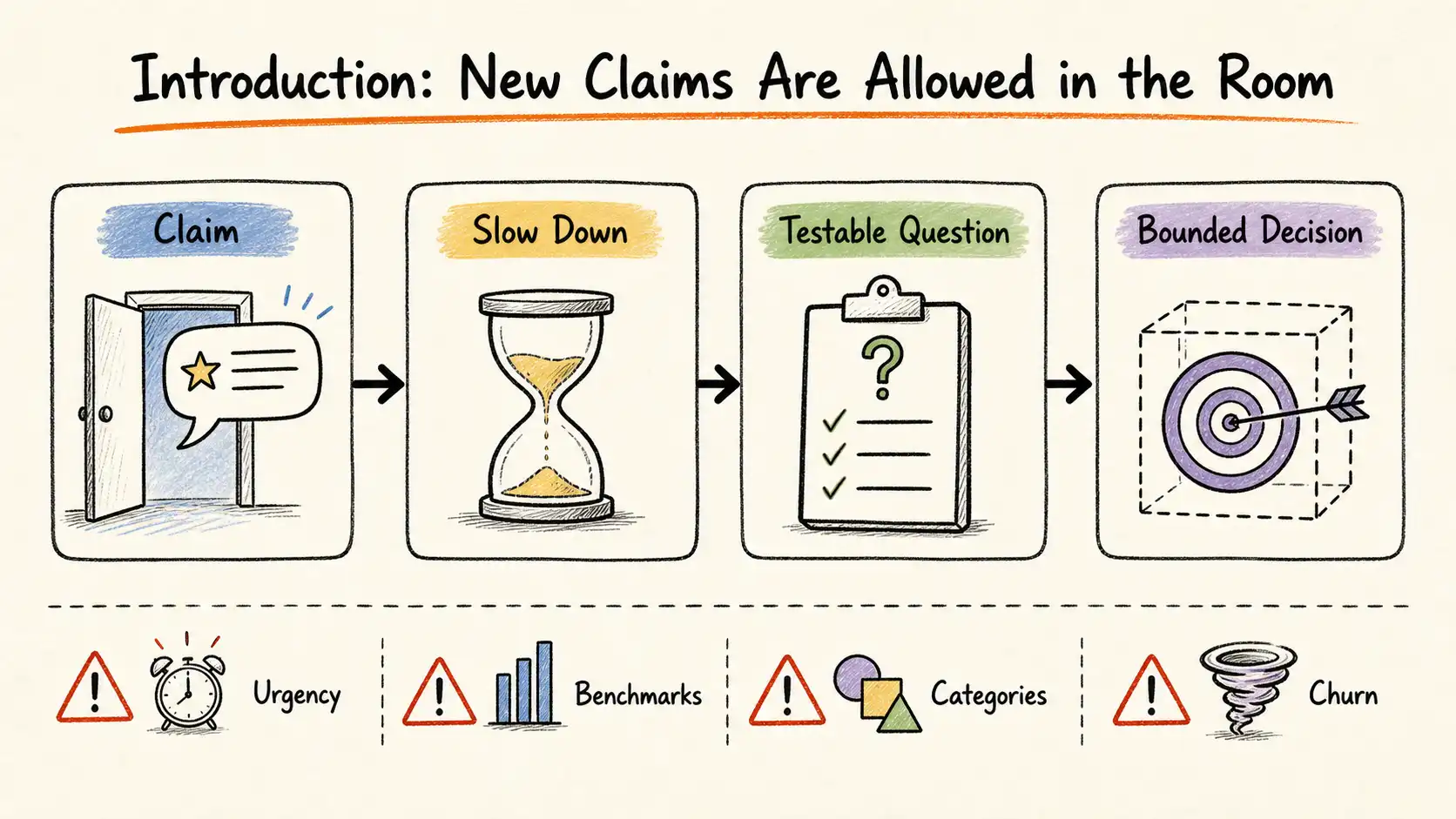
A hype cycle is not a reason to ignore new technology, it is a reason to slow the claim down until it becomes testable.

Research spine: this chapter stays grounded in Stanford HAI, 2025 AI Index Report and DORA, 2024 Accelerate State of DevOps Report, then applies that evidence to the operating judgment in the book. Read this alongside the First Principles AI book, the AI-Native thesis, and the full book library when you want the surrounding argument. The message landed in the leadership channel at 7:52 on a Tuesday morning, before most of the team had finished the first coffee. A frontier lab had shipped a new model the night before. The demo video was already at two million views. In it, an agent booked a flight, reconciled an expense report, and refactored a service, all from one paragraph of plain English. By 8:15 the founder had forwarded it to the executive group with three words: "We are behind."
By 9:00 the head of product had quietly reordered the roadmap in his head. By 10:00 the head of engineering was fielding questions about whether the team should pause the current quarter and "rebuild around agents." By noon a board member had asked, on a separate thread, what our "agent strategy" was, as though we had been caught without one. Nobody in any of these conversations had translated the demo into a single decision a person could actually make. There was urgency everywhere and judgment nowhere.
I have sat in that meeting more times than I can count, on both sides of the table. As an operator I have watched a viral clip rearrange a quarter of work. As someone who has sold software, I have also produced the clip, knowing exactly which failure modes the camera was carefully kept away from. The clip is real. The capability is sometimes real. And the meeting is almost always a mistake, because the meeting is being run by a claim that has not earned the right to run anything.
This book is about that exact moment, the gap between a new AI claim arriving and a decision getting made, and about the discipline that belongs in the gap.
Key Takeaways
- A hype cycle is not a reason to ignore new technology, it is a reason to slow the claim down until it becomes testable.
- The practical test is whether a team can name the evidence, owner, and failure mode before it changes behavior.
- Read this with First Principles for a Hype Cycle and the adjacent chapters when you need the wider AI Strategy and Hype Evaluation frame.
The thesis
Here is the whole argument in one sentence, and the rest of the book is the apparatus that makes it usable.
A hype cycle is not a reason to ignore new technology. It is a reason to slow the claim down until it becomes testable.
Most reactions to hype fall into two failure modes, and they are mirror images of each other. The cynic ignores the claim because the last ten claims were oversold, and so misses the one in ten that was not. The believer reorganizes the company around the claim because this time it feels different, and so pays the full cost of being early on something that was not ready. Both are reacting to the same input: the volume of the claim. Neither is reacting to its evidence.
The discipline this book teaches is to react to evidence, not volume, and to do it on a clock you control rather than the clock the feed sets for you. The recurring motif you will see in every chapter is this: new claims are allowed into the room. They are not allowed to run the meeting.
The enemy
The enemy of this book is not enthusiasm. Enthusiasm is fuel. The enemy is strategy by social feed: urgency theater, benchmark worship, vendor-defined categories, and roadmap churn triggered by every new AI claim.
Each of those four has a tell.
Urgency theater is the performance of speed in place of the substance of progress. It looks like a reordered roadmap, an all-hands about "moving faster," a Slack channel renamed to add the word agent. It feels productive and produces almost nothing, because the underlying question, what changed about what we should do, was never answered.
Benchmark worship is treating a number from a leaderboard as if it were a number from your own business. A model that scores higher on a coding benchmark has told you something about that benchmark. It has told you almost nothing about whether it will close more support tickets in your environment, against your data, under your latency and cost constraints.
Vendor-defined categories are the practice of letting the people selling the technology also name the problem. When a vendor invents a category, the category is shaped to fit the product, not your situation. You then find yourself buying a solution to a problem you would not have phrased that way if left alone.
Roadmap churn is the accumulated cost of all three. Every trend that turns into a pivot leaves debt: half-integrated tools, abandoned pilots, a team that has learned that this quarter's strategy expires in ninety days. Churn is the most expensive of the four because it is the only one that compounds.
The promise
What you get from this book is not a way to predict which trends will win. Nobody can do that reliably, and anyone selling that certainty is running the same play as the demo video. What you get is a disciplined way to evaluate AI trends without becoming either cynical or gullible. You will be able to take a viral claim, decompose it into its parts, decide which parts are testable, run cheap tests on the parts that matter, and make a decision proportional to the evidence and reversible where the evidence is thin.
You will leave with a small set of tools you can use the next morning. The SANE Filter, for the first thirty minutes after a claim arrives. The Claim Decomposition Sheet, for pulling a single grand promise apart into capability, cost, latency, integration, reliability, governance, adoption, and switching cost. The Hype Budget, for treating your team's attention and experiment capacity as the scarce, allocatable resource it actually is. The Reversibility Ladder, for matching the size of your commitment to the size of your evidence. And the Trend Triage Board, for sorting every incoming claim into adopt, experiment, watch, ignore, or avoid, so that the default is not panic.
What this book is not
Because the topic attracts a certain genre of writing, let me be precise about what you are not holding.
This is not an anti-hype rant. Cynicism is just credulity pointed in the opposite direction, and it is equally lazy. Some hyped things are real and arrive faster than the skeptics expect. A book that taught you to dismiss everything would get you killed in a market where occasionally the wild claim is true.
This is not a futurist prediction book. I am not going to tell you what AI will look like in 2035. I do not know, and the honest forecasters do not either. What I can give you is a way to be wrong less expensively in the meantime.
This is not a trend report. Trend reports go stale the week they ship, because they are inventories of claims rather than methods for handling claims. The specific models named in this book will be obsolete soon. The discipline for evaluating the next ones will not.
This is not a vendor comparison. I will not rank tools. By the time any ranking reached you it would be wrong, and rankings train you to ask "which one" before you have asked "whether" and "for what."
And it is not a generic innovation book. The mechanics of an AI hype cycle, where a demo can be genuinely impressive and genuinely non-reproducible at the same time, where benchmarks saturate within months, where the marginal cost of inference falls by orders of magnitude inside two years, are specific enough to need their own treatment.
How to read this book
The book is short on purpose. It is a Points of View volume, the seventh in a line, and its job is to change how you think and then get out of your way. Read it front to back the first time, because the frameworks build on each other. After that, treat it as a reference. The early chapters build the lens: why hype contains both fraud and signal, and how to slow a claim down. The middle chapters apply the lens to the two places hype does its best lying, demos and benchmarks, and then to the most underpriced cost in the whole system, strategy churn. The later chapters give you the allocation tools, the hype budget and the reversibility ladder, and then turn the lens on the events that trigger all of this, frontier releases and the question every leader actually asks, which is when to move and when to wait. The conclusion hands you a checklist and an operating cadence you can run every quarter.
Throughout, I have tried to obey my own rule about evidence. The claims in this book are sourced to primary research where research exists, to history where the pattern is old, and labeled as opinion where it is mine. You should hold this book to the same standard it asks you to hold a demo video: decompose it, test the parts that matter, and keep the parts that survive.
One last thing about the morning that opened this introduction. The right move was not the founder's three words and it was not the cynic's eye-roll. The right move took about forty minutes. We wrote the claim down in plain language. We asked what would have to be true for it to matter to us specifically. We identified the one assumption that, if false, made the whole thing irrelevant, and we designed a cheap test for that one assumption. We put the test on a two-week clock and went back to the work we had already committed to. The agent demo was real. In our environment, against our data, it was also two years from production. Knowing that cost us forty minutes. Not knowing it would have cost us the quarter.
That trade, forty minutes against a quarter, is the entire value proposition of this book. Let us make it repeatable.