Conclusion: The Burned Become Your Best Customers
Honest AI selling is not timid selling. It is stronger, because it selects the right buyers and moves evidence faster than hype moves promises.

The VP from the nine-minute meeting that opened this book is now the customer I would put in front of any skeptical prospect, and she would scare them appropriately, which is exactly why she is so valuable.
The arc from that collapsed first meeting to her advocacy is the whole argument of this book compressed into one relationship. She did not become a customer because I made a bigger promise than the vendor who burned her. She became a customer because I gave her a safer path to evidence, and then I walked it with her, rung by rung, without ever asking her to believe anything she had not measured herself. The diagnostic named what had killed her last pilot. The scoped pilot had kill criteria she could have triggered at any point. The ROI model showed her the pessimistic case before she asked. The reference call was an interrogation I stayed quiet through. And at one point, when she wanted to expand the pilot's scope in a way that would have blurred the evidence, I told her not to. None of that was timid. All of it was deliberate. And it is why she renewed, expanded, and now sells the deployment to her peers more effectively than I ever could.
This is the thing the hype seller never learns: the burned buyer, sold honestly, becomes the strongest customer you will ever have. Not despite the scar. Because of it.
Why the burned make the best customers
A buyer who was burned and then deployed successfully has something a fresh buyer never can: calibrated trust, earned through evidence, in a domain where they once got hurt. That trust is durable precisely because it is not naive. They know where the system is strong and where it needs a human, because you mapped it for them and the pilot confirmed it. They know the cost is real because they watched the sensitivity model hold up. They know you will show up when things go wrong because they saw how you behaved when the pilot hit a rough patch. Their confidence is not a balloon you inflated; it is a structure you built together, and structures do not pop.
This makes them low-churn. The MIT NANDA research located the failure of most AI efforts in the organizational gap, the inability to weave models into workflows and ownership (MIT, "The GenAI Divide," 2025). A burned buyer who deployed with you has, by the time they are live, closed that gap deliberately, because their scar forced them to insist on the named owner, the bounded scope, the real cost model. The very rigor that made them hard to sell to makes them hard to lose, because they did the organizational work that the failed majority skipped.
It makes them expansive. A burned buyer who watched one honest pilot produce real evidence is far more willing to run the next one, because they now trust the motion, not just the product. The land-and-expand pattern works better with a buyer whose first land was honest and small than with one whose first land was an oversold all-at-once deployment, because the honest first land created trust that funds the expansion.
And it makes them your best references, in exactly the way the references chapter described. The burned buyer who deployed successfully can sit across from the next skeptic and say "I did not believe it either, and here is what was hard, and here is how it actually went," with a credibility no happy-path customer can match. Your hardest-won customer is your most persuasive proof. The scar that made them difficult is the scar that makes their endorsement land.
What honest selling actually optimizes for
Step back from the techniques and the frameworks and the artifacts, and the book reduces to a single shift in what you are optimizing for. The hype seller optimizes for belief at the moment of signature. The honest seller optimizes for calibrated trust across the lifetime of the relationship. Those two objectives diverge sharply with burned buyers, and the divergence is the whole game.
Optimizing for belief at signature produces inflated demos, vague transformation claims, hidden cost, guaranteed accuracy, and coached references, because all of those maximize the feeling of confidence in the room. It also produces churn, bad references, and a vertical that closes its doors to you, because none of those survive contact with production. The hype seller wins the quarter and loses the market.
Optimizing for calibrated trust produces the diagnostic, the Proof Ladder climbed one rung at a time, the Scar Map, the Honest Pilot Contract with its kill criteria, the pessimistic ROI column, the candid reference, and the willingness to walk away. All of those reduce the feeling of confidence slightly in the room and increase the probability of a deployment that actually works and a relationship that actually lasts. The honest seller loses some quarters and wins the market.
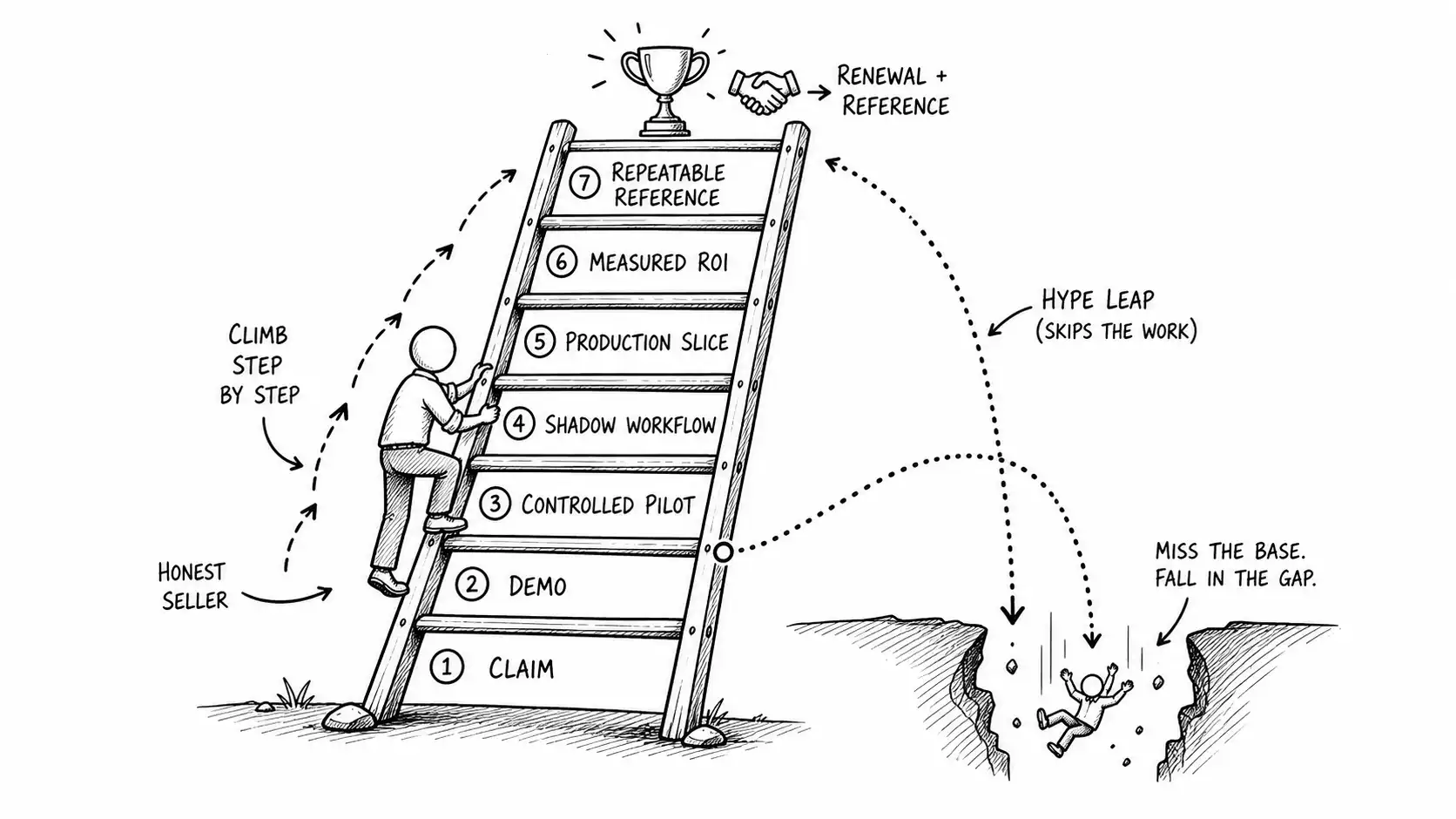
The frameworks in this book are all instruments of the second objective. The BURNED Diagnostic exists so you address the real failure mode instead of the one you wish were the problem. The Proof Ladder exists so you sell the climb instead of the leap. The Scar Map exists so you heal the whole committee instead of the one seat that already agreed with you. The Honest Pilot Contract exists so the pilot can produce evidence instead of ambiguity, and so its kill criteria can prove you are not desperate. Use them in service of belief-at-signature and they become hollow. Use them in service of calibrated trust and they become the most effective sales motion available in a burned market.
The honesty checklist
If you take one artifact from this book into every deal, make it this. Before any meaningful commitment in a burned-buyer deal, run the AI Sales Honesty Checklist:
- Have I run the BURNED Diagnostic and named the dominant failure mode of their last attempt?
- Am I selling the next rung of the Proof Ladder, or am I asking for a leap?
- Have I mapped the committee's scars, or am I relying on a single happy champion?
- Does my demo represent the production conditions honestly, or does it run on the happy path?
- Have I shown the buyer where my system is weak and what the fallback is?
- Is my ROI model conservative, fully loaded, and tied to a pilot metric, including a pessimistic case?
- Does the pilot have written kill criteria I would actually enforce?
- Is there a named owner on the buyer's side?
- Are my references candid interrogations, or staged testimonials?
- Am I willing to walk away from this deal, and would the buyer sense that I am?
If you cannot answer those cleanly, you are not yet selling honestly to this buyer, and a survivor will detect the gap before you do. If you can answer them cleanly, you are doing the one thing the vendor who burned them never did, and that difference is your entire competitive advantage.
Honest selling is stronger selling
I want to end where the book has been pointing the whole time, because the central misconception about everything in these pages is that it describes a softer, gentler, slower way to sell, the AI sales motion for people who are uncomfortable with sales. That is exactly wrong.
Honest selling is stronger selling, and it is stronger for hard, structural reasons. It is stronger because it selects the right buyers, spending the long relationship-intensive motion on workable-scar buyers where it actually closes instead of bleeding it into fresh-scar grief processing. It is stronger because it narrows scope to what can be proven, which means the pilots produce evidence instead of ambiguity and the deployments succeed instead of churning. It is stronger because it protects trust as the finite, expensive resource it is, never spending it on a withdrawal that a burned buyer will charge you double for. And it is stronger because it moves evidence faster than hype moves promises: a buyer climbing a Proof Ladder is accumulating real reasons to commit, while a buyer being promised at is accumulating reasons to suspect.
The hype seller and the honest seller are not running the same race at different speeds. They are running different races. The hype seller's race ends at signature, and in a market of survivors that finish line is increasingly a cliff, because the signature is followed by the failed deployment, the bad reference, and the closed vertical. The honest seller's race ends at the renewal, the expansion, and the reference, which are the only finish lines that compound. In a market where most pilots fail and most buyers are survivors, the honest seller is not the idealist who sells less. The honest seller is the realist who sells what lasts.
A burned buyer does not need a bigger promise. They need a safer path to evidence. Build that path, walk it with them honestly, and be willing to stop when the evidence says stop, and you will find that the buyers who were hardest to win become the customers hardest to lose. That is not a consolation for selling honestly. It is the reason to.
Key Takeaways
- The burned buyer, sold honestly, becomes your strongest customer: low-churn because their scar forced the organizational rigor most failed efforts skipped, expansive because they trust the motion, and your best reference because their credibility is earned.
- Honest selling optimizes for calibrated trust across the relationship's lifetime, while hype selling optimizes for belief at signature; with survivors, those objectives diverge and only the first compounds.
- The frameworks (BURNED, Proof Ladder, Scar Map, Honest Pilot Contract) are instruments of calibrated trust; used for belief-at-signature they go hollow.
- Run the AI Sales Honesty Checklist before any commitment; if you cannot answer it cleanly, a survivor will find the gap first.
- Honest selling is stronger, not softer: it selects the right buyers, narrows scope to what can be proven, protects trust as a finite resource, and moves evidence faster than hype moves promises.