References Without Theater
A burned buyer does not want a happy customer on a call. They want to interrogate a survivor who almost did not make it.

Research spine: this chapter stays grounded in MIT, "The GenAI Divide," 2025 and Dietvorst, Simmons, and Massey, 2015, then applies that evidence to the operating judgment in the book. Read this alongside the Pov Vol 1 book, the AI-Native thesis, and the full book library when you want the surrounding argument. The reference call had been going for twenty minutes and the prospect had not asked a single question. The reference customer, a friendly VP I had carefully selected, recited the benefits. The prospect nodded politely. When I followed up the next day, the deal had cooled. The prospect's exact words: "It was a nice call, but it felt like a commercial."
That is the failure mode of references in this market. A burned buyer has sat through the friendly reference call before, the one where a hand-picked happy customer says hand-picked happy things, and they have learned that it proves nothing. It is theater, and survivors of the hype wave are exceptionally good at spotting theater because theater is what sold them last time. The reference call as performance does not move a burned buyer one inch. What moves them is the opposite: a chance to interrogate someone who almost did not make it, who hit the same fears they have, and who can describe in concrete terms how the deployment actually went, including the parts that were hard.
This chapter is about social proof that survives interrogation. The principle is simple and uncomfortable: the most persuasive reference for a burned buyer is not your happiest customer. It is your most skeptical customer who deployed anyway.
Why happy references fail and skeptical ones work
A happy reference fails because it lacks the texture of reality, and burned buyers navigate by texture. The smooth story, no problems, instant adoption, immediate ROI, does not match anything the buyer has ever experienced, including their successful projects, which also had rough patches. So the smooth story reads as either curated or naive, and both readings undermine it. The buyer learns nothing they can use and trusts nothing they hear.
A skeptical reference works because it carries the texture. A customer who says "honestly, I almost killed this in month two when the accuracy on our complex cases was worse than I expected, and here is what we did about it" is giving the prospect something invaluable: a realistic picture of the path, including the dip, including the recovery. The prospect can map their own fears onto this story and see how they were handled. This is the reference that survives interrogation, because there is nothing to puncture; the difficulties are already on the table.
This is consistent with how committee buyers actually do diligence. They are looking for evidence that maps to their specific scars, not for a general endorsement. A reference who experienced the U scar, lost their sponsor mid-project, and describes how they re-established ownership, is worth more to a buyer carrying the U scar than ten references who say "it just worked." Match the reference's scar to the prospect's scar and the call does real work.
Selecting the reference that survives interrogation
This changes how you choose references. The instinct is to pick your happiest, most articulate, most successful customer. For a burned buyer, choose differently.
Choose a customer whose starting skepticism matched the prospect's. A reference who was burned before they bought from you and can say "I did not believe it either, here is what changed my mind" speaks the prospect's language natively.
Choose a customer who hit a real difficulty and worked through it. The recovery story is more persuasive than the no-problem story, because it demonstrates that when things go wrong, which they will, the vendor and the customer can fix them. The prospect is not afraid of a perfect deployment; they have never seen one. They are afraid of a deployment that goes wrong and a vendor who disappears. The recovery story directly addresses that fear.
Choose a customer in a comparable scar position. If the prospect's dominant BURNED failure mode is N, numbers that did not survive, choose a reference whose finance team was equally skeptical and whose ROI held up under their scrutiny. The reference's relevance is a function of scar match, not logo prestige.
And do not over-prepare the reference. The temptation to coach a reference into a clean message destroys the thing that makes them credible. A reference who has clearly been briefed sounds like the friendly-call theater the buyer distrusts. The best preparation is to tell the reference, honestly, "this prospect is skeptical and was burned before, so please be candid, including about what was hard, because that is what will help them." A candid reference is a credible reference.
Structure the reference call as an interrogation, not a testimonial
The format matters as much as the selection. A testimonial format, where the reference talks and the prospect listens, produces the commercial that cools deals. An interrogation format, where the prospect drives and the reference answers, produces trust.
So set it up that way explicitly. Tell the prospect before the call: "Ask them anything. I would rather you hear the hard parts now. I will be on the call but I am going to stay quiet." Then actually stay quiet. The seller who jumps in to soften a reference's candid answer destroys the call's credibility in one sentence, because the intervention signals there is something to soften. Let the reference be candid. The candor is the point.
Give the prospect a question set to make the interrogation productive. These are the questions that surface texture:
- "What did you think this would do that it did not?"
- "What was the hardest part of the deployment, and how long did it actually take?"
- "Tell me about a time it was wrong or failed. What happened?"
- "What did it cost you, fully loaded, versus what you expected?"
- "Who owns it now, and what happens when that person is out?"
- "If you were starting over, what would you do differently?"
- "Would you buy it again, and what would have to be true for you to say no?"
A reference who answers those questions candidly does more for the deal than any deck. And a reference who cannot answer them, who only has smooth things to say, was the wrong reference, which you will have learned before it cost you the deal.
When you do not have the right reference yet
Early-stage vendors and new entrants face a real problem: they may not have a reference with the right scar match, or any reference at all in the prospect's vertical. The honest moves here matter, because the dishonest move, manufacturing or exaggerating a reference, is precisely the kind of theater that burns buyers and, when discovered, ends the relationship.
If you do not have a relevant reference, say so. "We do not yet have a customer in your exact situation I can put you in front of honestly. Here is what I can offer instead." Then offer substitutes that carry real evidence:
A scoped pilot with kill criteria becomes the reference you do not have. If you cannot show another customer's outcome, you can offer the prospect their own evidence on their own data, which is more persuasive than any external reference anyway. "Instead of a reference call that proves nothing about your environment, let's run the pilot that produces evidence in your environment." For a burned buyer, this is often the better trade.
A reference for a different but analogous use case, presented honestly as analogous. "This customer used us for a different workflow, so it is not a perfect match, but the integration and adoption challenges were similar, and I think their experience on those dimensions is relevant to you." Naming the imperfection of the match is what makes it credible.
A technical or security reference rather than a business outcome reference. Sometimes the most useful reference for a scarred security architect is another security architect who attacked your pre-read and can speak to that, even if the business outcome reference is not ready. Match the reference to the seat on the Scar Map that needs it.
The dishonest alternative, finding a logo to wave or a quote to cite that does not survive a real conversation, is short-term thinking. A burned buyer who discovers a reference was theater files you permanently under the last vendor. Honesty about what you can and cannot prove is, again, the faster path with this audience.
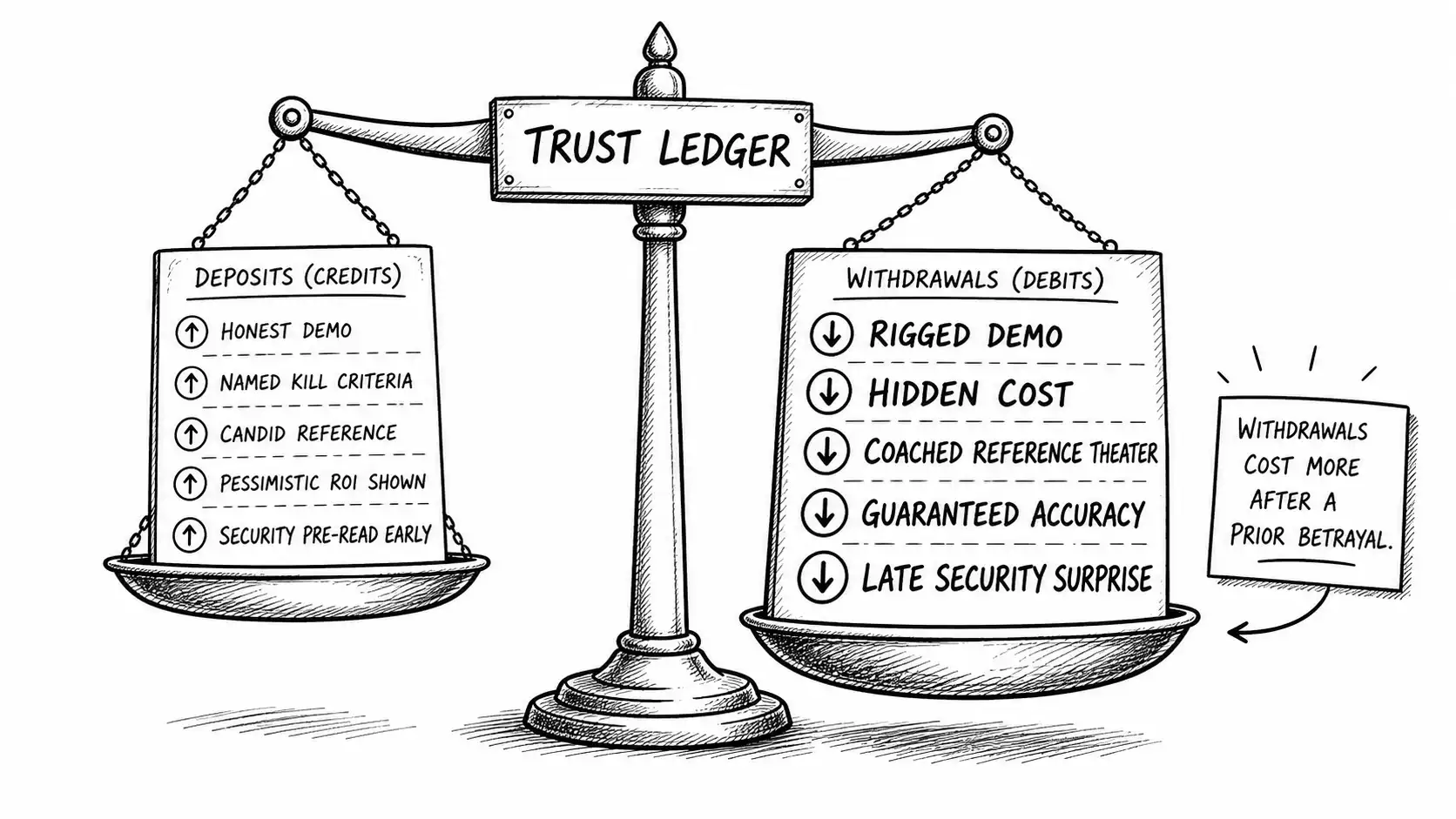
The trust ledger
It helps to think of trust as a ledger with deposits and withdrawals across the sales process, because references are a high-stakes entry in it. Every honest, texture-rich interaction is a deposit. Every moment of theater, evasion, or inflated claim is a withdrawal, and withdrawals with burned buyers are large because they pattern-match to the prior betrayal.
The ledger reframes the reference call as a moment of either large deposit or large withdrawal. A candid reference who survives interrogation is one of the largest deposits available to you, because the prospect knows it was not staged. A theatrical reference is a withdrawal, because the prospect detects the staging and debits you for the attempt. There is no neutral reference call with a burned buyer. You either deposit by being candid or withdraw by performing.
The reference is also a forecast of your post-sale behavior
Here is the deeper reason references matter so much to survivors. The prospect is not only evaluating whether your product works. They are evaluating how you behave when things go wrong, because their scar was caused as much by the vendor's behavior after the sale as by the product. Did the vendor stick around when the accuracy dipped? Did they help re-establish ownership when the sponsor left? Or did they collect the signature and vanish?
A candid reference answers this implicitly. When a reference says "we hit a hard month and they were in the trenches with us," they are forecasting your post-sale behavior more credibly than any service-level promise you could make yourself. This is why the recovery story is so powerful: it is evidence not of a perfect product but of a vendor who shows up. For a burned buyer, the vendor who shows up is the entire purchase.
In the next chapter we take the hardest discipline in honest selling, the discipline that proves all the rest is real: knowing when to walk away from a deal you could probably close.
Practical Exercise
List your last five reference calls and mark each as a deposit or a withdrawal on the trust ledger. For the withdrawals, identify whether the problem was the wrong reference selection or over-coaching. Then, for your current top burned-buyer deal, identify the reference whose starting skepticism and scar most closely match the prospect's, and set up the call as an interrogation with the question set above, with a commitment to stay quiet.
Key Takeaways
- The friendly reference call is theater, and burned buyers detect theater instantly because theater sold them last time.
- The most persuasive reference is your most skeptical customer who deployed anyway and can describe the difficulty and the recovery with real texture.
- Select references by scar match, not logo prestige, and structure the call as a prospect-driven interrogation, then stay quiet.
- When you lack the right reference, say so and substitute real evidence: a pilot on the prospect's own data, an honestly framed analogous reference, or a security peer.
- Treat trust as a ledger; a candid reference is a large deposit and a coached one is a large withdrawal, because the prospect is really forecasting how you will behave after the sale.