Talking About Probability Without Killing Momentum
You can tell a buyer the system will sometimes be wrong and have them trust you more, not less, if you frame the error instead of hiding it.

The most honest sentence in an AI sales cycle is also the one most sellers are terrified to say out loud: "This system will sometimes be wrong."
I used to be terrified of it too. The fear is reasonable on its face. You have spent weeks building belief, the demo went well, the champion is excited, and now you are going to introduce doubt? The instinct is to bury the uncertainty, to use words like "highly accurate" and "production-grade" that imply a determinism the system does not have, and to hope the buyer never pushes. But with a burned buyer this instinct is fatal, because they have already met a system that was sometimes wrong, nobody warned them, and the surprise is exactly what burned them. The seller who hides the probabilistic nature of the system is repeating the precise pattern that created the scar. The seller who frames it correctly does the opposite: they become the first vendor to tell the truth, and the truth, framed well, builds momentum rather than killing it.
This chapter is about how to communicate probabilistic behavior, error, and uncertainty in a way that calibrates trust instead of destroying it. It is the most counterintuitive skill in the book, and it is the one that separates sellers who survive in this market from those who churn through it.
Why hiding the probability backfires specifically with burned buyers
A deterministic system either works or has a bug. A probabilistic system has a distribution of outcomes, and the tail of that distribution contains errors that are not bugs; they are the expected behavior of the system. This is genuinely different from traditional software, and buyers who learned software in the deterministic era find it disorienting.
When a seller papers over this with confident language, two things happen, both bad. The buyer who believes the implied determinism deploys with overtrust, hits the error tail in production, and experiences it as a betrayal, the E scar from the BURNED Diagnostic, evidence that was performative. The buyer who is sophisticated enough to know the system is probabilistic hears the confident language, recognizes it as evasion, and concludes the seller is either ignorant or dishonest. Either way you lose, and the more burned and sophisticated the buyer, the faster you lose.
The research on trust in automation is direct about the alternative. The goal is calibrated trust, where the operator's reliance matches the system's actual reliability, and calibration depends on the operator understanding when the system is and is not reliable (Lee and See, 2004, "Trust in Automation," Human Factors). You cannot calibrate trust by hiding the error. You calibrate it by mapping the error: showing the buyer where the system is strong, where it is weak, and what the fallback is for the weak cases. The mapping is the reassurance. A bounded, understood error is far less frightening than a vague, hidden one.
Frame the error, do not confess it
There is a world of difference between confessing error and framing it, and burned buyers can feel which one you are doing.
Confessing error sounds defensive and reactive. It happens when the buyer corners you with a hard question and you reluctantly admit a limitation you were hoping to avoid. The admission, dragged out, reads as something you were hiding, which confirms the buyer's suspicion that there is more you are still hiding. Confession loses momentum because it surrenders control of the narrative.
Framing error is proactive and structural. You introduce the system's probabilistic nature on your own terms, early, as a designed-for property rather than a flaw. "This system is right most of the time and it is wrong sometimes, by design, the same way a junior analyst is. So the question is not whether it is ever wrong, it is whether we have the right way to catch the wrong cases and whether the net is better than what you have now. Let me show you exactly where it is strong, where it needs a human, and what the fallback is." That framing keeps you in control of the narrative, treats the buyer as sophisticated, and turns the conversation from "is it perfect" to "is the system, including its human fallback, better than the status quo," which is the only question that actually matters.
The reframe to "is the net better than today" is the key move. The status quo is not error-free either. Human agents make mistakes, miss things, and vary in quality. A burned buyer comparing your system to an imagined perfect process will always find it wanting. A buyer comparing your system, errors and fallback included, to their actual current process, errors included, can evaluate it fairly. Your job is to insist on the fair comparison, which is also the honest one.
The "what we know / what we do not know yet" slide
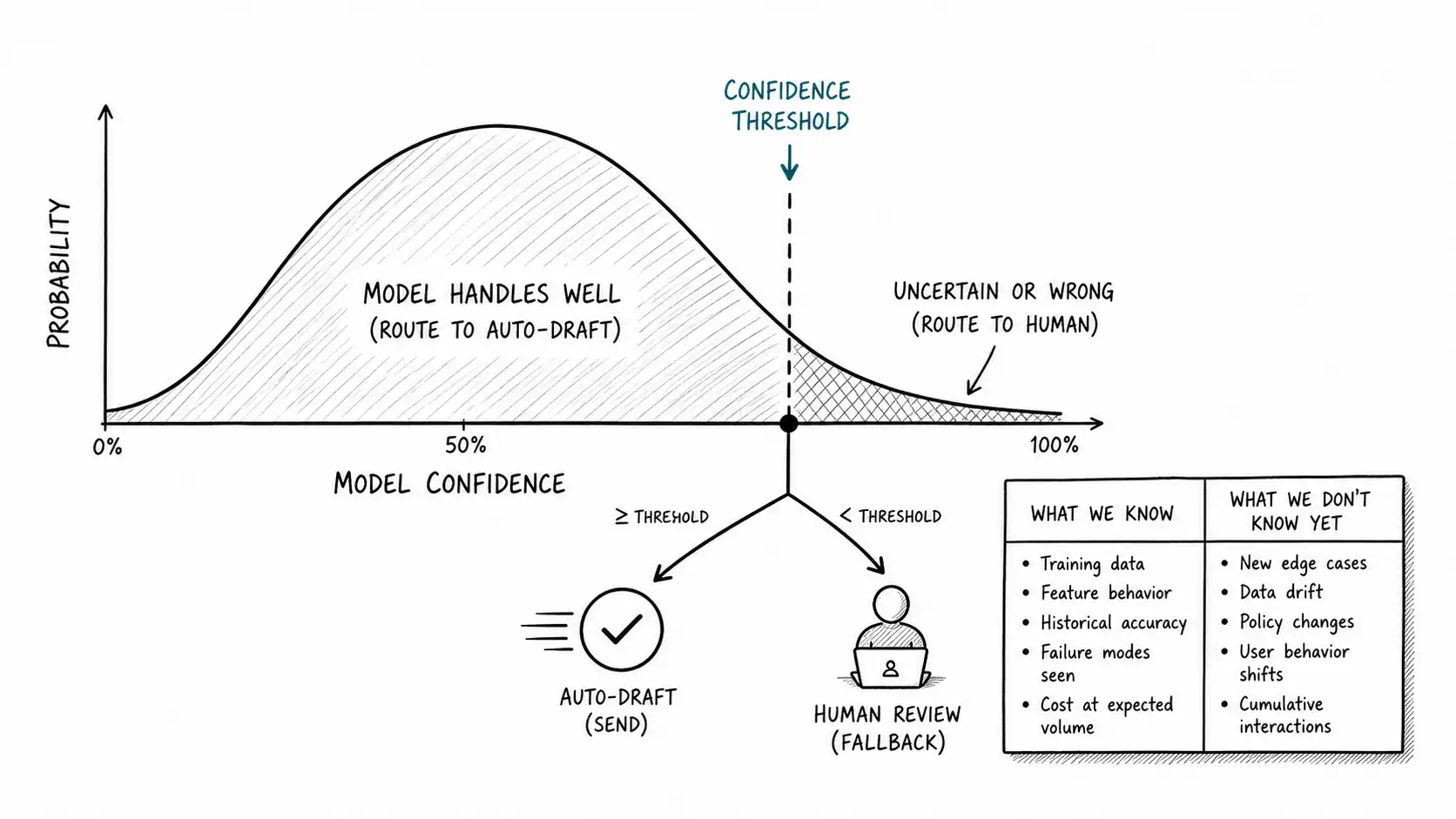
The single most useful communication artifact for this is a two-column slide, introduced earlier and worth specifying fully here. Left column: what we have measured and can stand behind, with numbers. Right column: what we have not yet proven in your environment and propose to test. It looks like this in practice:
| What we know | What we do not know yet |
|---|---|
| On a public benchmark of billing queries, the model drafts a usable response 78% of the time | How it performs on your specific products and policies |
| It handles standard inquiries well; it struggles with multi-issue tickets | Your real distribution of single- vs multi-issue tickets |
| Inference latency is under 2 seconds at typical input sizes | Whether your input sizes and volume change that |
| Review by a human catches the large majority of errors in our other deployments | Your team's actual review time and error-catch rate |
Presenting this slide does something remarkable to a burned buyer. It is the first time a vendor has voluntarily told them the boundary of the vendor's own knowledge. The right column, far from undermining the sale, is the most credible thing on the slide, because it proves the left column is not also inflated. And the right column is not a weakness, it is the pilot plan: every item in it is something the Honest Pilot Contract will measure. You have turned your admission of uncertainty into the structure of the next step.
Confidence, thresholds, and the fallback
The technical concept that makes probabilistic systems sellable is the confidence threshold with a fallback. Most useful AI systems can produce not just an answer but a signal of how sure they are, and you can route the low-confidence cases to a human. This converts an unbounded "it might be wrong anywhere" into a bounded "it acts autonomously where it is confident and asks for help where it is not."
This is worth explaining to buyers explicitly, because it directly addresses the operator and user scars. The operator who feared babysitting a model relaxes when they understand the model surfaces its own uncertain cases rather than failing silently. The user who feared a tool that overrode them relaxes when they understand they review and can override, which connects to the behavioral finding that aversion drops sharply when people can adjust the system's output (Dietvorst, Simmons, and Massey, 2018). The fallback is not a limitation you are apologizing for. It is the feature that makes the system trustworthy, because it ensures the error tail lands on a human rather than on a customer.
A subtlety worth getting right: the threshold is a business decision, not a fixed technical setting. A higher threshold means the model acts autonomously less often but is right more often when it does; a lower threshold means more automation but more errors slipping through. Presenting this as a dial the buyer controls, with the tradeoff explicit, gives them exactly the sense of control whose absence is the true objection. "You decide how aggressive the automation is, and here is the tradeoff at each setting" is a powerful sentence, because it hands the buyer the steering wheel on the dimension they were most afraid of.
Hard questions and how to answer them
Burned buyers ask sharp questions about probability. Here are the hard ones and the honest answers, in the form they should actually take.
"How often is it wrong?" The wrong answer is a single confident number. The right answer names the conditions: "On cases like X it is right around N percent of the time; on cases like Y it is materially worse, which is why those route to a human. The pilot will measure the real rate on your data." You are refusing to give a context-free number because context-free numbers are exactly what burned them.
"What happens when it is wrong?" The wrong answer is to minimize. The right answer describes the fallback and the blast radius: "On the cases it is unsure about, it routes to a human before any action is taken. On the cases it is confident about but still wrong, here is how we detect it and here is the worst that can happen, which is bounded because the model does not take irreversible action autonomously."
"Can you guarantee accuracy?" The wrong answer is to inch toward yes. The right answer is a clean no with a substitution: "No, and any vendor who guarantees a fixed accuracy on your unseen data without testing it is telling you something I would not trust. What I can do is measure it on your data in a pilot with kill criteria, so you see the real number before you commit." That answer, refusing the guarantee a dishonest seller would offer, is the most trust-building thing you can say to someone who was burned by exactly such a guarantee.
"How is this different from the thing that failed on us?" Run the BURNED Diagnostic out loud. Name the failure mode that killed their last pilot and show how your motion is built to avoid it. This question is a gift; it is the buyer asking you to demonstrate that you understand their specific scar.
Momentum comes from clarity, not from confidence
The belief this chapter argues against is that momentum is made of confidence, that every expression of uncertainty bleeds energy from the deal. With a burned buyer the opposite holds. Their momentum is throttled by suspicion, and suspicion feeds on vagueness. Every vague confident claim you make adds to the suspicion, because it pattern-matches to the last vendor. Every clear, bounded, honest statement about where the system is strong and weak reduces the suspicion, and reduced suspicion is what actually releases momentum.
So the seller who says "it is highly accurate and production-grade" and moves on is bleeding momentum without knowing it, because the burned buyer has just filed them under "sounds like last time." The seller who says "here is exactly where it is strong, here is where it needs a human, here is the dial you control, and here is how we will measure it on your data" is building momentum, because they have given the buyer the one thing the last vendor never did: a clear-eyed map of the system's actual behavior. Clarity, not confidence, is the fuel here.
In the next chapter we turn to the social proof that burned buyers trust and the social proof they have learned to dismiss: references. The reference call done as theater is worthless to a survivor. We build the reference that survives interrogation.
Practical Exercise
Take the three hardest probability questions your buyers ask. Write your current answer and your honest answer side by side. Then build your "what we know / what we do not know yet" slide for a live deal, with real numbers in the left column and the pilot plan in the right. If your left column has no numbers or your right column is empty, you are still hiding the probability, and a burned buyer will surface what you left off.
Key Takeaways
- Hiding the probabilistic nature of the system repeats the exact pattern that burned the buyer; framing it openly breaks the pattern.
- The goal is calibrated trust, where reliance matches reliability, which you achieve by mapping the error rather than concealing it.
- Frame error proactively as a designed-for property and shift the question from "is it ever wrong" to "is the net, including the human fallback, better than today."
- The confidence threshold with a human fallback converts unbounded uncertainty into bounded behavior and hands the buyer a control dial, which addresses the real objection of lost control.
- With burned buyers, clarity releases momentum and vagueness throttles it; honest, bounded statements build the deal that confident claims would have lost.