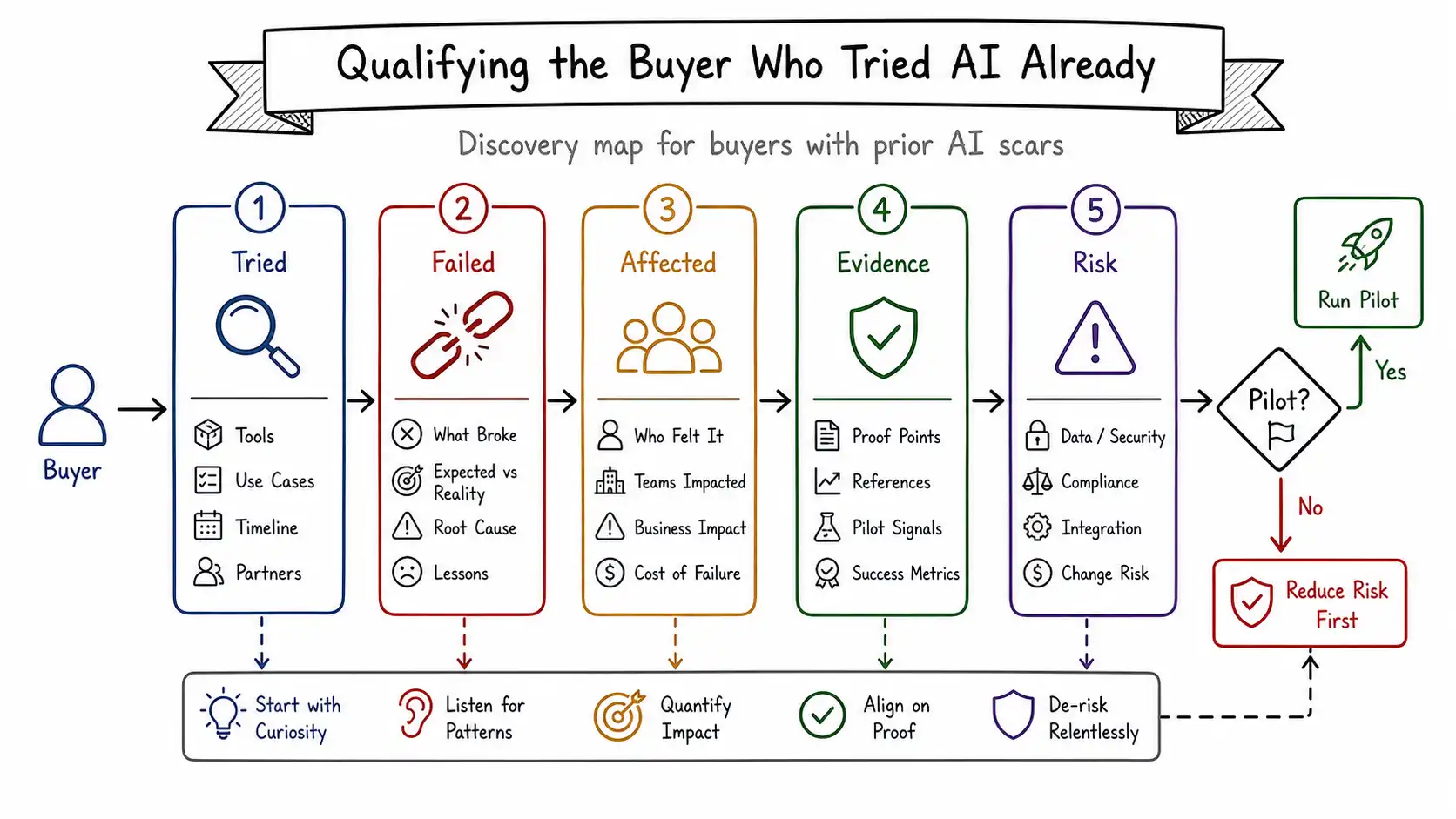
Qualifying the Buyer Who Tried AI Already
Not every burned buyer is ready, and the honest seller's edge is knowing which scars are workable and which are not yet.

There is a kind of deal that feels alive but is actually dead, and learning to tell the difference is worth more than any closing technique.
It feels alive because the buyer is engaged. They take your calls, they tell you their story, they let you run discovery. A seller running on activity metrics looks at this deal and sees momentum. But underneath, the buyer is not evaluating a purchase. They are processing a grief, and you have become a free therapist for an organization that is not going to buy anything from anyone for another two quarters. The conversations are real. The deal is not. And every hour you spend on it is an hour you did not spend on a buyer whose scar is workable now.
Qualification, in a market of survivors, is not about whether the buyer has budget and authority. It is about whether their scar is in a state you can work with. Some scars are fresh wounds that need time. Some are healed enough to engage. Some belong to organizations that have decided, rationally, to wait out the technology, and no amount of evidence will move that decision on your timeline. The honest seller's edge is reading the scar's state correctly and spending their finite time where evidence can actually land.
The qualification question for burned buyers is about readiness, not interest
Traditional qualification frameworks ask about budget, authority, need, and timeline. Those still matter, but for a burned buyer they sit on top of a prior question: is this organization in a state where new evidence can change its mind? An organization can have budget, authority, a real need, and a stated timeline, and still be unqualified, because the scar is too fresh or too structural for evidence to land.
This is not pessimism. It is respect for the buyer's actual state. An organization three months out from a painful failed pilot, with the post-mortem still circulating and the responsible executive recently departed, is not in an evidence-receptive state. Their reflex is protective, and correctly so. Pushing a great pilot offer at them now is like proposing marriage at a funeral. The right move is not to force the deal; it is to recognize the timing, stay in honest contact, and return when the scar has settled into a workable state.
The MIT NANDA finding that most failures are organizational rather than technical has a qualification implication (MIT, "The GenAI Divide," 2025). An organization whose last failure was organizational, no owner, no integration into workflow, ignored decision path, has to have done some organizational repair before a new pilot can succeed, regardless of how good your product is. If they have not learned the lesson, your pilot will hit the same wall. Part of qualification is assessing whether the buyer has metabolized their last failure into a lesson or is still just nursing the wound.
Scar states: fresh, workable, and structural
It helps to sort burned buyers into three states, because each calls for a different action.
A fresh scar is recent and raw. The failed pilot is within the last few months, the responsible people may still be in the building processing it, and the organization's reflex is purely protective. A fresh-scar buyer will engage with you, often warmly, because telling the story is part of the processing. But they are not ready to buy, and treating their engagement as buying intent wastes both your time. The right action is to be useful without selling: help them decompose the failure with the BURNED Diagnostic, share genuinely relevant perspective, and earn the right to be the call they make when the scar settles. You are planting, not harvesting.
A workable scar is a wound that has become a lesson. Enough time has passed, the organization has named what went wrong, and they have turned the failure into a set of requirements, the named owner, the cost ceiling, the early security review. This is the qualified burned buyer, and counterintuitively they are often a better prospect than a buyer who has never tried AI, because they know exactly what evidence they need and they will engage seriously with an honest motion. Their scar has made them rigorous, and rigor is what makes a deal survive. The right action is to engage fully, run the diagnostic, build the proof, and propose the Honest Pilot Contract.
A structural scar belongs to an organization that has made a deliberate, often rational, decision to wait. Maybe their last failure convinced leadership that the technology is not ready for their use case yet. Maybe a regulatory cloud, like the shifting EU AI Act high-risk timeline now provisionally deferred toward December 2027 under the Digital Omnibus, makes them prefer to wait for clarity (Gibson Dunn on the EU AI Act Omnibus agreement). A structural-scar organization is not going to be moved by a better pilot on your timeline, because their decision is not about your pilot; it is a strategic posture. The right action is honesty with yourself: this is not a deal this year. Maintain a light, honest relationship and reallocate your selling energy.
The mistake sellers make is treating all three states as the same engaged prospect. The fresh-scar buyer's warmth gets misread as buying intent. The structural-scar buyer's politeness gets misread as a long sales cycle. Only the workable-scar buyer is actually a deal, and the skill is telling them apart early.
The AI deal qualification scorecard
To make this operational, here is a scorecard. Score each item, and let the total tell you the scar state and the action. This is a tool to use after your first one or two discovery conversations.
| Dimension | Strong signal (2) | Mixed (1) | Weak signal (0) |
|---|---|---|---|
| Time since last failure | Settled, lessons drawn | Recent, still raw | Within weeks, people still leaving |
| Failure metabolized into requirements | They have specific requirements from the last failure | Vague lessons | "It just didn't work," no decomposition |
| Named owner available | A specific person ready to own it | Someone might | No one will own it |
| Decision path mapped | They name the committee and gates | Champion only | Champion thinks they decide alone |
| Workable use case | One bounded, high-value workflow | A list of vague ambitions | "Transform everything" |
| Evidence-receptive | They ask for proof on their data | They want reassurance | They want a guarantee |
| Strategic posture | Actively want to try again | Neutral | Decided to wait |
Score 11-14: workable scar, qualified, engage fully. Score 6-10: partially workable, engage selectively on the dimensions scoring low, do not propose a pilot until the named owner and decision path improve. Score 0-5: fresh or structural, do not force it, stay in honest contact, plant rather than harvest.
Notice that this scorecard is built almost entirely from the frameworks in this book. The dimensions are the BURNED failure modes, the Scar Map seats, and the Proof Ladder readiness, turned into a qualification lens. Qualification is not separate from the diagnostic; it is the diagnostic applied to the question of timing.
The use case has to be workable, not just valuable
One dimension on the scorecard deserves emphasis because it is where good sellers most often misjudge: the use case. A burned buyer will sometimes present a use case that is high-value but not workable for a probabilistic system, and selling into it sets up the next failure. The signal of a workable use case is bounded scope, tolerance for a human fallback, a clear success metric, and a value that survives the error cases. The signal of an unworkable one is "transform our whole operation," zero tolerance for error, no clear metric, or a workflow where the model's mistakes are catastrophic and unrecoverable.
The honest seller qualifies the use case as hard as they qualify the buyer. Steering a buyer away from an unworkable use case toward a workable one is one of the highest-trust moves available, because it demonstrates you are optimizing for their success rather than for any close you can get. "The use case you described is the one I would not start with, because the error cases there are too costly. Here is the adjacent workflow where the same technology has a fallback and a clear win, and I would prove that one first." A burned buyer hearing that recognizes a seller who has seen failures and is steering them clear of one.
Disqualifying out loud
The final discipline is disqualifying out loud, with the buyer, rather than silently downgrading the deal in your CRM. When a buyer is in a fresh or structural state, telling them so is a gift and a deposit on the trust ledger. "Honestly, given how recent the last one was and how it is still settling in your org, I do not think the right move is to start a new pilot right now. I would rather come back when you have a named owner and the dust has settled, and in the meantime I am happy to be a sounding board." That sentence loses you a deal you were not going to win anyway and earns you the deal you will win in two quarters, because you will be the vendor who told them the truth about timing when everyone else was pushing.
This is hard to do with a quota breathing down your neck, and I am not going to pretend otherwise. But the math favors it. Time spent on unqualified burned buyers is the most expensive waste in this market, because those deals consume the long, relationship-intensive selling motion that burned buyers require without producing revenue. Disqualifying early frees that energy for workable-scar buyers, where the same motion actually closes. The discipline of walking away from the unready, which the next chapter takes up fully, starts here, in qualification, with the honesty to name a buyer's state out loud.
Practical Exercise
Score your current burned-buyer pipeline on the qualification scorecard. Be honest about the time-since-failure and strategic-posture rows, which sellers inflate. Identify every deal scoring under 6 and reclassify it from "active" to "plant," and reallocate the time you were spending on it to your highest-scoring workable deal. For one fresh-scar buyer, draft the honest "I do not think now is the right time" message and send it.
Key Takeaways
- For burned buyers, qualification is about readiness, not interest; an engaged buyer processing grief can feel alive while being a dead deal.
- Sort burned buyers into three scar states: fresh (raw, plant don't harvest), workable (a wound metabolized into requirements, engage fully), and structural (a deliberate wait, stay light).
- A workable-scar buyer is often a better prospect than a never-tried buyer, because the scar made them rigorous about exactly the evidence that makes a deal survive.
- Qualify the use case as hard as the buyer; steering away from an unworkable use case toward a workable one is a high-trust move.
- Disqualify out loud; naming a buyer's unready state honestly loses a deal you would not win and earns the one you will win later.