The Anatomy of a Buyer Scar
A scar is not a feeling. It is a stored decision rule, and you can read it like a system log.

Pull the post-mortem from any failed enterprise AI pilot and you will find the same artifact: a document nobody wanted to write, written carefully, circulated narrowly, and then quietly enshrined as policy. The policy is rarely formal. It lives in the reflex of a procurement lead who now adds ninety days to any AI timeline "to be safe," in the security architect who flags any vendor that touches customer data with a model, in the CFO's standing instruction that no AI project gets approved without a named owner and a hard cost ceiling. None of those people would call themselves anti-AI. They would call themselves experienced.
That reflex is what I mean by a scar. A scar is not an emotion and it is not stubbornness. It is a stored decision rule, formed by a specific past event, that fires automatically when a similar situation appears. If you treat it as irrationality, you will argue with it and lose. If you treat it as a log entry, you can read what wrote it, and that changes how you sell.
A scar is a heuristic with a history
The behavioral literature is clear that the reflex is predictable. People lose confidence in an algorithmic decision-maker faster than in a human one after witnessing the same error, a pattern named algorithm aversion (Dietvorst, Simmons, and Massey, 2015). The same researchers later showed something that should give every seller hope: aversion drops sharply when people are allowed to even slightly adjust the algorithm's output (Dietvorst, Simmons, and Massey, 2018). The scar is not "I will never use AI." The scar is "I will not surrender control to a system that has burned me and that I cannot correct." Those are very different objections, and only the second one is true. Selling against the first wastes the meeting. Selling against the second wins it.
This matters because the surface objection a burned buyer voices is almost never the scar itself. "We're not sure the accuracy is there" might be a real accuracy concern, or it might be the displaced memory of an owner who left mid-project and stranded the work. "Procurement will be tough" might be process, or it might be a finance team that got embarrassed by a budget overrun and now treats every AI invoice as a threat. Your job in early discovery is to map the surface statement back to the originating event. That is what the rest of this chapter equips you to do.
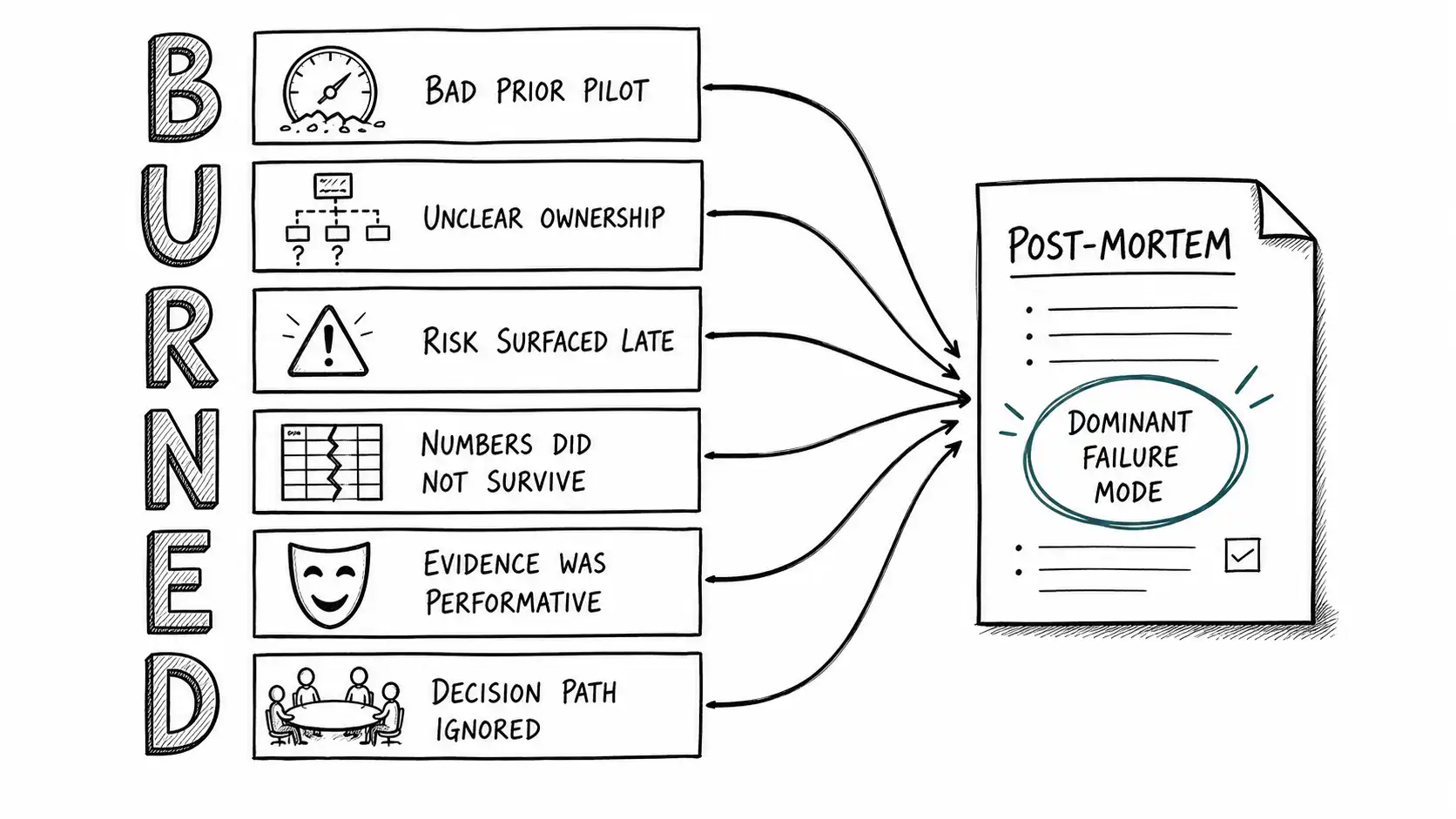
The six things that actually killed the last pilot
When a buyer says "we tried AI already," resist every instinct to reassure. Reassurance is information-free; it is what the last vendor offered too. Instead, run the BURNED Diagnostic, which sorts post-mortems into the six failure modes that account for nearly all of them.
B is for a bad prior pilot. The most literal scar. The pilot ran, it underdelivered, and the disappointment is fresh. But "bad" is too coarse to act on. You need to know whether it was bad because the use case was wrong, the data was not ready, the model genuinely could not do the task, or the rollout was botched. Each points to a different proof you will need to offer.
U is for unclear ownership. This one is invisible in demos and lethal in deployments. The MIT NANDA work found that the dominant cause of failure was organizational rather than technical, the inability to weave the model into workflows, structures, and culture (MIT, "The GenAI Divide," 2025). Unclear ownership is the mechanism. A pilot with an enthusiastic executive sponsor and no operational owner is a pilot that dies the moment the sponsor's attention moves. The scar this leaves is a buyer who now demands to know, before anything else, who on their side will own this thing on a Tuesday afternoon six months from now.
R is for risk surfaced late. The pilot got far enough that legal, security, or compliance finally looked at it, found a problem that should have been raised on day one, and the whole thing stalled or died in review. The scar is a buyer whose security and legal functions now insert themselves early and skeptically, because last time they were treated as an afterthought and it cost everyone three months.
N is for numbers that did not survive. The ROI model looked clean in the proposal. Then real token costs, human-in-the-loop review time, latency-driven workarounds, and integration labor showed up, and the business case inverted. The scar is a finance function that no longer trusts any AI ROI slide and will discount your projections by reflex.
E is for evidence that was performative. The demo was rigged, not maliciously necessarily, but it ran on hand-picked inputs, an idealized environment, and a happy path that does not exist in production. When the buyer's real data hit the system, the gap was brutal. This scar produces the most dangerous buyer for a dishonest seller and the best buyer for an honest one: someone who now distinguishes sharply between a demo and a proof, and who will respect you precisely for acknowledging the difference.
D is for a decision path that was ignored. The last vendor sold to a champion and never mapped the actual committee, the actual procurement gates, the actual veto holders. The deal either died at a gate nobody warned the champion about, or it closed and then the ignored stakeholders sabotaged the rollout. The scar is structural: the buying organization now formalizes its committee early and watches whether you respect it.
Most failed pilots involve two or three of these at once. The discipline is to find the dominant one. You are not running the diagnostic to sound thorough. You are running it because the dominant failure mode tells you exactly which rung of the Proof Ladder you have to start on and which stakeholder's scar you have to address first.
Reading the diagnostic in a live conversation
Here is the diagnostic as it actually sounds, not as a checklist you read aloud but as a line of questioning you internalize. The buyer says they ran a pilot that did not work. You ask what the pilot was supposed to prove. If they cannot answer crisply, you have likely found a scope or evidence problem (B or E). You ask who owned it after the kickoff. If the answer is a name who has since left, or a committee, or a shrug, you have found U. You ask when security and legal first saw it. If the answer is "near the end," you have found R. You ask what the business case assumed about cost. If they describe a per-seat number with no mention of usage, review labor, or integration, you have found N. You ask how the demo compared to the live results. The size of that gap is your read on E. You ask who had to sign off and whether anyone was surprised to be involved. That is D.
Six questions, asked conversationally over twenty minutes, and you have a structured read on a failure the buyer themselves may never have decomposed. That decomposition is a gift to them. It is also the single most disarming thing you can do, because it demonstrates that you are interested in what actually happened rather than in steering past it to your pitch.
A worked diagnostic
Here is a hypothetical, labeled as such, drawn from the composite shape of failures I have seen rather than any single real account.
A mid-market insurer piloted an AI tool to draft adjuster notes. Demo was flawless. Six months later it was dead. Running the diagnostic:
| Letter | Finding | Severity |
|---|---|---|
| B (Bad prior pilot) | Yes, but the model itself worked; the use case was fine | Low |
| U (Unclear ownership) | The sponsoring VP changed roles; no operational owner inherited it | High |
| R (Risk surfaced late) | Compliance flagged a record-retention issue in month four | Medium |
| N (Numbers did not survive) | Review time per note was higher than projected; net savings near zero | High |
| E (Evidence performative) | Demo used clean claims; real claims had attachments the model ignored | Medium |
| D (Decision path ignored) | Claims operations leadership was never consulted | High |
The headline the insurer would tell you is "the AI did not work." The diagnostic says something more useful: the model worked, but ownership evaporated, the cost model ignored review labor, and the people who run claims were never in the room. Three of those are organizational. If you walk in selling model accuracy, you are solving the one problem they did not have. If you walk in with a named-owner requirement, a review-labor-inclusive cost model, and a claims-operations stakeholder in your first meeting, you are speaking directly to the scar.
Organizational memory outlives people
A crucial property of scars: they survive the departure of the people who formed them. The sponsoring VP leaves, but the procurement rule she triggered stays. The analyst who babysat the model moves teams, but the operator distrust persists as folklore. This is why you cannot resolve a scar by waiting for turnover or by finding a new champion who "wasn't there for the last one." The new champion inherited the rules without inheriting the context, which can make them more rigid, not less, because they are enforcing a policy whose origin they cannot evaluate.
The practical consequence is that early in any AI deal you should ask, directly, "What did your last AI effort teach the organization?" Not "did it go well." The organizational lesson is the scar in its most actionable form. The answer is often a sentence the buyer has heard repeated in their building, like the CFO's "we bought a story, not a system." When you hear that sentence, write it down. It is the exact thing your proof has to disprove, in their words, which means your job is now specified.
A scar discovery question bank
Use these to surface the originating events without interrogating. Ask three or four, not all, and listen longer than you talk.
- "Tell me about the last time your team tried something like this. What did it teach you?"
- "If we do nothing, what is the cost of staying where you are? And what is the cost of trying again and having it not work?"
- "Who owned the last effort day to day, and where are they now?"
- "When in the last process did security and legal first get involved, and how did that go?"
- "What did the business case assume that turned out to be wrong?"
- "How close was what you were shown to what you actually got?"
- "Who had to approve it, and was anyone surprised to be asked?"
- "Is there a phrase people in your org use now when AI comes up?"
- "What would have to be true for you to trust a tool like this in production, not just in a test?"
The last question is the most valuable one in this book. It hands the buyer the pen and asks them to write your proof requirement. Whatever they say, that is the top rung your Proof Ladder has to reach. Everything you do afterward is climbing toward the answer they just gave you.
Why this protects the deal, not just the relationship
Reading scars carefully is not only the decent thing to do. It is the commercially correct thing to do, because the alternative is expensive in a way that does not show up until later. A deal closed without resolving the dominant scar is a deal that will stall in deployment, churn at renewal, or generate the kind of reference that quietly kills your next three opportunities in that vertical. The cost of skipping the diagnostic is deferred, not avoided. Burned buyers are, in effect, doing free diligence on your implementation by forcing you to confront the failure modes before you sign. A seller who welcomes that is a seller who closes deals that survive.
In the next chapter we take the failure mode that produces more bad AI deals than any other, the gap between what a demo proves and what production demands, and we make it visible, because you cannot sell the climb up the Proof Ladder until both you and the buyer can see exactly where the floor drops out.
Practical Exercise
Take a live deal where the buyer has mentioned a prior AI effort. Before your next call, fill in the BURNED table from the worked example using only what you already know. Mark every cell you cannot fill as a discovery target. The empty cells are your agenda for the next conversation. You are not allowed to propose a pilot until at least the U, N, and D rows are filled, because those three are the failure modes a demo cannot fix and a contract must.
Key Takeaways
- A buyer scar is a stored decision rule formed by a specific failure, not an emotion or a knowledge gap.
- Algorithm aversion is real and triggered by witnessed error, but it collapses when buyers regain control, so the true objection is loss of control, not AI itself.
- The BURNED Diagnostic sorts post-mortems into six failure modes: Bad prior pilot, Unclear ownership, Risk surfaced late, Numbers did not survive, Evidence was performative, Decision path was ignored.
- Most failures combine two or three modes; your job is to find the dominant one, because it tells you where to start on the Proof Ladder.
- Scars outlive the people who formed them, so you cannot wait out a skeptical organization; you have to disprove the specific lesson it learned, in its own words.