Why Demos Create Belief but Not Trust
A demo proves the system can work once. A burned buyer is asking whether it will work every time.

I once watched a demo get a standing ovation and lose the deal in the same week.
The vendor was good. The product genuinely did interesting things. The demo was a piece of theater built over months: a curated dataset, a presenter who knew exactly which inputs the model handled gracefully, a narrative that moved from a hard-looking problem to a clean answer in under three minutes. The room was impressed. The champion was thrilled. Then the buyer's lead engineer, who had said nothing the entire session, asked one question: "Can we run it on a hundred of our own tickets, picked by us, with you not in the room?" The presenter said they would set that up. They never could make it work cleanly, and the deal evaporated.
That question is the whole chapter. A demo proves the system can produce a good output once, under conditions the seller controls. The engineer was asking whether it would produce good outputs repeatedly, under conditions the buyer controls, on data the seller has never seen. Those are different claims. The demo answers the first. Trust requires the second. And the gap between them is exactly where burned buyers live.
Belief is cheap; trust is earned against base rates
Belief is the feeling that something could work. Demos are belief machines, and they are very good at their job. The problem is that belief and trust are not the same currency, and burned buyers know it because they spent the first one and never got the second.
The reason the gap is so wide with AI specifically comes down to how these systems behave. A deterministic system that passes a demo will, barring environmental change, behave the same way in production. You can extrapolate from one successful run. A probabilistic system cannot be extrapolated the same way. A model that produces a correct answer on the demo input tells you almost nothing about its behavior on the inputs you did not show, especially the long tail. And in most real workflows, the long tail is not an edge. It is the majority of the volume by count, even if each individual case is rare.
This is why the headline accuracy in a pitch and the lived accuracy in production diverge so reliably. A model can be "92 percent accurate" on a benchmark and feel like 70 percent to an operator, because the 8 percent of failures cluster on exactly the cases that are hard, ambiguous, high-stakes, or unusual, which are the cases humans remember. Operators do not experience an average. They experience a sequence of individual encounters, and the bad ones weigh more. The demo shows the average at its best. The operator lives the variance at its worst.
Demos optimize for the happy path; production runs on the tail
Walk through what a demo systematically omits, because each omission is a future scar.
A demo runs on clean inputs. Production runs on inputs with attachments, typos, mixed languages, internal jargon, malformed records, and the occasional input that is actively adversarial. A demo runs in a sandbox with no integration. Production runs inside an identity system, a data pipeline, a permissions model, a logging requirement, and a latency budget. A demo has the vendor's best engineer watching. Production has a tired operator at 4pm. A demo has no governance. Production has retention policies, audit requirements, and a security review that can veto the whole thing.
None of this is the demo being dishonest, although it sometimes is. It is the demo being a demo. The category error is asking a demo to carry the evidentiary weight of a production decision. Burned buyers make this category error once, get hurt, and then refuse to make it again. The performative-evidence scar from the BURNED Diagnostic, the E, is precisely the residue of having trusted a demo as if it were a proof. When you meet a buyer with that scar, the worst thing you can do is run a better demo. You are pouring water on a grease fire.
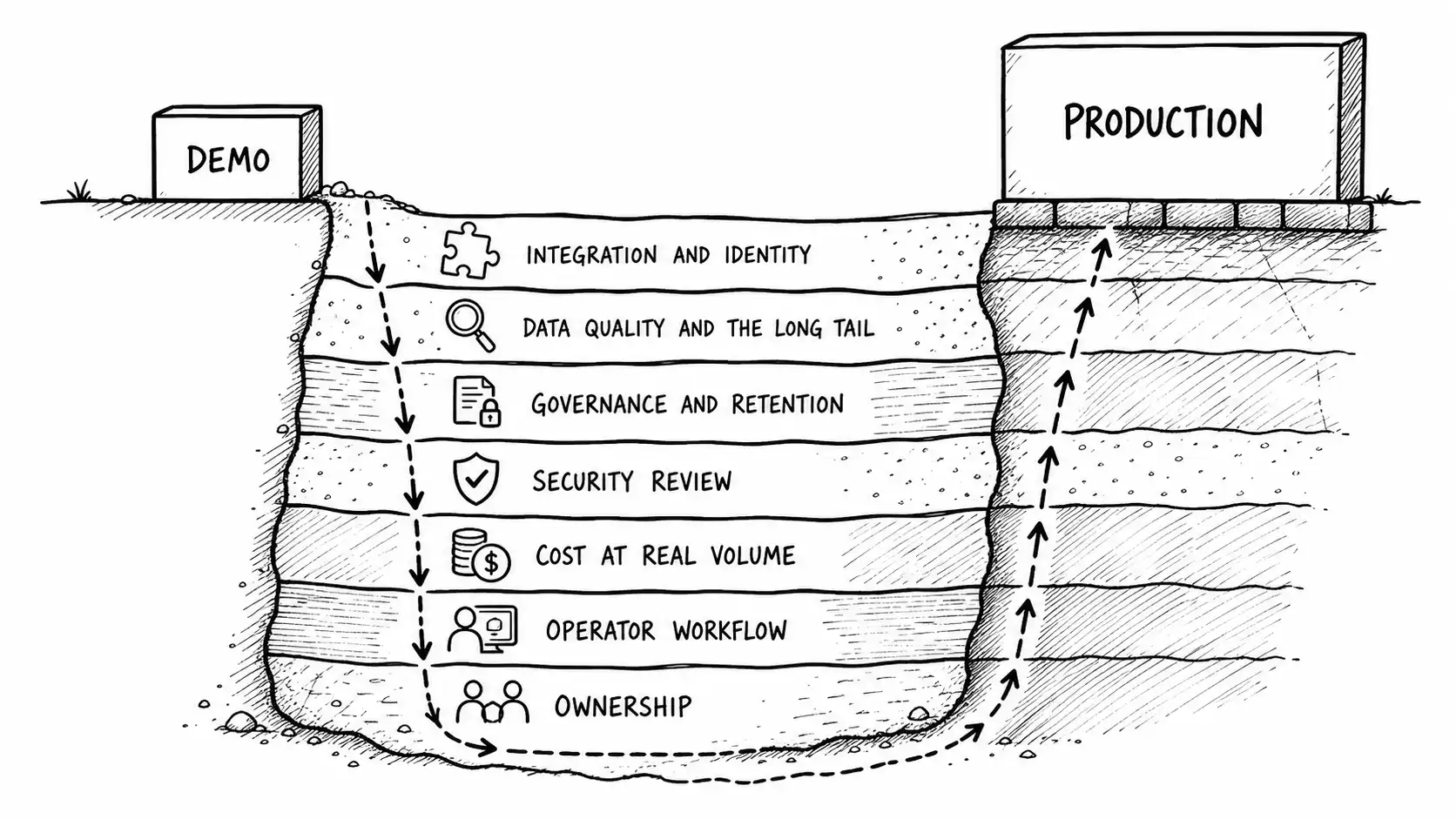
The demo-to-production gap, made visible
The honest move is to name the gap before the buyer does, and to draw it. I keep a simple map I walk buyers through, layer by layer, because seeing the hidden layers is what converts a vague worry into a manageable plan.
The layers in the gap are not exotic. They are the same every time, which is why a checklist works.
| Layer | What the demo skipped | The question it raises |
|---|---|---|
| Data | Ran on clean, curated inputs | How does it behave on our messiest 10 percent? |
| Integration | Lived in a sandbox | What does it cost to connect to our identity, data, and systems? |
| Governance | No retention, audit, or logging | Can we explain a given output to a regulator in a year? |
| Security | No review | What data leaves our boundary, and where does it go? |
| Cost | Per-seat headline | What is the fully loaded cost at our real volume, including human review? |
| Operator | Vendor's best engineer driving | What happens when a tired analyst hits an edge case at 4pm? |
| Ownership | Vendor presenting | Who on our side owns this in production six months from now? |
Hand a burned buyer this table, filled in honestly for your product, and you have done something the last vendor never did. You have treated the gap as the subject of the sale rather than the thing to hide. That is not a weakness. It is the most credible thing you can offer someone who has been burned by the opposite.
The Proof Ladder: selling the climb, not the leap
If the demo is one rung, what are the others? This is where the Proof Ladder does its work. The full ladder runs:
- Claim. A stated capability. Cheapest evidence, almost worthless to a burned buyer.
- Demo. The system works once, under your control. Generates belief.
- Controlled pilot. The system runs on a defined slice of the buyer's real data, with success defined in advance.
- Shadow workflow. The system runs alongside the human process without taking action, so its outputs can be compared to reality at production scale without production risk.
- Production slice. The system takes real action on a narrow, reversible portion of the workflow.
- Measured ROI. The production slice runs long enough to produce a number that survives finance review.
- Repeatable reference. Another customer has climbed the same ladder and will say so.
The defining mistake of AI selling is living on rungs one and two and asking for a commitment that belongs to rung five or six. The buyer feels the missing rungs as a floor that is not there. The honest seller's job is to make the ladder explicit, agree with the buyer on which rung they are on, and propose the smallest credible step to the next rung. You are not selling the leap from claim to production. You are selling one rung at a time, and each rung is a smaller ask that produces real evidence.
The shadow workflow rung deserves special attention because it is underused and it is the single best instrument for a probabilistic system. Running the model in shadow, where it generates outputs but a human still makes the decision, lets you measure real-world behavior on real-world inputs at full volume with zero production risk. It directly answers the engineer's question from the opening: a hundred of your own tickets, picked by you, with the vendor not in the room. The output is a comparison table the buyer trusts because they built the test. A shadow run that produces an honest, unflattering-in-places accuracy curve is worth more than a flawless demo, because it is evidence rather than performance.
Calibrated trust is the real goal
The research on human-automation interaction has a precise term for what you are trying to build, and it is not "trust." It is calibrated trust: trust that matches the system's actual reliability, neither over- nor under-relying (Lee and See, 2004, "Trust in Automation," Human Factors). Overtrust is what the demo produces and what burns people. Undertrust is the scar that follows. The seller's job is to move the buyer to the middle, where their reliance matches reality.
This reframes the entire sales motion. You are not trying to maximize the buyer's confidence. You are trying to calibrate it. A buyer whose confidence exceeds your system's reliability is a future churn event and a future bad reference. A buyer whose confidence is correctly calibrated, who knows exactly where the model is strong and where it needs a human, is a buyer who will deploy successfully and defend you afterward. Calibration is not a softer goal than belief. It is a more durable one.
The practical implication is uncomfortable for sellers trained on enthusiasm: you should actively tell the buyer where your system is weak. Not as a confession dragged out under questioning, but proactively, in the form of a "what we know and what we do not know yet" framing. The buyer-facing slide is two columns. Left: what we have measured and can stand behind. Right: what we have not yet proven in your environment and propose to test. Burned buyers read that slide and exhale, because it is the first time a vendor has told them where the floor is before they stepped on it.
A demo-to-production gap checklist
Before you let any demo carry weight in a burned-buyer deal, run this:
- Did the demo use the buyer's data or yours? If yours, the demo proves capability, not fit.
- Could the buyer pick the inputs? If not, you have shown the happy path.
- Was integration represented or hand-waved? Name the integration cost out loud.
- Did anyone mention governance, retention, or audit? If not, security has not weighed in, and the R scar is loaded.
- Is there a number for fully loaded cost at real volume? If not, the N scar is loaded.
- Is there a named production owner on the buyer's side? If not, the U scar is loaded.
- Did you propose the next rung up the ladder, or did you ask for a leap?
If three or more of these are unaddressed, you do not have a deal. You have a demo, and a burned buyer can tell the difference.
The seller's discipline
The hardest thing about this chapter is that it asks you to defuse your own best weapon. The demo is the most reliable dopamine hit in a sales cycle. It makes the room happy. It makes the champion look good. And with a fresh, optimistic buyer it can work fine. But with a burned buyer, the demo's emotional high is precisely what they have learned to distrust, because last time the high was followed by the fall. The discipline is to let the demo be small, honest, and quickly followed by an offer to climb the ladder on their terms. You trade the standing ovation for the signature that survives.
In the next chapter we stop talking about evidence in general and start talking about the fact that there is no single buyer to convince. There is a committee, and each member was burned in a different place, and a proof that heals one of them does nothing for the others.
Practical Exercise
Take your standard demo and write down, for each impressive moment, the exact production condition it omits. Then build the two-column "what we know / what we do not know yet" slide for your product, honestly. If the right column is empty, you are not being honest, and a burned buyer will find the items you left off before you do. Bring both to your next demo and present the gap before you present the magic.
Key Takeaways
- A demo proves a system can work once under the seller's control; a burned buyer is asking whether it works every time under theirs.
- Probabilistic systems cannot be extrapolated from a single good run, so headline accuracy and lived accuracy diverge on the long tail that operators actually remember.
- Name and draw the demo-to-production gap yourself, layer by layer, instead of hiding it; the gap is the subject of the sale.
- The Proof Ladder sells one rung at a time; the shadow workflow rung answers the buyer's real question with zero production risk.
- The goal is calibrated trust, not maximal confidence; tell the buyer where your system is weak, because overtrust is a future churn and a bad reference.