Introduction: The Buyer Was Not Confused
Burned buyers do not object to AI. They object to being asked to believe again without evidence.

Read this alongside the Pov Vol 1 book, the AI-Native thesis, and the full book library when you want the surrounding argument. The meeting was scheduled for forty-five minutes. It collapsed in nine.
I had walked in with the deck most AI sellers walk in with. Slide three said the platform would cut handle time by 40 percent. Slide seven had a logo wall. Slide eleven was the demo, the one we had rehearsed until it never stuttered. I opened with a line about how their industry was at an inflection point and how the companies that moved now would pull away from the ones that hesitated. I believed it. I had said it dozens of times.
The VP of Operations across the table did not reach for her coffee. She let me get to slide four, then she said, quietly, "We already did this."
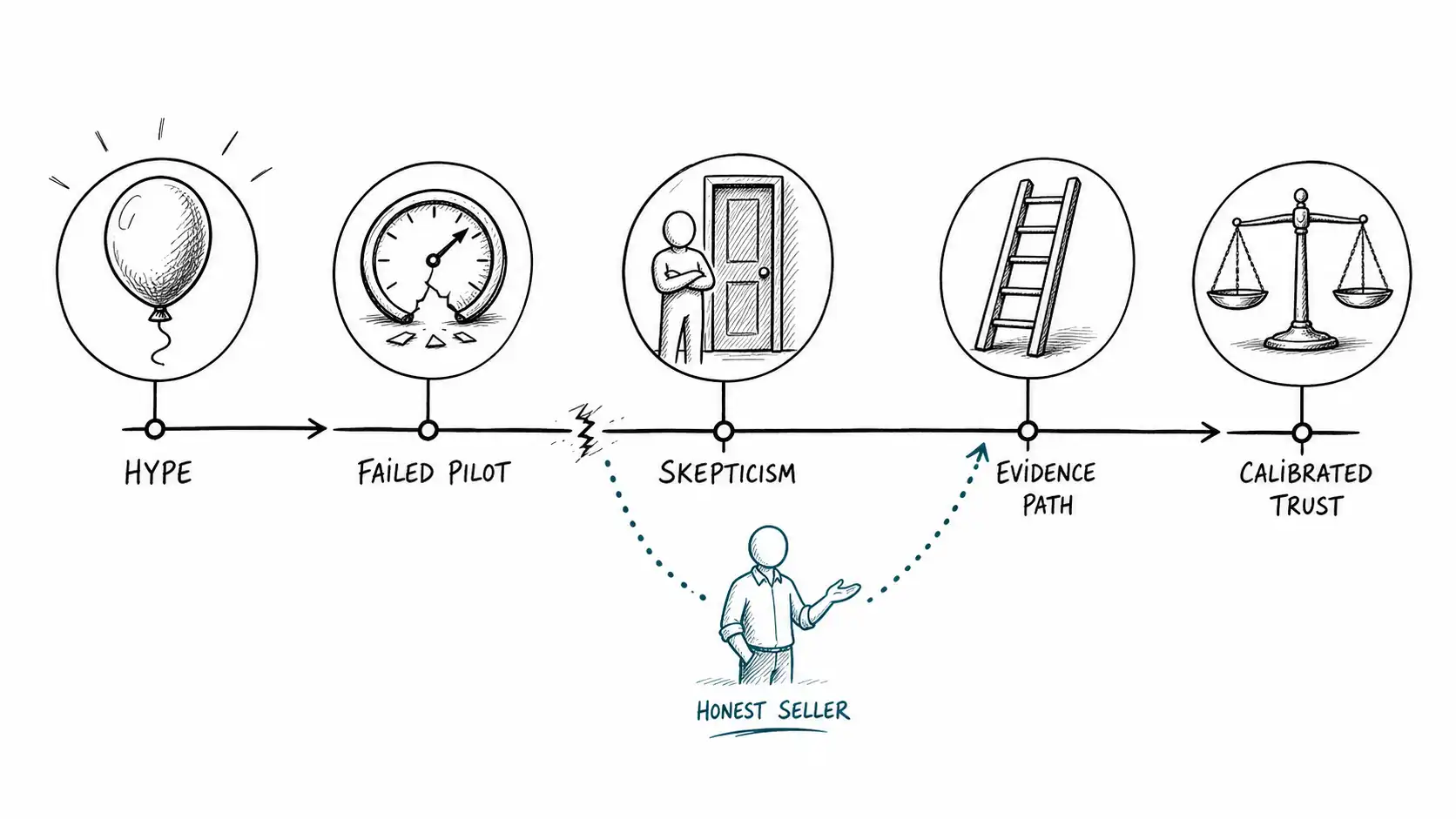
What followed was not a question. It was a casualty report. Eighteen months earlier her team had run a generative AI pilot with another vendor. The demo had been spectacular. The procurement cycle had been fast because everyone was excited. Then the model met their actual ticket data, which was messier than the sandbox, and the accuracy that looked like 92 percent in the pitch behaved more like 70 percent on the long tail of edge cases that made up most of their volume. The integration that was "a few weeks" took a quarter. The cost that was quoted per seat ballooned once token usage and human review were counted. Two analysts had been pulled off their real jobs to babysit the thing. It never reached production. The executive who sponsored it had since left. And the line her CFO used in the post-mortem had become a kind of scar tissue in the org: "We bought a story, not a system."
She was not confused about AI. She understood it better than the seller who had burned her. My first mistake, the mistake this entire book is about, was the assumption I carried into the room before I said a word: that her skepticism was a knowledge gap I could close with a better explanation. It was not a knowledge gap. It was memory. And you cannot overwrite memory with a louder promise.
The enemy of this book
The enemy is unearned confidence in AI selling. It shows up as inflated demos that run on curated inputs, vague transformation language that survives no contact with a workflow, implementation cost that gets discovered after the contract is signed, and sellers who treat a skeptical buyer as someone to be educated rather than someone to be believed.
This enemy is winning right now because it is profitable in the short term and because the market made it easy. When MIT's Project NANDA studied enterprise generative AI in 2025, it reported that roughly 95 percent of organizations were seeing no measurable return from their AI pilots despite tens of billions in spend, a gap the researchers attributed not to the models but to the inability to integrate them into real workflows (MIT, "The GenAI Divide: State of AI in Business 2025"). Read that number from the buyer's side. For every five enterprises that tried, four or more have a story like the VP's. The burned buyer is not a rare segment. The burned buyer is the market.
That changes the job. In a market full of survivors, the seller's task is no longer to generate belief. It is to repair the conditions under which belief is rational. A burned buyer does not need a bigger promise. They need a safer path to evidence. That sentence is the thesis of this book, and everything else is the machinery for making it true.
What I am, and what this book is
I have sold software, run revenue teams, and sat on the other side of the table approving and killing AI projects. I have written the optimistic deck and I have written the post-mortem. I have walked away from deals I wanted and regretted closing deals I should have walked away from. So this is an operator's book, written in the first person, with the specific texture of meetings that went wrong.
It is not a generic B2B sales book. The frameworks here only matter because the buyer has a particular kind of memory. It is not a prompt-engineering guide. It is not a collection of objection-handling tricks, because tricks are exactly what burned buyers have been trained to detect, and deploying them is the fastest way to confirm their worst assumption about you. It is not a hype manifesto. And it is emphatically not a manual for manipulating skeptics into yes. If your goal is to get an unqualified buyer past their defenses and into a contract they will resent, this book will actively work against you, because manipulated trust is the most expensive thing you can sell. It withdraws later, with interest, in the renewal conversation.
The four instruments
The book runs on four original instruments that recur in every chapter, used in different contexts rather than defined once and abandoned.
The first is the BURNED Diagnostic, a six-part read of why a prior AI effort failed: aBad prior pilot, Unclear ownership, Risk surfaced late, Numbers that did not survive contact with reality, Evidence that was performative rather than real, and aDecision path that was ignored. When a buyer says "we tried AI already," your job is not to reassure them. It is to run this diagnostic and find out which of the six killed the last attempt, because that is the wound you are actually selling against.
The second is the Proof Ladder, a sequence that walks from a claim to a repeatable reference: claim, demo, controlled pilot, shadow workflow, production slice, measured ROI, repeatable reference. Most AI sales motions live entirely on the bottom two rungs and then ask for a signature meant for the top. Burned buyers can feel that gap in the floor. The Proof Ladder is how you sell the climb instead of the leap.
The third is the Scar Map, a stakeholder-by-stakeholder record of how a previous AI failure registered differently for the CFO, the CIO, legal, security, operators, end users, and data owners. The CFO remembers the budget overrun. Security remembers the data exposure that almost happened. The operator remembers the two months babysitting a model. They are not one buyer with one objection. They are a committee of differently scarred people, and a single proof point does not heal all of them.
The fourth is the Honest Pilot Contract, a pilot defined as a written agreement rather than a favor: scope, data, metric, cost ceiling, integration boundary, security assumptions, fallback, production path, owner, and kill criteria. The presence of kill criteria is the tell. A seller who writes down the conditions under which the buyer should stop is a seller the buyer can finally believe.
How to read this
Read it in order the first time. The chapters build: you cannot design proof until you can read scars, and you cannot write an honest pilot until you understand which evidence each stakeholder actually buys. After that, treat it as a field reference. The artifacts, the discovery question bank, the qualification scorecard, the Proof Ladder worksheet, the pilot contract template, the ROI assumption table, the objection decoder, are meant to be lifted out and used in a live deal this week, not admired.
A word on the artifacts. They are worksheets, not scripts. If you read a buyer-discovery question off a page in the tone of a man reading a buyer-discovery question off a page, the burned buyer will know, and the conversation will close in nine minutes. Internalize the intent, then talk like a person.
What burned buyers are protecting
There is a temptation, common among sellers, to treat the skeptical buyer as the obstacle. The research suggests the opposite. People do not distrust algorithms because they are ignorant of them. In the classic studies on algorithm aversion, participants lost confidence in an algorithmic forecaster faster than in a human one after watching each make the same mistake, even when the algorithm was measurably better (Dietvorst, Simmons, and Massey, 2015). The aversion is real, it is durable, and it is triggered by witnessed error. A buyer who watched an AI system err in their own building is not being irrational. They are running a heuristic that has, in their experience, protected the company.
So when you sit across from someone defending their org against another disappointment, understand what you are looking at. They are not protecting themselves from AI. They are protecting their team's time, their budget's credibility, and their own name on the next post-mortem. That instinct is not your enemy. Aimed correctly, it is the most valuable diligence partner you will ever have, because a buyer who pressure-tests your evidence before signing is a buyer who will defend the deployment after signing.
This is the reframe the whole book turns on. Honest AI selling is not timid selling. It is stronger selling, because it selects the right buyers, narrows scope to what can be proven, protects trust as a finite resource, and moves evidence faster than the hype vendor can move promises. The hype vendor wins the demo. The honest seller wins the renewal, the reference, and the expansion. In a market of survivors, those are the only things worth winning.
The VP from the nine-minute meeting eventually became a customer. Not that day. It took two more conversations, a scoped pilot with written kill criteria, and a reference call she ran like an interrogation. She is now one of the strongest advocates I have. The arc from that collapsed meeting to that advocacy is the arc of this book.
Key Takeaways
- The burned buyer is not a niche. With most enterprise AI pilots failing to show measurable return, survivors of disappointment are the mainstream market.
- Skepticism after a failed pilot is memory, not ignorance, and it cannot be overwritten with a louder promise.
- A burned buyer does not need a bigger promise. They need a safer path to evidence.
- Four instruments recur throughout: the BURNED Diagnostic, the Proof Ladder, the Scar Map, and the Honest Pilot Contract.
- Honest selling is stronger, not softer: it wins the renewal and the reference, which are the only durable outcomes in a market full of survivors.