When the Honest Seller Walks Away
The willingness to lose a deal is what makes every other honest move credible.

Research spine: this chapter stays grounded in MIT, "The GenAI Divide," 2025 and Dietvorst, Simmons, and Massey, 2015, then applies that evidence to the operating judgment in the book. I lost a deal on purpose once and it was the best thing I did for the business that quarter.
The buyer wanted to buy. The budget was approved, the champion was strong, and procurement was moving. The problem was that the use case they were committed to, fully autonomous handling of a high-stakes, irreversible decision with no tolerance for error, was a use case where the technology would fail them, slowly and then all at once, sometime in the second quarter of deployment. I knew it. I could see the failure from where I sat. And I had a choice: close the deal I could close, book the revenue, and watch them become a churned logo and a poisonous reference in their vertical, or tell them the truth and walk away from a signature that was sitting right in front of me.
I told them the truth. I said the use case they wanted was the one I would not sell them, explained exactly why, offered the adjacent workable use case instead, and when they insisted on the original, I declined to bid. They were surprised. They bought the autonomous system from someone else. It failed roughly on the schedule I expected. And eighteen months later, the same champion called me, now at a different company, and said, "You were the only vendor who told us not to do it. We are doing the thing now that you said we should do then. Let's start there." That call was worth more than the deal I walked away from, and it would not have happened if I had closed.
This chapter is about the discipline that makes every other honest move in this book credible: the willingness to lose a deal. Without it, the kill criteria are theater, the honest ROI is a tactic, and the candid reference is a setup. With it, all of them become real, because the buyer can sense that you would actually walk, which means everything you say carries the weight of someone who is not desperate to close.
Why walking away is a sales skill, not a failure
There is a deep confusion in sales culture that treats every lost deal as a failure and every closed deal as a win. For honest AI selling to a burned market, this is exactly backwards on a meaningful fraction of deals. A closed deal that churns, generates a bad reference, and confirms a vertical's skepticism is a loss that keeps costing you. A walked deal that protects a buyer from a failure they would blame on AI, and on you, is an investment that pays back in trust, in future deals, and in the reference you did not poison.
The economics support this more than sales culture admits. In a SaaS or AI subscription business, the value of a customer is realized over the renewal and expansion, not at the initial signature. A customer who deploys into a use case that fails does not renew, does not expand, and tells their network. The fully loaded cost of a bad-fit close, the implementation effort, the support burden, the eventual churn, the reputational damage in a tight vertical, frequently exceeds the revenue. Walking away from a bad-fit deal is not leaving money on the table. It is declining to pick up a liability that looks like money.
This is sharpened by the structure of the burned market. Survivors talk to each other. A vertical that has been through the hype wave has a dense informal network of operators comparing notes on which vendors burned them. A single bad deployment becomes a story that closes doors across the vertical. Conversely, a single "they told us not to buy the wrong thing" story opens them. The willingness to walk away is, in a connected market, a marketing strategy.
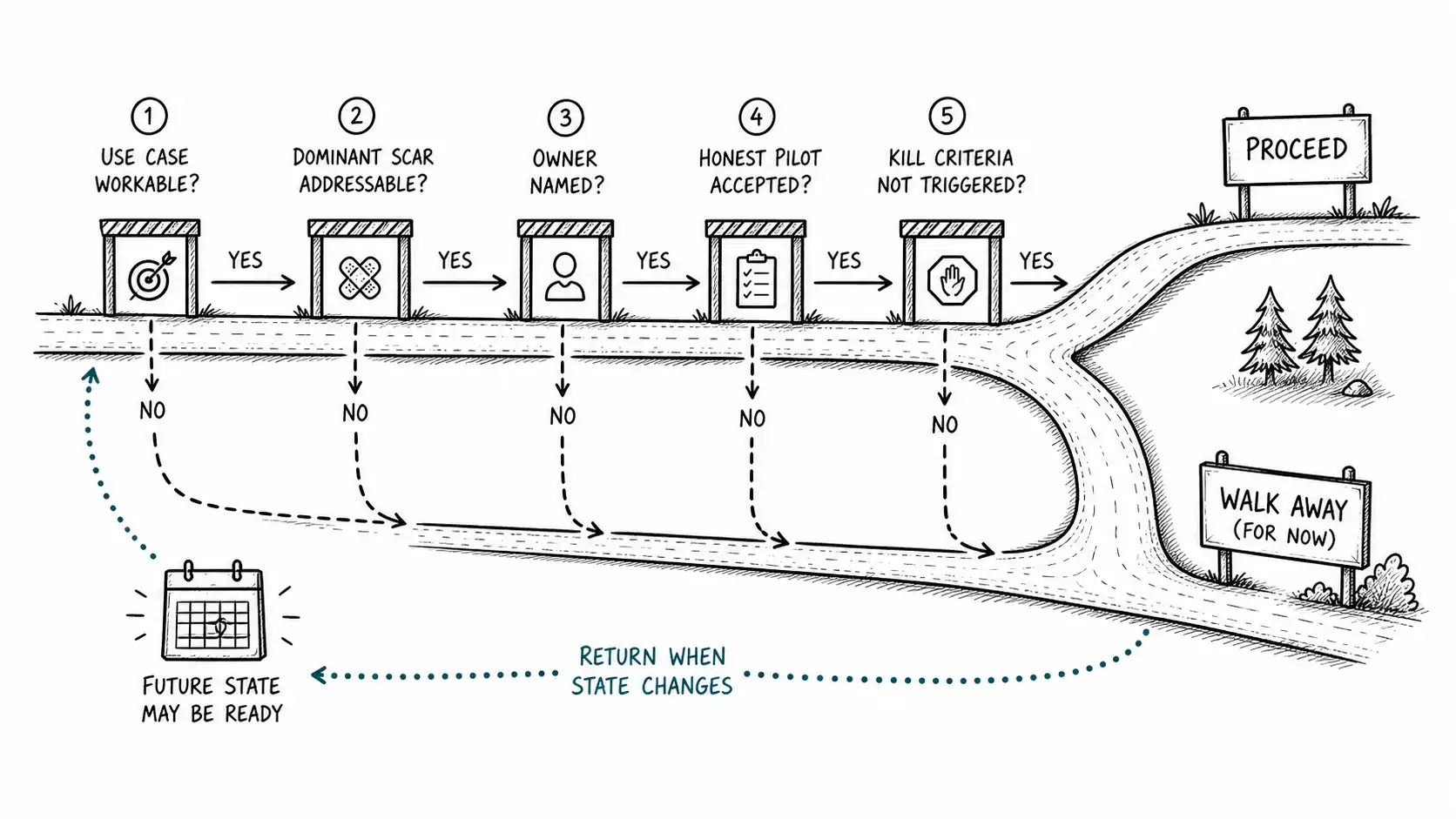
The walk-away signals
When should the honest seller walk? The frameworks in this book give precise signals. Walk away, or at minimum decline to proceed on the current terms, when:
The use case is unworkable for a probabilistic system and the buyer will not move off it. As in the opening story, an irreversible, zero-tolerance, high-stakes autonomous use case is a failure waiting to happen. If the buyer insists on it, the honest move is to decline, not to close and hope.
The dominant BURNED failure mode is unaddressed and unaddressable. If the last pilot died of unclear ownership and the buyer still cannot name an owner, your pilot will die the same way. If the last one died because the decision path was ignored and the buyer still will not let you meet the committee, you are being set up to repeat it. When the failure mode that killed the last attempt is structurally present in this attempt, walking is wiser than proceeding.
The pilot's kill criteria are met. This is the in-flight version of walking away. You wrote kill criteria into the Honest Pilot Contract precisely so that you would stop when they were hit. Stopping when they are hit is not losing; it is the system working. The seller who wrote kill criteria and then ignores them when they trigger has destroyed the one thing that made them credible.
The buyer wants a guarantee you cannot honestly give. A buyer who will only proceed on a guaranteed accuracy on unseen data, and who will not accept a measured pilot instead, is asking you to lie. Decline the lie. Offer the pilot. If they refuse the pilot and demand the guarantee, that deal is a future dispute, not a future customer.
The scar is fresh or structural and the buyer is not in an evidence-receptive state. From the qualification chapter: do not force a deal onto an organization that needs time. Walking away here is temporary; you are deferring, not abandoning.
How to walk away without burning the relationship
Walking away badly, abruptly, with judgment, or with a thinly veiled attempt to guilt the buyer into staying, wastes the trust you are trying to build. Walking away well preserves and even deepens the relationship. The difference is in the framing.
Frame the walk-away around their success, not your assessment. "I do not think this is the right move for you right now, and here is specifically why" centers their outcome. "We are not going to be able to make this work" centers your limitation and reads as either weakness or excuse. The first builds trust; the second does not.
Be specific about what would change the decision. A good walk-away always includes the conditions under which you would re-engage: "If you can name an operational owner, or if you are open to starting with the adjacent use case, I would be glad to pick this back up." This turns a no into a not-yet with a clear path, which keeps the door open and demonstrates the no was reasoned rather than reflexive.
Offer something useful on the way out. Even a deal you are declining can end with a genuine contribution: the BURNED Diagnostic of their situation, an introduction to a resource, an honest take on what to look for in any vendor. The buyer remembers the vendor who was useful even when there was no deal, and useful-with-no-deal is the most credible thing you can be, because there is nothing in it for you.
Document it honestly internally. Walking away from a deal needs to be defensible inside your own organization, especially against a sales culture that counts pipeline. Document the walk-away with the specific reason, ideally tied to the frameworks: "Declined to proceed; dominant unaddressed scar (unclear ownership), use case unworkable for probabilistic system, buyer would not accept a measured pilot. Re-engage when owner is named." This protects you and builds an organizational memory of disciplined qualification.
Walking away is what makes honesty real
Here is the structural reason this chapter sits where it does, near the end. Every honest move in this book, the named kill criteria, the pessimistic ROI column, the candid reference, the "what we do not know yet" slide, depends for its credibility on the buyer's sense that you would actually act on it. Kill criteria from a seller who would never enforce them are theater. A pessimistic ROI column from a seller who would close regardless is a tactic. The willingness to walk away is what makes all of it real, because it is the demonstration that your honesty is not a performance designed to close; it is a genuine willingness to not close when not closing is right.
Burned buyers can sense desperation, and desperation undoes honesty. A seller who needs this deal will, consciously or not, shade their kill criteria softer, their ROI rosier, their references happier, and the buyer will feel the shading even if they cannot name it. A seller who is genuinely willing to walk carries a different energy, one the buyer reads as safety. The willingness to lose the deal is, paradoxically, what lets you win the deals worth winning, because it is the foundation on which every honest claim stands.
This does not mean walking away is common. Most workable-scar buyers with workable use cases should be sold to, energetically and well. Walking away is the exception that proves the rule, the discipline you exercise on the minority of deals where proceeding would harm the buyer and ultimately you. But the willingness has to be real and present on every deal, because its presence is what the buyer is actually evaluating when they decide whether to believe you.
In the final chapter we close the loop: how the burned buyer you sold honestly to, slowly, through evidence, becomes your strongest customer, your best reference, and your most durable source of growth, and why honest selling is therefore not the timid choice but the strong one.
Practical Exercise
Review your pipeline for any deal that fails one of the walk-away signals: an unworkable use case the buyer will not move off, an unaddressable dominant scar, a demanded guarantee you cannot honestly give. For the worst one, draft the walk-away message using the framing above: center their success, specify what would change the decision, offer something useful, and document the internal reason tied to the frameworks. Then ask yourself honestly whether the only thing keeping the deal alive is your quota, and if so, what that is costing you in the deals you are not working.
Key Takeaways
- The willingness to walk away is what makes every other honest move credible; without it, kill criteria and honest ROI are just tactics the buyer can sense.
- A closed deal that churns and poisons a vertical is a loss that keeps costing; a walked deal that protects the buyer is an investment in trust and future deals.
- Walk away on clear signals: an unworkable use case, an unaddressable dominant scar, triggered kill criteria, a demanded guarantee you cannot honestly give, or a fresh/structural scar state.
- Walk away well: center their success, specify what would change the decision, offer something useful, and document the reason internally.
- In a connected market of survivors, the willingness to walk is also a marketing strategy, because the "they told us not to buy the wrong thing" story opens doors a bad deployment would close.