Conclusion: Redraw the Map Before It Lies
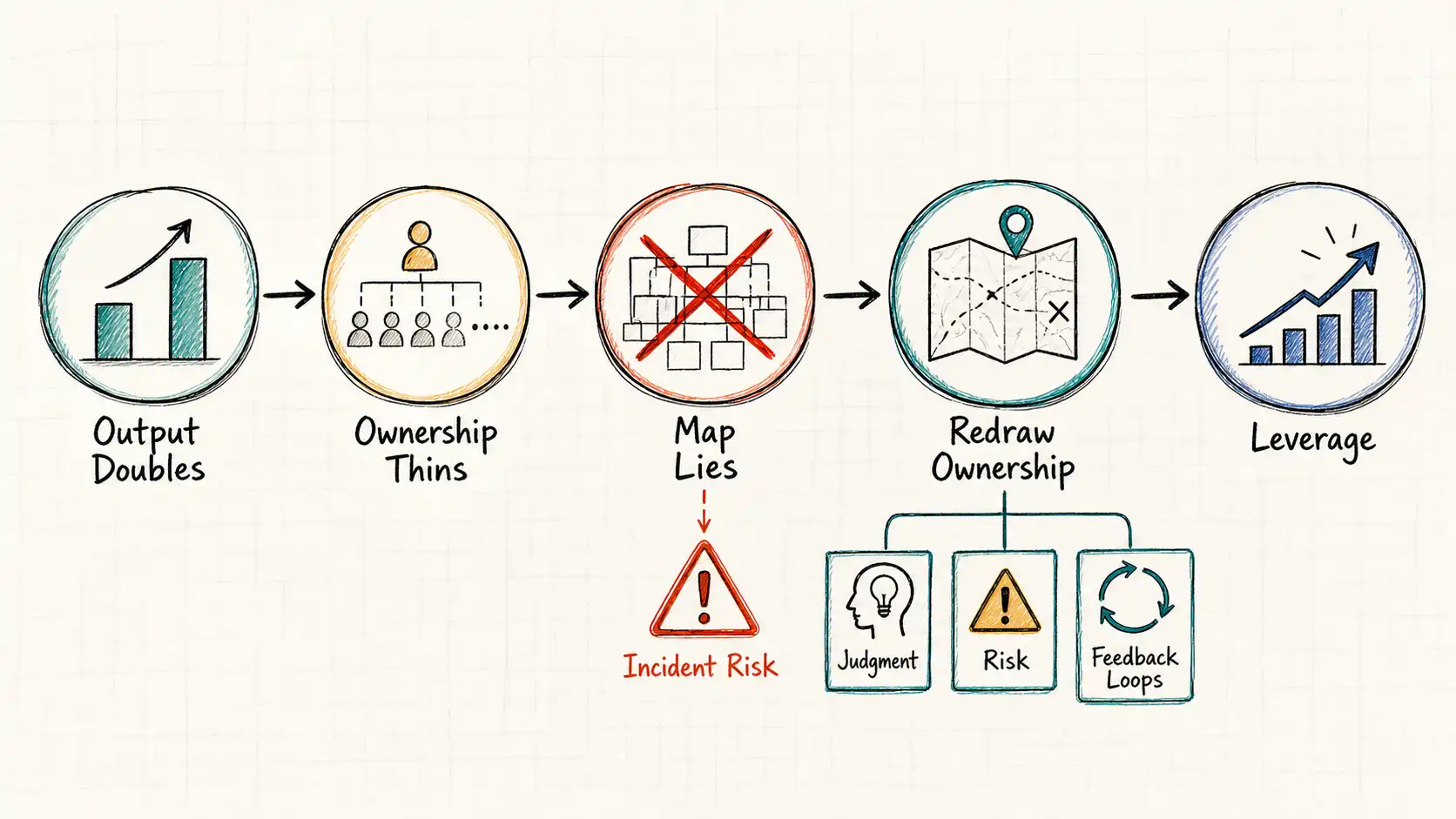
Mature organizations do not redraw the org chart around output. They redraw it around judgment, risk, and feedback loops, and they do it on purpose, before the incident.

Research spine: this chapter stays grounded in 2024 GitHub Copilot field experiments across Microsoft and Accenture and 2024 DORA report, then applies that evidence to the operating judgment in the book. The manager from the introduction, the one who shipped twice as much and had never been more nervous, called me about a year later. The nerves were gone, and I asked what had fixed them. He said something I have repeated many times since: "I stopped managing the output and started managing the ownership." That is the book in nine words. He had not slowed the team down. He had not cut headcount. He had redrawn the map so that it told the truth again, so that every artifact his organization now produced had a named human who could own it, and once that was true, the doubled output stopped being a source of dread and became what it was supposed to be, which is use.
The whole book has been one argument in many costumes. Automation does not remove the need for ownership; it makes ownership the scarcest and most important thing in the organization, because more work can now be produced with less friction and less review. The org chart is the ownership map, and when automation changes the work, the map starts to lie unless you redraw it on purpose. Everything else, the seniority shift, the apprentice gap, the span of judgment, the human-in-the-loop fallacy, the incident accountability, the operating models, has been a different lie the map tells and a different way to find it before it costs you.
What mature organizations do differently
The difference between organizations that get use from AI and organizations that get chaos is not the tools, the talent, or the budget. They have the same tools. The difference is that mature organizations redraw ownership deliberately around three things, and immature ones redraw nothing and let the spreadsheet redraw output around headcount.
The three things mature organizations organize around:
Judgment, not production. They recognize that production became cheap and judgment became the constraint, so they level, hire, promote, and staff around who can make good decisions about artifacts, not who can produce the most artifacts. Their senior roles are judgment-and-ownership-heavy. Their managers are allocators of judgment, not collectors of supervision. Their leveling guides reward catching the plausible-wrong artifact, not shipping the most plausible-looking ones.
Risk, not effort. They govern automation by the cost of being wrong, not by the effort saved, which means they run their workflows through something like the Automation Displacement Grid and treat the trap zone, high effort saved and high risk, with the suspicion it deserves. They know the effort axis is the one that feels good and the risk axis is the one that hurts, and they let the risk axis win.
Feedback loops, not dashboards. They build the connective tissue: error budgets that signal when to throttle production, blameless-but-system-ruthless postmortems that fix ownership gaps instead of finding people to blame, evals that own the definition of correct, and the platform-to-edge loop that lets central governance and embedded ownership actually learn from each other. They know a dashboard raises supervision while a feedback loop raises judgment, and they invest in the second one.
Immature organizations buy the tool, book the productivity gain in the spreadsheet, and stop. They have the artifact volume and none of the ownership structure, which is the exact condition under which the queue grows, the leakage compounds, the best people compress into single points of failure, the apprentice pipeline drains, and the first real incident discovers that "the AI did it" is not an answer. They are not doing AI wrong because they chose bad tools. They are doing it wrong because they treated an operating-model change as a procurement decision.
The Automation Org Design Checklist
This is the artifact the book has been building toward. Run it on your own organization. It is organized around the failure modes each chapter exposed, and a "no" on any line is a place the map is lying. You do not need to fix all of them at once. You need to know which ones are true.
Production and capacity
- We measure absorption rate (review + integrate + own) per workflow, not just production rate, and we know our real capacity is the absorption rate.
- When production outruns absorption, we respond by raising absorption, throttling production, or lowering absorption cost per artifact, not by letting the overflow leak and calling production our capacity.
The ownership map
- We have tested our org chart as a hypothesis: for each box, we have checked whether that person can actually own what they are accountable for.
- We have found our Ownership Compression points, the people producing what three used to, and we have a plan for the single points of failure they represent.
Risk and automation scope
- Each AI-assisted workflow is placed on the risk-versus-effort grid, and trap-zone workflows (high effort saved, high risk) have a different, heavier ownership posture than easy-win workflows.
- Someone (an automation PM) owns the decision of where AI is allowed to operate, including the decision to keep some work human even though the tool could do it.
Seniority and the pipeline
- Our leveling guide rewards judgment, taste, and ownership, not just production volume, which AI commoditized.
- We are deliberately building junior judgment with manufactured reps (produce-before-consulting, diagnose-before-applying, review-beside-seniors), and we are still hiring and protecting juniors as a four-year pipeline investment.
- Senior time is protected for apprenticeship and not entirely consumed by review load.
Span and management
- We size teams by what they can collectively own (span of judgment), not by what a manager can supervise (span of supervision).
- No one is accountable for output that lives outside someone's judgment span; the gap between supervised and owned is something we actively measure and close.
Review and human-in-the-loop
- Every "human in the loop" passes the five conditions: context, authority, time, incentive, escalation. We have scored our loops and know which are controls and which are comfort.
- Reviewer capacity is set by time-per-artifact against volume, and reviewers are rewarded for catches, not throughput.
Incident accountability
- Every AI-generated artifact stream that reaches consequence has exactly one named human in the Accountable cell, who passes the five conditions. Blank or group-owned streams are not deployed.
- We have error budgets per workflow, blameless-but-system-ruthless postmortems adopted before our first AI incident, and a named incident owner with real authority.
Operating model
- Consistency-ownership (governance, guardrails, model risk, eval infrastructure) sits central; context-ownership (workflows, prompts, domain evals, the artifacts) sits at the edge.
- There is a live feedback loop between central and edge, and we treat the operating-model redraw, not the tool adoption, as the actual work.
A score on this checklist is not a grade. It is a map of where your map is lying. The lines that are false are the places an incident will originate, a senior drought will form, or a single point of failure is quietly growing behind a green dashboard. Knowing which lines are false is most of the battle, because the failures in this book are all failures of not noticing, and the checklist is an instrument for noticing.
A 90-day starting move
If the checklist is overwhelming, here is the minimum sequence I give leaders who want to start Monday, compressed into a quarter.
Days 1 to 30: find the lies. Inventory your AI-generated artifact streams, you probably cannot list them, so listing them is step one. Run the highest-volume teams through the ownership worksheet from the first chapter and the span-of-judgment audit. Do not fix anything yet. Just find where production has detached from ownership. You are building the true map.
Days 31 to 60: name the owners. For every high-risk and trap-zone stream, fill in the ownership template and put a name in the Accountable cell, with the five conditions actually met. Where you cannot name an owner who passes the conditions, either build the conditions or pull AI out of that workflow until you can. This is the redraw. It is the hard part and the whole point.
Days 61 to 90: build one feedback loop. Pick the most important workflow and build the loop: an error budget, an eval that owns the definition of correct, and a blameless postmortem practice. One real loop, working, is worth more than ten dashboards. It is your proof that ownership can be made real, and it is the template you scale from.
Ninety days does not finish the work; the operating-model redraw is ongoing, because the tools keep changing and the map keeps drifting back toward lying. But ninety days is enough to stop being an organization that bought a tool and start being one that redrew its ownership, and that distinction is the one that decides which side of the use-or-chaos line you end up on.
The last word
I have spent this book being skeptical of the productivity story, not because the production gains are fake, they are real, but because the gains are the easy half and the industry keeps mistaking the easy half for the whole thing. The hard half is ownership, and ownership does not show up in the demo, the spreadsheet, or the first quarter's dashboard. It shows up in the incident you did not have, the senior you still have in five years, the artifact stream that never orphaned, the single point of failure that you split before it failed. Those are invisible victories, which is why they are undervalued, which is why most organizations will not invest in them, which is precisely why the organizations that do will pull away.
The org chart is the ownership map. Automation changed the work. Redraw the map, deliberately, around judgment and risk and feedback loops, before the map lies in a way that costs you. The manager who shipped twice as much and was terrified was right to be terrified, and he was right to fix it not by slowing down but by redrawing. Do the redraw. It is the only work that the tool cannot do for you, which is exactly why it is the work that matters.
Key Takeaways
- Mature organizations redraw ownership around three things: judgment (not production), risk (not effort), and feedback loops (not dashboards). Immature ones stop at tool adoption and let the spreadsheet redraw output around headcount.
- The Automation Org Design Checklist is an instrument for noticing where your org chart lies, because every failure in this book is a failure of not noticing. A false line is where an incident, a senior drought, or a single point of failure will originate.
- A 90-day starting sequence: find the lies (inventory and audit), name the owners (ownership template, five conditions, real names), build one feedback loop (error budget, eval, blameless postmortem).
- The production gains are real and are the easy half. Ownership is the hard half, it is invisible in the demo and the first-quarter dashboard, and it is the only work the tool cannot do for you, which is why it is the work that matters.