Who Owns AI Generated Work
When AI-generated code causes the outage, the postmortem cannot say the AI did it, so someone is accountable whether or not anyone agreed to be.

Here is a hypothetical that is only barely hypothetical, because I have watched its components happen separately and it is a matter of time before they happen together. A payments service goes down for ninety minutes during peak hours. The root cause is a configuration change that an engineer generated with an AI assistant, reviewed quickly because it looked routine, and merged. The change was plausible and wrong: it referenced a value that was valid in staging and catastrophic in production. The postmortem convenes. The first question, always, is "who owns this?"
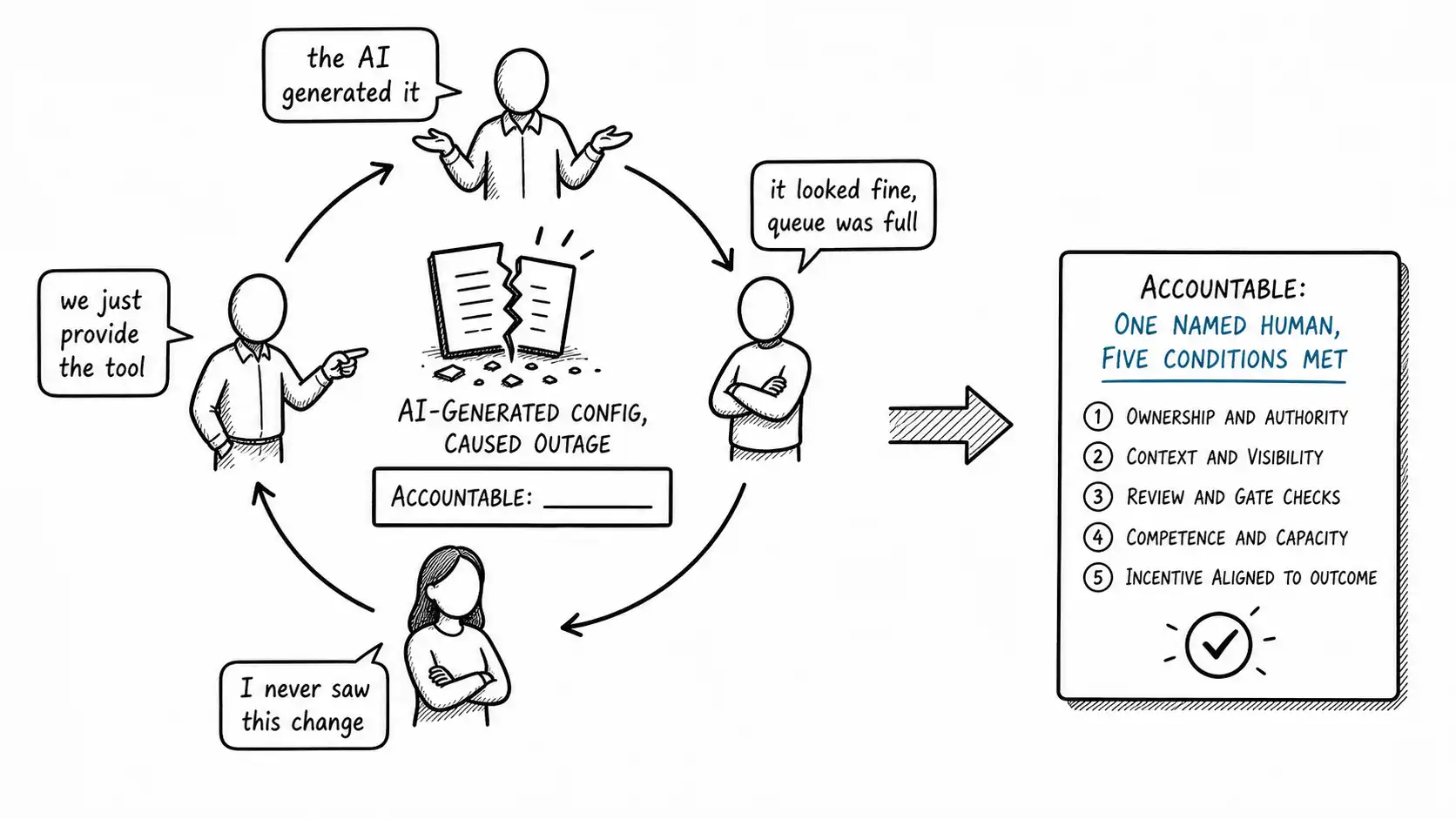
And there is a pause. Because the engineer will say, reasonably, "the AI generated it, I just reviewed it." The reviewer will say, reasonably, "it looked fine, and I had forty other things in the queue." The manager will say, reasonably, "I supervise the team but I never saw this change." The platform team will say, reasonably, "we provide the tool, we don't own what people generate with it." And somewhere in that pause is the most important sentence in incident response, the one nobody wants to say: the AI did it.
That sentence cannot be the answer. You cannot say it to a customer, you cannot put it in a regulatory filing, you cannot tell your board that the system is owned by a tool that has no accountability, no continuity, and no capacity to be held responsible. Accountability is a property of humans and organizations. It does not transfer to software, no matter how much of the work the software did. So the real question is not "did the AI do it" but "who agreed, in advance, to own the consequences if the AI did it wrong," and the disaster is that, in most organizations, the answer was never decided, so it gets assigned in the postmortem, retroactively, to whoever is least able to defend themselves.
Accountability does not flow to the producer anymore
For the entire history of knowledge work, accountability tracked production by default. You wrote it, you owned it. The person who produced the artifact was the natural owner of its consequences, because production and understanding were the same act: to make the thing, you had to understand it, so the maker was always the most qualified owner. We never had to assign ownership because production assigned it automatically.
AI severs production from understanding. The person who "produced" the AI-generated change did not necessarily understand it; they prompted, the tool generated, they skimmed, they merged. Production no longer implies understanding, which means it no longer implies the qualification to own. The default ownership assignment, "you made it, you own it," now points at someone who may have no more understanding of the artifact than a person who found it on the street. The old rule still fires, it just fires at the wrong target, assigning ownership to a producer who never had the context that ownership requires.
This is why "who owns AI-generated work" is a genuinely new question and not just an old question with a new tool. The mechanism that used to answer it automatically, production-equals-understanding, is broken. Ownership now has to be assigned deliberately, in advance, by someone thinking about it on purpose, because it will no longer assign itself correctly by default. And if you do not assign it in advance, it gets assigned in the postmortem, which is the worst possible time and method, because postmortem-assigned ownership is really just blame, distributed by power rather than by who could actually have owned the thing.
What the SRE world already figured out
The discipline that has thought hardest about ownership of automated systems is site reliability engineering, and its answers transfer directly. Google's SRE practice is built around a few ideas that this chapter borrows wholesale.
The first is error budgets. Rather than pretending systems never fail, SRE sets an explicit budget for failure: a service is allowed to be down for some amount of time, and as long as it stays within budget, the team ships freely; when it blows the budget, shipping stops until reliability recovers. The relevance to AI-generated work is direct. You will not eliminate errors in AI output. So decide, in advance, how much error you can tolerate per workflow, make it explicit, and tie the freedom to use AI aggressively to staying within that budget. A workflow generating AI artifacts faster than it can own them will blow its error budget, and that is the signal to throttle production, exactly the move from the capacity chapter, now with a number attached.
The second is blameless postmortems, which are blameless about people and ruthless about systems. The point is not that nobody is accountable; it is that the accountability attaches to the system design, not to the individual who happened to be holding the artifact when it broke. Applied to AI: when AI-generated work causes an incident, the postmortem should not hunt for the engineer to blame. It should ask why the system allowed unowned AI output to reach production, which is a design failure, not a person failure. The engineer who merged the plausible-wrong config is a symptom. The absence of a real ownership assignment is the disease.
The third is on-call as explicit, bounded, compensated ownership. SRE does not leave it ambiguous who answers when a system breaks; there is a named on-call, a rotation, an escalation path, and the responsibility is real and supported. AI-generated work needs the same: a named owner per workflow, with the responsibility made explicit and the context, authority, and time to carry it, the five conditions from the previous chapter, instantiated as a role rather than a hope.
The ownership assignment, made explicit
Since ownership no longer assigns itself, you assign it with an artifact. This is the AI-generated-work ownership template, and it is the practical heart of the chapter. For each workflow where AI generates artifacts that reach any consequence, you fill this in before deployment, not after the incident.
| Field | Question it answers |
|---|---|
| Workflow | What AI-generated artifact stream are we governing? |
| Quadrant | Where does it sit on the Automation Displacement Grid? (risk if wrong) |
| Named owner | Which specific human owns the consequences? (a role, with a name in it) |
| Owner's context | Do they understand the system well enough to own it? (five-conditions check) |
| Acceptance bar | What must be true before an artifact ships? Who verifies it? |
| Error budget | How much failure is tolerable before we throttle production? |
| Escalation | When the owner is unsure, who decides, how fast? |
| Incident path | When it breaks, who is paged, and what is their authority? |
The single most important row is "named owner," and the most important property of that row is that it contains a name, or a named role with a real human in it, not a team, not a function, not "engineering." "The team owns it" is how nobody owns it, because shared accountability with no named individual is diffusion of responsibility, and diffusion of responsibility is precisely the condition under which everyone assumes someone else has it and no one does. The bystander effect is well documented in psychology, and it operates in org design exactly as it operates on a sidewalk: the more people who could act, the less likely any one of them does. Ownership that is everyone's is no one's.
The RACI that survives AI
People reach for RACI here, and RACI is fine as far as it goes, but AI-generated work exposes a flaw in how most teams use it. The standard RACI has Responsible, Accountable, Consulted, Informed, and teams routinely smear the Accountable across multiple people or assign it to a group. That worked when production assigned ownership automatically and RACI was just documentation. It fails now, because RACI is the assignment, and a smeared Accountable means no assignment.
Here is the discipline. In an AI-assisted workflow RACI, the Accountable must be exactly one named human, and they must pass the five conditions for the artifacts they are accountable for. The AI tool can be Responsible (it does the work). The reviewer can be Responsible (they check it). But Accountable is one person, with context, authority, time, incentive, and escalation, who answers when it breaks. If you cannot name that person, the workflow is not ready to deploy, full stop. The RACI is not documentation of a decision you made elsewhere; filling it in is the decision, and the blank Accountable cell is the most important thing on the page.
AI-assisted workflow RACI (the part that matters):

 Responsible: the AI tool + the engineer who prompts/reviews it
 Accountable: EXACTLY ONE named human, who:
 - understands the system (context)
 - can stop a release (authority)
 - has time budgeted for this (time)
 - is rewarded for catching, not throughput (incentive)
 - knows who to escalate to (escalation)
 Consulted: domain experts, platform/governance team
 Informed: manager, stakeholders

 Rule: if the Accountable cell is blank, a group, or a person who
 fails the five conditions, DO NOT SHIP. The workflow has no owner.
The continuity problem AI introduces
There is a subtler ownership failure I want to name, because it does not show up in any single incident and is therefore easy to miss. AI-generated artifacts have a provenance problem and a continuity problem. When a human writes something, the knowledge of why it was built that way lives in the human, and you can go ask them. When AI generates something and the human merely approves it, the "why" may not live anywhere: the human did not form the reasoning, they evaluated an output, and the tool does not retain the reasoning either. Six months later, when someone needs to modify the thing, there is no one who knows why it is the way it is, because nobody ever knew, the way was generated.
This is an ownership decay that compounds. Each AI-generated artifact that ships without a human truly understanding it adds to a growing body of work that the organization is accountable for but does not comprehend. It is technical debt, but worse, because traditional technical debt was understood by someone once. This debt was never understood by anyone. The ownership template's "owner's context" row is partly a defense against this: requiring that a named human actually understands the artifact, not just approves it, means the "why" lives somewhere, in that person, and continuity is preserved. An organization that lets unowned AI artifacts accumulate is building a system that no one understands, which is to say a system that no one can own, which is to say a system that will eventually fail in a way no one can fix.
What to do before your first AI incident
You will have an incident caused by AI-generated work. The only question is whether you decided ownership before it or after. Three moves, in order:
First, inventory your AI-generated artifact streams and run each through the ownership template. Most organizations cannot even list where AI output is reaching consequence. List it. Any stream with a blank "named owner" is an incident waiting for a postmortem to assign blame, and you want to assign ownership now, calmly, rather than then, angrily.
Second, adopt blameless-but-system-ruthless postmortems for AI incidents specifically, before you have one, so that when it happens the reflex is to fix the ownership gap rather than to find the engineer to fire. Firing the engineer who merged the plausible-wrong config teaches everyone to merge faster and document less, which is the opposite of what you need.
Third, make "I own this AI-generated work" a real, supported, compensated commitment, not an assumption. The person who owns a high-stakes AI workflow is doing harder work than they were before AI, because they are owning output they did not produce, which is the hardest kind of ownership. Pay for it, staff for it, and reward it. Ownership that is assumed for free is ownership that evaporates the moment it is tested.
The pause in the postmortem, the one where everyone reasonably explains why the AI-generated disaster was not theirs, is the sound of an organization discovering that it deployed automation without deciding who owns the consequences. The fix is not a better postmortem. It is to have the conversation before the incident, with a template, a name in the Accountable cell, and a budget that makes the ownership real. The AI did it. That is true and useless. Someone owns it. Make sure that someone agreed to, while there was still time to choose.
Key Takeaways
- Accountability is a property of humans and organizations and does not transfer to software. "The AI did it" is true and useless, so someone owns AI-generated work whether or not anyone agreed to.
- Production used to assign ownership automatically because making something required understanding it. AI severs production from understanding, so ownership must now be assigned deliberately in advance, or it gets assigned as blame in the postmortem.
- Borrow from SRE: error budgets (decide tolerable failure per workflow and tie AI freedom to staying within it), blameless-but-system-ruthless postmortems (fix the ownership gap, not the person), and explicit named on-call ownership.
- The Accountable in an AI-assisted RACI must be exactly one named human who passes the five conditions. A group, a function, or a blank cell means no owner; do not ship.
- AI introduces an ownership-decay problem: artifacts approved but never understood leave no one holding the "why," producing a system no one can own. Require that a named human actually understands each high-stakes artifact, and pay for that ownership as the hard work it is.