The Span of Judgment
A manager can now supervise far more output than before and not one ounce more responsibility, and confusing the two is how teams quietly become ungovernable.

Read this alongside the Pov Vol 3 book, the AI-Native thesis, and the full book library when you want the surrounding argument. In 1937, an engineer named V. A. Graicunas published a short paper that did something unusual for management writing: it used arithmetic. He pointed out that when you add direct reports to a manager, the number of relationships the manager has to hold does not grow linearly. It explodes. With four reports, a manager juggles forty-four distinct relationships, the direct ones, the cross-relationships between reports, and the group relationships. Add a fifth report and the count jumps to one hundred. Luther Gulick carried this into the foundations of administrative theory, and "span of control" entered the management vocabulary as a hard limit: there is a ceiling on how many people one human can actually manage, and it is lower than ego wants it to be.
For ninety years, span of control has been about people. How many reports can one manager hold? Five, says Graicunas; seven, say the optimists; it depends, say the consultants. AI breaks this question in a way that nobody who wrote about span of control could have anticipated, because AI changes what a "report" produces without changing how many reports there are. So I want to retire the old question for a moment and ask a new one. Not "how many people can a manager supervise," but "how much output can a manager actually own?" That is the span of judgment, and it is the framework this chapter builds.
Two spans, not one
Here is the distinction that the whole chapter turns on.
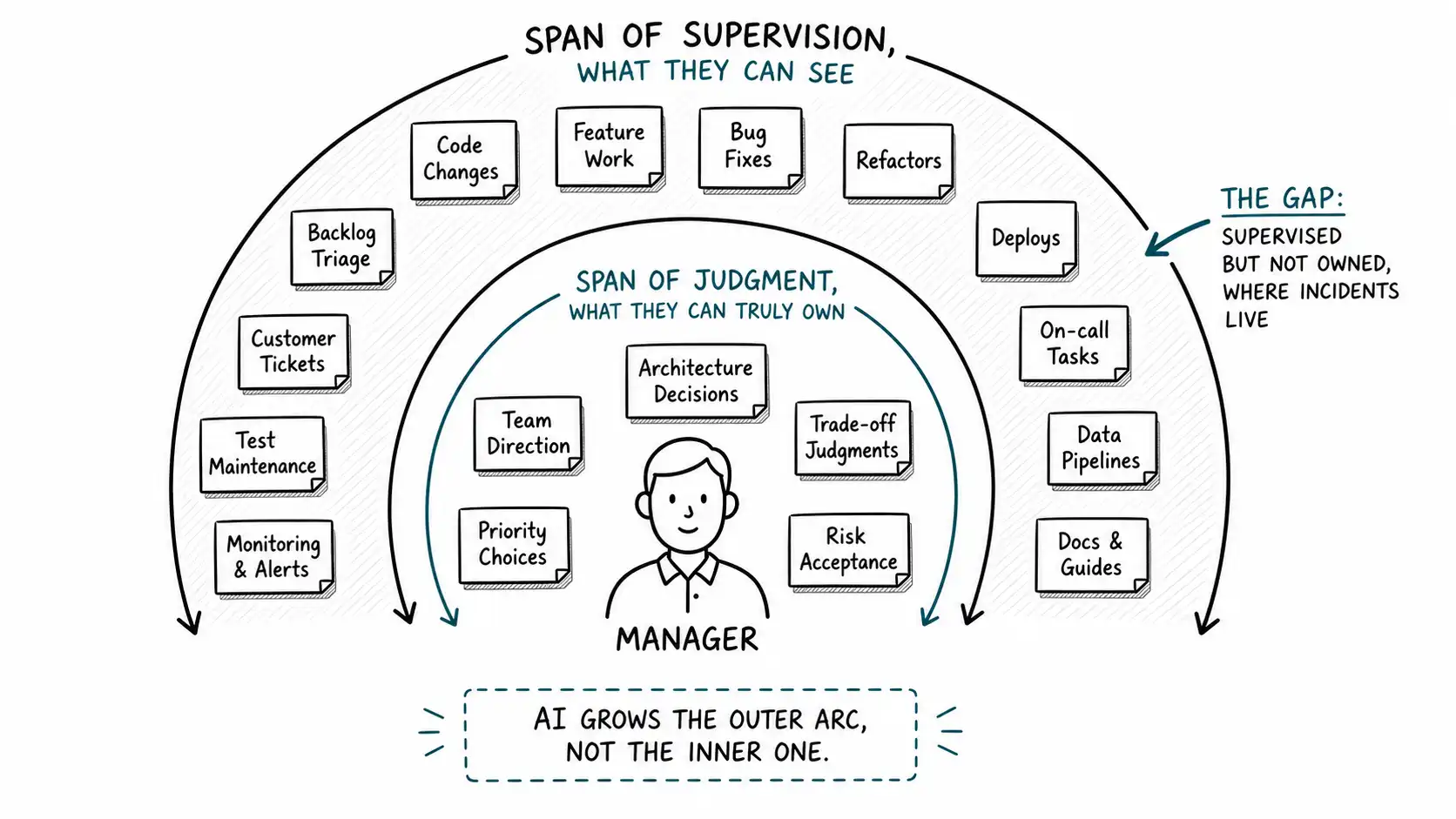
Span of supervision is how much output a manager can oversee, route, and coordinate. This number is large and getting larger. A manager with AI-augmented tooling can track more work in flight, get more visibility, coordinate more streams. Dashboards summarize, alerts surface, the manager sees more than they used to.
Span of judgment is how much output a manager can actually take responsibility for: how much they can understand well enough to vouch for, to catch when it is wrong, to answer for when it breaks. This number is small and roughly fixed, because it is bounded by human cognition. You can only deeply understand so much. You can only hold so many load-bearing decisions in your head. You can only genuinely own what you can genuinely comprehend.
Before AI, these two spans were close together, so we conflated them and called the result "span of control." A manager supervised seven reports and could roughly own what seven reports produced, because seven people produced a comprehensible volume of work. Supervision and judgment moved together.
AI rips them apart. It dramatically increases span of supervision, because tooling lets a manager see far more output. It does not increase span of judgment at all, because understanding-well-enough-to-own is human cognition and human cognition did not change. So you get managers supervising three times the output they used to and owning the same amount they always could, with the gap between the two spans filled by output that is supervised but not owned. That gap is where incidents live. It is supervised, so it shows up green on a dashboard. It is not owned, so when it breaks, the manager discovers they were responsible for something they never actually understood.
The number that does not move
Why is span of judgment roughly fixed? Because owning a piece of work requires holding its context, and context does not compress the way artifacts do.
To own a decision, you need to know why it was made, what alternatives were rejected, what assumptions it rests on, what depends on it, and how it fails. That is a substantial amount of state to hold per decision, and humans have a hard ceiling on how much such state they can carry. The cognitive-load research that underpins Team Topologies makes this concrete at the team level: a team has a finite cognitive-load budget, and loading it past capacity degrades performance, which is why the book insists on limiting the size of the domain any one team is responsible for. The same is true of an individual manager. There is a budget. AI does not expand it. AI just produces far more work to spend it on.
The tempting error is to believe that better tooling raises the ceiling. It does not. Better tooling raises supervision, the ability to see and route, which is real and useful. It does not raise judgment, the ability to deeply own, because judgment requires holding context and a dashboard does not hold context for you, it summarizes it away. A summary is the opposite of the deep context ownership requires. The better your dashboards get, the wider the gap between what you can see and what you can own, because you can now see far more than you could ever hold the context for. Tooling can make the span-of-judgment problem worse by making you feel in control of output you do not actually understand.
What happens in the gap
Let me make the gap concrete with the kind of situation that produces a 2 a.m. phone call.
A manager has eight reports, each shipping roughly triple their pre-AI output. The manager's dashboard is beautiful: green across the board, velocity up, queue manageable. The manager genuinely believes the team is healthy, and on the supervision axis, they are right. They can see everything.
Now something breaks. A piece of AI-generated code in a payment path had a subtle flaw that passed review because the reviewer was carrying triple the review load and the output was plausible. The incident escalates. The manager is paged, because the manager owns the team, says the org chart. And the manager discovers, in real time, in front of an angry customer or a worried executive, that they have no idea how this part of the system works. They supervised it. It was in their span of supervision. It was never in their span of judgment, because they were supervising three times the output they could ever have owned, and this was one of the two-thirds that lived in the gap.
This is the failure mode. Not that the manager was lazy or incompetent. That they were responsible for more than they could own, because the org chart drew their accountability around their span of supervision while their actual capacity to own was bounded by their span of judgment, and nobody noticed the two had come apart. The chart lied, in exactly the way the first chapter described, and the lie was denominated in span.
Designing around the real span
If span of judgment is fixed and span of supervision is rising, you have to design your org so that accountability tracks judgment, not supervision. This is the practical core of the chapter. A few moves follow directly.
First, stop sizing teams by how much output a manager can supervise. Size them by how much output the team can collectively own. A manager supervising eight people producing triple output is supervising twenty-four people's worth of pre-AI work, and no manager owns twenty-four people's worth of work. Either the team is smaller in output terms, or ownership is distributed below the manager to people who can hold the context, or you have an ungovernable team wearing a green dashboard.
Second, distribute judgment, do not centralize supervision. The instinct when output rises is to give the manager better dashboards so they can supervise more. The correct move is the opposite: push ownership down to the people closest to each piece of work, so that the judgment span is distributed across many heads rather than bottlenecked in one. The manager's job shifts from "owns everything the team produces" to "ensures every piece of what the team produces is owned by someone with the judgment span to own it." This is the allocator role, and it is the subject of the next move.
Third, make the manager an allocator of judgment, not a collector of supervision. The valuable manager in the AI era is not the one who can see the most. It is the one who correctly matches each piece of work to an owner who has the judgment span to hold it, and who notices when a piece of work has no real owner. That is a different management skill than the old one. The old skill was coordination: keeping the supervised work moving. The new skill is allocation: ensuring the owned work is actually owned. Coordination scales with tooling. Allocation scales with the manager's judgment about who can own what, which is harder and more valuable.
A span-of-judgment audit
Here is the worksheet. Run it on any manager you suspect is in the gap, which is most of them.
For each manager:
 reports = number of direct reports
 output_multiple = how much more each ships vs pre-AI (e.g. 2.5x)
 effective_output = reports * output_multiple
 (in "pre-AI person-equivalents of work")

 owned_directly = how much of that output can the MANAGER
 personally understand well enough to vouch for?
 owned_by_reports = how much is genuinely owned by a report with
 the judgment span to hold it?

 gap = effective_output - (owned_directly + owned_by_reports)

 if gap > 0:
 "gap" person-equivalents of work are SUPERVISED BUT NOT OWNED.
 This is your incident surface. Either:
 - distribute ownership (raise owned_by_reports), or
 - reduce effective_output (throttle or split the team), or
 - shrink what the manager is accountable for to match owned.
 Do NOT close the gap by adding dashboards. That raises supervision,
 not judgment, and widens the real gap while hiding it.
The line that matters is the last one. Almost every organization's response to rising output is to invest in supervision: more dashboards, more metrics, more visibility. That response feels like control and is the opposite. It widens the gap between supervised and owned while painting the gap green. The honest responses are to distribute ownership, reduce output to match capacity, or shrink the accountability to match what is actually owned. All three are harder than buying a dashboard, which is why dashboards win and gaps grow.
The manager's own reckoning
If you are a manager, the uncomfortable question this chapter asks you is: of everything you are accountable for, how much could you actually answer for if it broke right now? Not "could you find out," but "do you hold enough context to have caught the error, and to own the consequence without flinching toward 'the AI did it' or 'the spec was unclear'?"
For most managers in AI-heavy organizations, the honest answer is "less than I'm accountable for, and the gap is growing." That is not a personal failing. It is the structural result of supervision span outrunning judgment span while the org chart kept drawing accountability around the former. Your job is not to heroically expand your judgment span, which is fixed. Your job is to make sure nothing you are accountable for lives outside someone's judgment span, even if that someone is not you. A manager who has distributed ownership well can be accountable for far more than they personally understand, because every piece is owned by someone who does understand it. A manager who has only supervised well is accountable for a pile of work that nobody owns, and they will find out which kind of manager they are during the incident.
Graicunas counted relationships and found a ceiling. The AI-era version counts judgment and finds the same kind of ceiling in a new place. The number of people you can manage was always smaller than ego wanted. The amount of output you can own is smaller still, and it does not grow no matter how much output your tools can produce. Design for the small number. Distribute the rest. The alternative is a beautiful dashboard and a phone that rings at 2 a.m. about a system you were responsible for and never understood.
Key Takeaways
- Span of control was always about people. The new constraint is the span of judgment: how much output a manager can actually own, as distinct from the span of supervision, how much they can see.
- AI dramatically raises span of supervision and does nothing to span of judgment, which is bounded by human cognition. The gap between them is output that is supervised but not owned, and that gap is where incidents originate.
- Better tooling raises supervision, not judgment, and can make the problem worse by making managers feel in control of output they do not understand. A summary is the opposite of the context ownership requires.
- Design accountability to track judgment, not supervision: size teams by what they can collectively own, distribute ownership down to people with the judgment span to hold each piece, and turn managers into allocators of judgment rather than collectors of supervision.
- The honest responses to a span-of-judgment gap are distributing ownership, throttling or splitting output, or shrinking accountability to match what is owned. Adding dashboards is the dishonest response that widens the gap while hiding it.