The Apprentice Gap
AI automates exactly the tasks juniors used to learn judgment on, and the bill for that arrives four years downstream when your senior pipeline is empty.

There is a kind of organizational damage that does not show up for years, and by the time it shows up the cause is too far in the past to be obvious. The apprentice gap is one of these. It is the most dangerous risk in this book precisely because it is invisible on every dashboard you currently watch. Nothing breaks. Output looks great. Junior costs drop. And four years later you cannot find a senior to promote, and nobody connects the drought to a decision made four years earlier to automate the work juniors used to learn on.
Let me make the mechanism concrete, because stated abstractly it sounds like hand-wringing and it is not.
How judgment was actually built
Nobody is born with the judgment we priced in the last chapter. It is built, and it is built in a specific way: by doing a large volume of low-stakes production tasks, getting them wrong, having someone more senior catch the error and explain it, and slowly internalizing the patterns. The junior wrote the simple feature, the senior reviewed it and said "this works but it will fall over under load, here's why," and the junior learned something that no amount of reading could teach. The boring production tasks were not just output. They were the curriculum. The apprentice learned judgment by producing under supervision, accumulating reps, and absorbing corrections.
This is not a metaphor. It is how every skilled profession has trained people for as long as we have had skilled professions, from medical residency to legal associates to the engineering apprenticeship. The classic study of how people move from novice to expert, Dreyfus and Dreyfus's model of skill acquisition, describes exactly this: expertise is not acquired by learning rules but by accumulating a vast library of concrete experienced situations, which is to say, by doing the work and seeing how it turns out, many times. You cannot skip to the expert stage. The experienced cases are the expertise.
Now look at what AI automates. It automates the simple feature, the boilerplate, the first draft, the routine query, the standard analysis. It automates, with eerie precision, the exact set of low-stakes production tasks that constituted the curriculum. The tasks were boring, so automating them feels like pure upside: who wants juniors doing boilerplate? But the boring tasks were how juniors earned the reps that turn into judgment. Remove the tasks and you remove the curriculum, and you do it without removing the need for the judgment those tasks used to build. You have automated the training pipeline while still requiring its graduates.
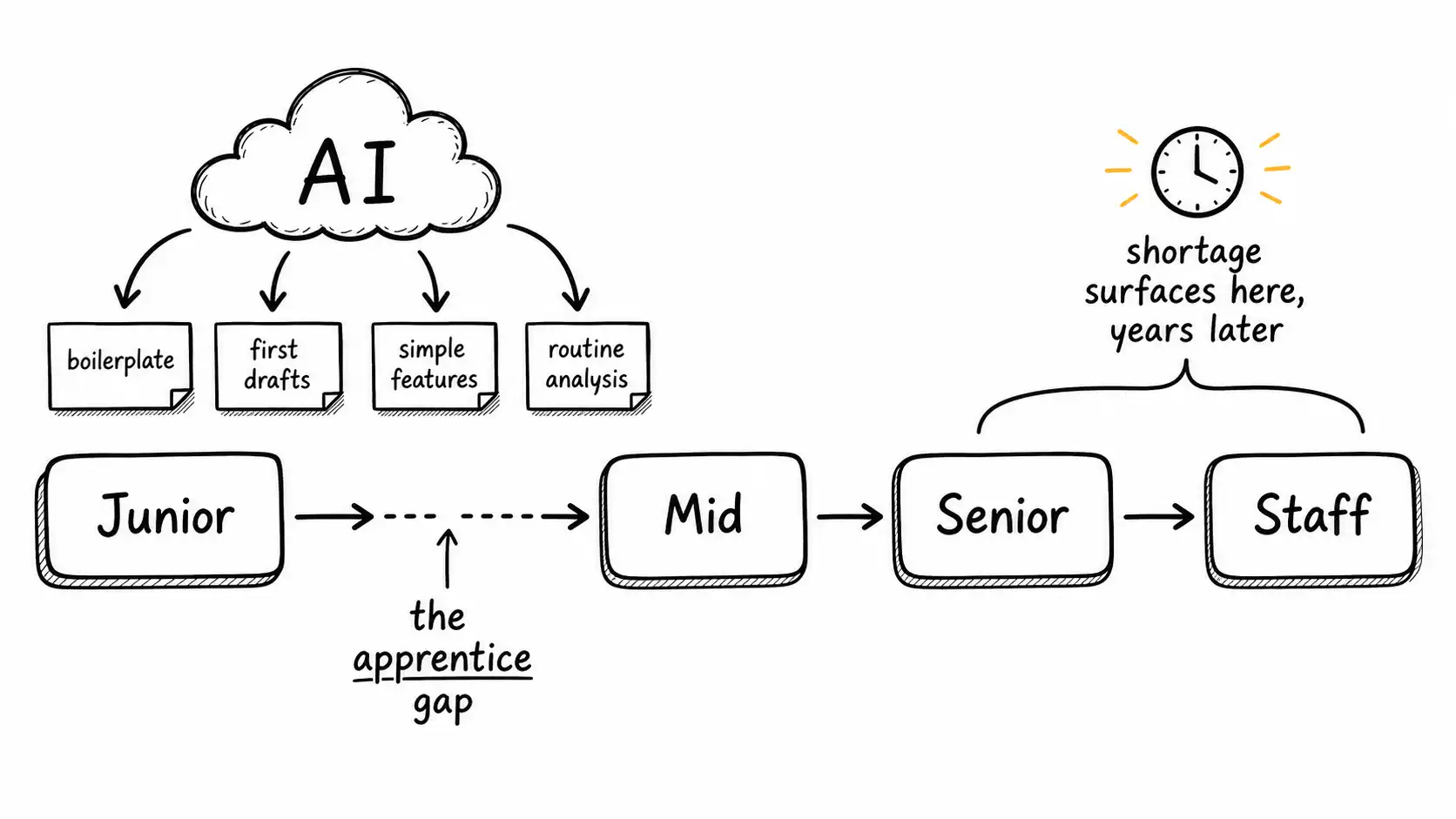
The Apprentice Gap, framed
Here is the framework, and it is a pipeline, not a quadrant, because the damage is about flow over time.
The Apprentice Gap: AI removes the entry-level production tasks that juniors used to build judgment on, so the pipeline that converts juniors into seniors quietly drains, and the shortage surfaces years downstream when the current seniors retire or leave and there is nobody who learned the way they did.
The pipeline has a long lag, and the lag is what makes it dangerous. You make the automation decision today. The juniors you hire today produce great output immediately, because the tool carries them. For two or three years everything looks fine, better than fine: junior productivity is way up, you may even hire fewer of them. The gap is accumulating the entire time, invisibly, because it is a deficit in judgment formation, and judgment formation has no current-quarter metric. Then, three or four years out, your seniors start leaving at the normal rate, and you reach for the people who should have grown into senior judgment by now, and they produced a lot but never built the judgment, because they never did the reps, because the tool did the reps for them. The drought arrives with no visible cause, attributed to "a tight talent market" or "we're just not finding good seniors," when the real cause was a training-pipeline decision made years earlier.
Why you cannot just "train them differently"
The obvious objection is that juniors will simply learn judgment some other way: by reviewing AI output, by tackling harder problems sooner, by learning at a higher level of abstraction. There is something to this, and I will get to the real version of it. But the naive version fails for a reason worth understanding.
Judgment is built by being wrong in low-stakes situations and getting corrected. The critical ingredients are: you make the call, you are wrong, the stakes are low enough that being wrong is safe, and someone catches and explains the error. AI breaks this in a specific way. When the tool produces the artifact, the junior never makes the call, so they are never wrong, so they are never corrected. They become a reviewer of plausible output before they have ever built the judgment that reviewing requires. You have asked them to grade work in a subject they have not taken. They will pass things that should fail, because the output is plausible and they lack the experienced cases that would let them see why it is wrong. And because the output usually is fine, they get no signal that they are missing things, right up until the time they miss something that matters.
This is the automation-bias problem from two chapters ago, but aimed at the people least equipped to resist it. Parasuraman and Manzey's synthesis found that complacency afflicts experts and novices alike, but novices have an additional handicap: they lack the mental model of the correct system against which to notice that the automated output is wrong. An expert reviewing AI code has decades of experienced cases pattern-matching against the output. A junior reviewing the same code has the output and a feeling that it looks right. The junior cannot build the missing mental model by reviewing, because reviewing is the thing the model is a prerequisite for.
The real fix: design the curriculum deliberately
Since the curriculum is no longer free, you have to build it on purpose. The reps that used to happen automatically, because juniors had to do the production, now have to be manufactured, because the production is automated away. This is a real cost and a real role, and organizations that pay it will have seniors in five years while their competitors do not.
Here is a junior apprenticeship map, which is the artifact this chapter exists to produce.
| What the junior used to do | What the tool now does | The replacement rep, designed on purpose |
|---|---|---|
| Write the simple feature | Tool drafts it | Junior must produce their own version first, then compare to the tool's and the senior's, and explain the differences |
| Fix the easy bug | Tool suggests the fix | Junior must diagnose the root cause and explain why the fix works before applying any suggestion |
| Review small PRs | Tool generates large PRs | Junior reviews AI output with a senior beside them, and is graded on the errors they catch and miss, not on throughput |
| Build the routine model | Tool builds it | Junior must break the tool's model on purpose, find the assumption that fails, and report it |
The unifying principle is that you deliberately reintroduce the experience of making the call and being corrected, even though the tool could do the task. You make the junior produce before they consult the tool, so they have a position to be wrong from. You make them diagnose before they apply, so they build causal models. You pair them with seniors on review, so the corrections still happen. You task them with breaking the tool's output, so they learn what plausible-but-wrong looks like from the inside. None of this maximizes short-term output. All of it builds the judgment that short-term output no longer builds for free.
The cost is real: a junior on this curriculum produces less than a junior who just ships the tool's output, in the short term. That is the price of having seniors later. An organization that refuses to pay it is borrowing against its future senior bench at an interest rate it will not understand until the bill comes due.
The hiring trap that makes it worse
There is a compounding error here, and I want to name it because it is the default move. When junior productivity rises and junior judgment is invisible, the rational short-term decision is to hire fewer juniors. Why hire three juniors when one junior with a tool produces the same output? The output math is impeccable. It is also exactly the move that empties the pipeline fastest, because it cuts the intake of the very people who, trained properly, become your future seniors.
So the apprentice gap has two drivers stacking on top of each other: the automation removes the curriculum from the juniors you do have, and the output math tempts you to hire fewer juniors in the first place. Both are locally rational. Together they guarantee a senior drought. The organizations that survive this will, paradoxically, hire juniors they do not strictly need for output, and invest in training them in judgment they cannot get for free, treating junior hiring as pipeline investment rather than current-quarter capacity. That is a hard sell to a CFO optimizing the output spreadsheet, which is why most organizations will not do it, which is why senior talent will become even scarcer and more expensive than it already is. The discipline to keep filling a pipeline whose payoff is four years out is rare. It is also the entire ballgame for long-range org health.
What to do this year
You will not feel the apprentice gap this year, which is exactly why you have to act on it this year, because the lag is the trap. Three moves:
First, stop measuring juniors purely on output. A junior who ships a lot of tool-generated work and is learning nothing is a liability dressed as an asset. Measure judgment formation: errors caught in review, root causes correctly diagnosed, the quality of their critique of AI output. These are harder to measure and they are what matters.
Second, protect senior time for apprenticeship. The seniors are now the only source of the corrections that build judgment, and they are also the people most buried under the review load from the previous chapters. If you let the review load consume all their time, they will have none left to teach, and the pipeline drains faster. Apprenticeship is a senior responsibility that has to be explicitly funded out of their time budget, not assumed to happen for free.
Third, keep hiring juniors, and tell the CFO why. Frame it as what it is: an investment in the senior bench four years out, at a moment when the market is teaching everyone else to stop making that investment, which is exactly when making it is most valuable.
The apprentice gap is the clearest case in this book of automation creating an ownership problem rather than solving one. The work juniors did was never just output. It was how the organization manufactured the judgment it runs on. Automate the work without replacing the curriculum, and you are eating your own seed corn while the harvest still looks good.
Key Takeaways
- Judgment is built by doing a high volume of low-stakes production tasks, being wrong, and being corrected. Those boring tasks were the curriculum, not just output.
- AI automates precisely those entry-level tasks, removing the curriculum while still requiring its graduates. The Apprentice Gap drains the junior-to-senior pipeline invisibly, surfacing as a senior drought years downstream with no obvious cause.
- Juniors cannot build judgment by reviewing AI output, because reviewing requires the very mental model that doing-and-being-corrected builds. Novices are especially vulnerable to automation bias, lacking the experienced cases to see why plausible output is wrong.
- The fix is to manufacture the reps on purpose: make juniors produce before they consult the tool, diagnose before they apply, review beside seniors, and break the tool's output to learn what plausible-but-wrong feels like.
- Two locally rational moves stack into a senior drought: removing the curriculum and hiring fewer juniors on output math. Surviving organizations keep filling the pipeline as a four-year investment and protect senior time to teach.