Introduction: The Day Output Doubled
Automation does not remove the need for ownership. It makes ownership the scarcest thing in the building.

The manager I am thinking of ran a forty-person engineering organization, and in the spring of his AI rollout he sent me a message that I have kept because it was so honest. It said, in full: "We shipped twice as much last month. I have never been more nervous." He was not nervous because the work was bad. He was nervous because he could no longer see it.
That sentence is the whole book. For two decades the binding constraint on knowledge work was production. Writing the code, drafting the contract, building the deck, assembling the analysis: these were slow, and because they were slow they were rationed, and because they were rationed they were reviewed by the same people who produced them, at roughly the same pace they were produced. The org chart was built on top of that physics. A senior engineer could review what four engineers wrote because four engineers could only write so much. A manager could carry seven reports because seven people generated a knowable amount of decisions per week. A director could trust a chain of command because each link produced at a human cadence.
Then production got cheap, and the physics changed, and nobody redrew the chart.
What actually happened to the manager
His team did not get twice as smart. It got twice as fast at the part of the job that AI is good at, which is generating plausible artifacts. Code, copy, configs, queries, summaries, first drafts of almost anything. The 2024 GitHub Copilot field experiments across Microsoft and Accenture measured this directly: developers with the assistant completed somewhere between roughly 8 and 22 percent more pull requests per week depending on the cohort. That is real, and it is the number that ends up in the board deck.
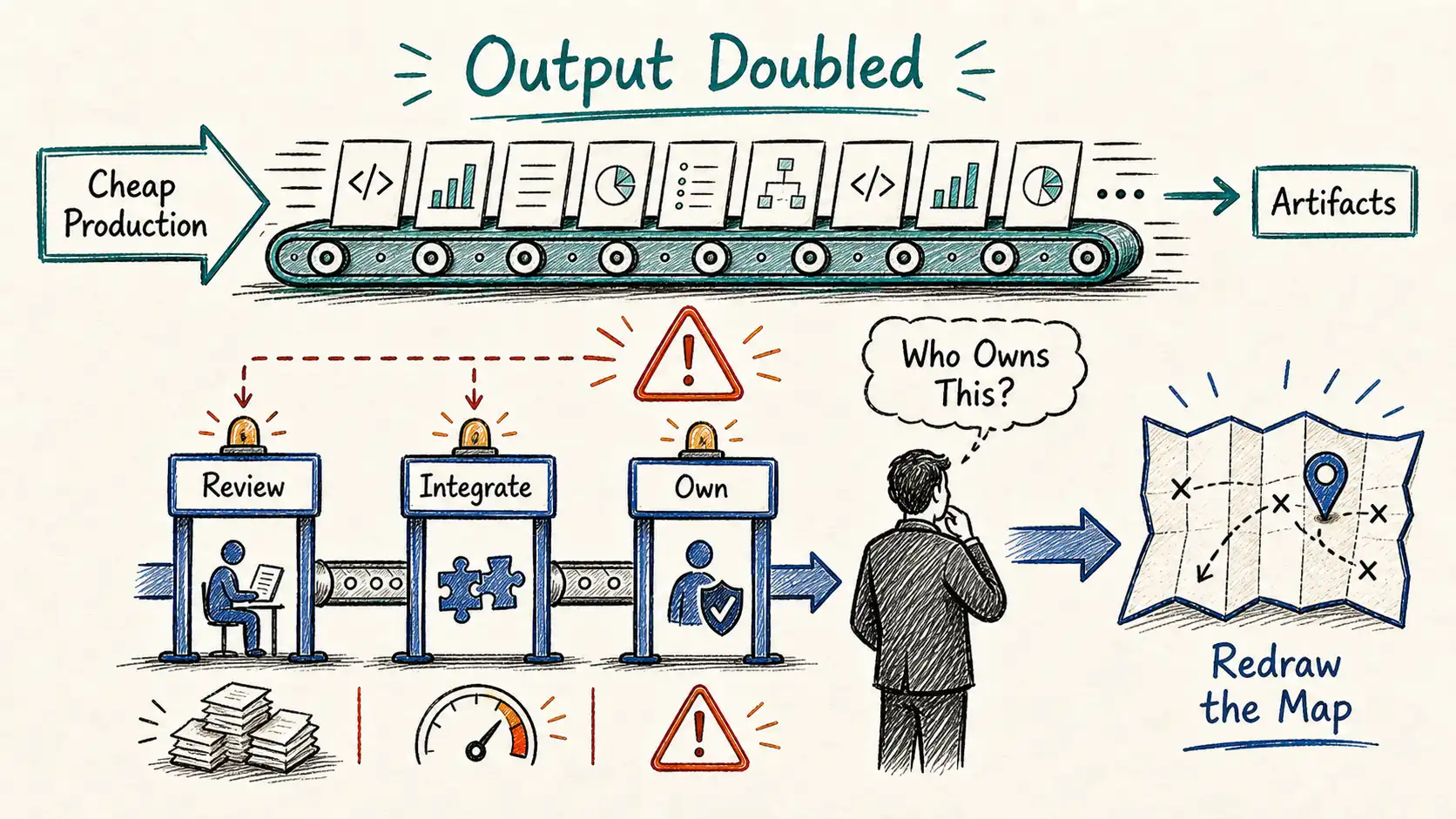
Here is the number that does not end up in the board deck. The same surge of artifacts has to be reviewed, integrated, owned, and answered for, and those activities did not speed up at the same rate. Google's 2024 DORA report found that as AI adoption rose, software delivery throughput and stability actually went down, not up: a 25 percent increase in AI adoption was associated with an estimated 1.5 percent drop in throughput and a 7.2 percent drop in delivery stability. More code, written faster, in bigger batches, moving slower through the system that has to absorb it. The manager doubled his production rate and inherited a review queue, an incident surface, and a decision-ambiguity load that doubled with it.
That gap, between what AI produces and what an organization can actually own, is the subject of this book.
The enemy
The enemy is headcount-first thinking that treats AI as a spreadsheet exercise instead of an ownership and operating-model change.
You have seen the spreadsheet. It has a row for each function, a column for "AI productivity uplift," and a column at the end where the uplift is converted into either fewer people or more output per person. It is the natural artifact of a CFO conversation, and it is not wrong about the cost of production. It is wrong about what production was protecting. Every produced artifact in a knowledge organization carried, invisibly, a bundle of judgment, context, and accountability. The person who wrote the migration knew which tables it would lock. The analyst who built the model knew which assumption was load-bearing. When you make the artifact cheap and keep the judgment bundle implicit, you do not get the same work for less money. You get more artifacts and less ownership per artifact, and ownership is the thing that was actually scarce.
This is why the book is not a job-loss prediction, not a future-of-work essay, not a tools comparison, not a flat-org manifesto, and not a headcount-cutting playbook. Those books all start from the spreadsheet. This one starts from the queue.
The thesis
Automation does not remove the need for ownership. It makes ownership more important, because more work can now be produced with less friction and less review.
Read that twice, because the intuition runs the other way. The intuitive story is that AI handles the boring production and frees humans for the high-judgment work, so judgment becomes easier. The opposite is true. When production was expensive, judgment was distributed across the act of producing: you judged as you typed, because typing was slow enough to think inside. When production collapses to seconds, the judgment does not get done faster. It gets skipped, deferred, or quietly assumed to live somewhere else. The METR randomized trial of experienced developers in 2025 is the cleanest illustration: developers using 2025-era AI tools were actually 19 percent slower on their own mature codebases, even though they believed they were 20 percent faster. The artifacts came fast. Owning them in a real system did not. And the people doing the work could not feel the difference, which is the most dangerous part.
So ownership becomes the binding constraint. Not talent, not tooling, not even compute. The question that decides whether your AI rollout creates use or chaos is brutally simple: for every artifact your organization now produces, is there a named human with the context, authority, time, and incentive to own the consequences if it is wrong? When the answer is no, you have not automated work. You have orphaned it.
The motif
The org chart is the ownership map. When automation changes the work, redraw the map before the map lies.
A reporting line is not a status hierarchy, although it gets used as one. It is a claim about who answers for what. When you draw a box around a person and connect it to a system, you are asserting that this person owns the consequences of that system, and that someone above them owns the consequences of their ownership. That assertion was approximately true when production was slow, because the volume of consequence per person was bounded by the volume of production per person.
Cheap production breaks the assertion silently. The boxes look the same. The reporting lines look the same. But behind one box a single engineer is now merging the output of three engineers' worth of generation, and the chart still says that engineer's manager reviews that engineer's work, when in reality nobody is reviewing two-thirds of what now ships. The map did not change. The territory did. So the map lies, and it lies in the most expensive way a map can lie: it tells you that something is owned when it is not.
Throughout this book I return to five frameworks that I built to find those lies before they cost you an incident:
- The Automation Displacement Grid, which maps how much AI reduces the effort of a task against how much risk attaches to that task being wrong, because those two axes have nothing to do with each other and most rollouts confuse them.
- The New Span of Judgment, which separates how much output a manager can supervise from how much responsibility a manager can actually carry, and shows why the first number can explode while the second stays roughly fixed.
- The Ownership Compression Pattern, which is what happens when one role quietly absorbs the production of three, creating a single point of failure that no org chart shows.
- The Apprentice Gap, which is the slow-motion crisis you create when AI automates exactly the tasks juniors used to learn judgment on, so your senior pipeline dries up four years downstream.
- The Human-in-the-Loop Fallacy, which is the belief that putting a person at the end of an automated process constitutes ownership, when review without context, authority, time, incentive, and a real escalation path is theater.
These are not acronyms to memorize. They are diagnostic instruments. By the end of the book you should be able to look at any team, any workflow, any reorg proposal, and locate where the ownership map has started to lie.
Who this is for, and how to read it
If you are a CTO or engineering leader redrawing teams around AI-assisted delivery, a product leader trying to keep speed and accountability in the same sentence, a founder scaling output without scaling chaos, a senior engineer wondering whether your role is being elevated or hollowed out, an operations leader pushing AI into support or finance or legal, or a people leader rewriting leveling guides that no longer describe reality, this book is aimed directly at you. It is written from the operator's chair, by someone who has sold the software, run the rollout, owned the incident, and sat in the uncomfortable meeting afterward where everyone discovers that "the AI did it" is not a sentence you can say to a customer, a regulator, or a board.
You do not need to read it in order, but it builds. The early chapters establish why the old map is wrong and why output and capacity are different things. The middle chapters redesign the load-bearing roles: the senior, the junior, the manager. The later chapters confront ownership and accountability directly: human-in-the-loop, incident responsibility, and the new operating roles and team shapes that actually hold. It ends with a checklist you can run against your own organization, because a point of view that does not survive contact with Monday morning is just an opinion.
Every chapter carries its own research spine. I treat the productivity studies skeptically, including the ones that flatter the technology, because the gap between measured production gains and measured delivery outcomes is the most important finding in the whole literature and almost nobody is pricing it in.
The manager I started with eventually got his nerves back. Not by slowing down production, and not by cutting headcount. He got them back by redrawing the map: by deciding, deliberately and per workflow, who now owns what, who can actually review it, and what happens when it breaks at three in the morning. That redrawing is the work. Let's start where it starts, with the first org chart that quietly becomes wrong.