Seniority When the Junior Tasks Are Gone
If a tool now does what a senior used to be paid to do, you have to know what you were actually paying the senior for.

A CTO asked me a question over coffee that I have heard, in some form, a dozen times since: "If the AI writes code as well as my mid-level engineers, what exactly am I paying my seniors for?" He meant it sincerely, not cynically. He had watched his senior engineers' raw output advantage shrink, because the floor had risen: the tool made everyone's first draft competent, so the gap between a senior's first draft and a junior's first draft narrowed dramatically. The thing he had always used to justify the senior's salary, "they produce better code, faster," was suddenly less true. So what was he paying for?
The honest answer is that he had never been paying for the code. He had been paying for the code as a proxy for something harder to see, and the tool had just stripped the proxy away, leaving him staring at the actual thing he valued without the convenient measurement he used to price it.
What seniority actually was
Let me decompose what a senior knowledge worker provides, because the decomposition is the whole chapter, and the components do not all move the same way under automation.
A senior brings four things:
- Production skill. They make the artifact well and fast. This is the visible, measurable part, the part we used proxy salaries on.
- Judgment. They know which artifact to make, which approach is right, which assumption is load-bearing, where the bodies are buried. This is mostly invisible and shows up as the absence of disasters.
- Taste and standards. They know what "good" looks like and hold a line on it, which is how an organization's quality survives turnover.
- Ownership. They will answer for the consequences. When it breaks, they do not say "the spec was unclear." They own it.
AI substitutes hard for component one and barely touches components two, three, and four. The Stanford AI Index 2025 frames the productivity research as "skill augmentation," noting that AI support lets less experienced workers reach results that previously required expertise. Read carefully, that is a statement about component one. It says the tool raises the production floor so juniors produce senior-looking artifacts. It says nothing about judgment, taste, or ownership, because those are not what the studies measure. They measure artifacts.
So the CTO's confusion was a measurement confusion. He had been pricing seniority on component one because it was the part he could see, and component one is exactly the part that just got commoditized. The components he actually could not run his organization without, two through four, are untouched and now more valuable, because the flood of plausible artifacts makes judgment, taste, and ownership the binding constraints. He was not paying his seniors for less than before. He was paying them for the same thing, finally visible now that the proxy had burned away.
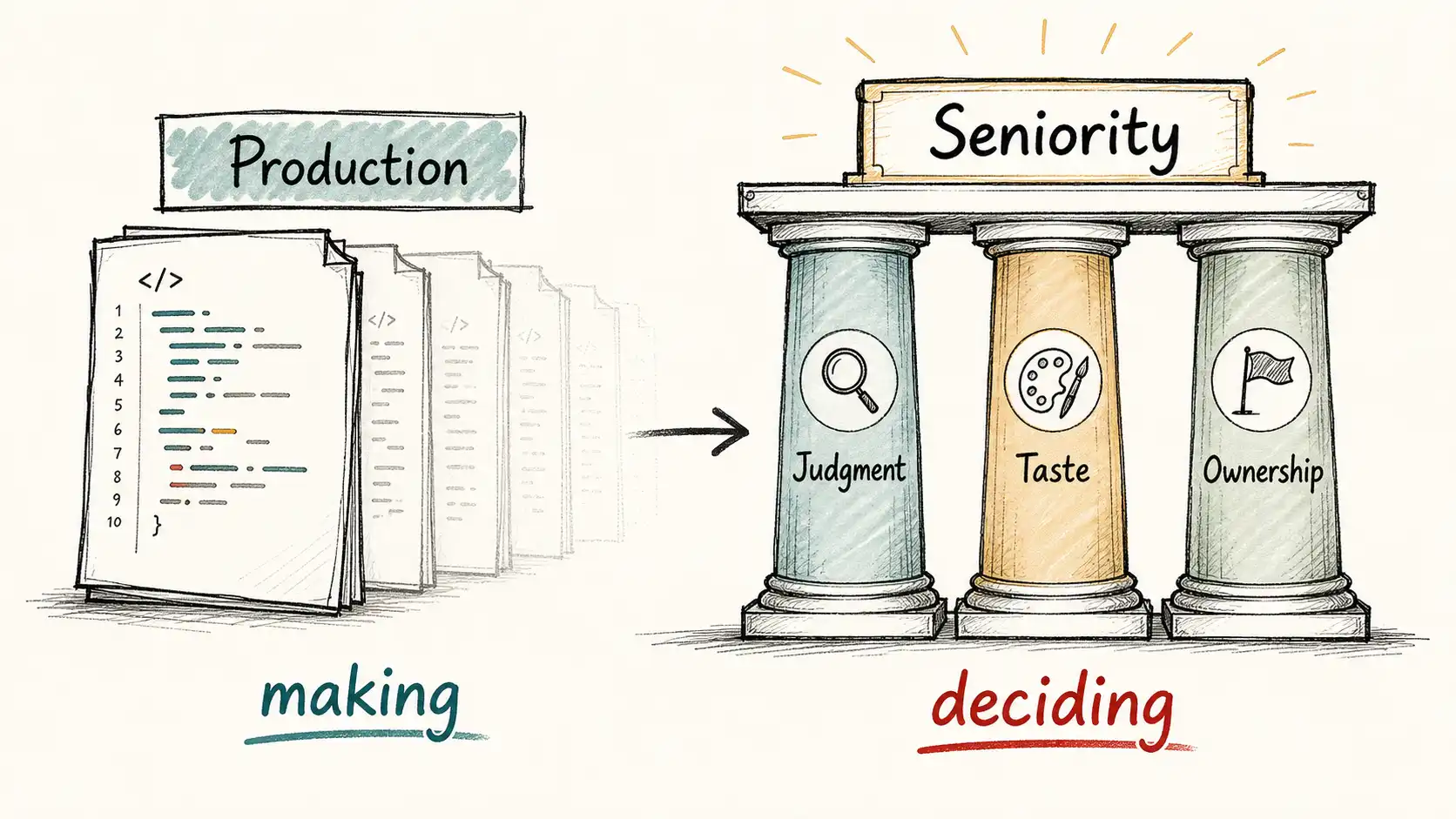
Seniority shifts from making to deciding
Here is the reframe to take into your leveling guide. Before AI, a senior's day was production-heavy with judgment woven through it: they made things, and the judgment rode along inside the making. After AI, the making is cheap, so the senior's day inverts. It becomes judgment-heavy with production as a thin layer on top: they decide what should be made, evaluate what the tools and juniors made, hold the standard, and own the result.
This is not a small adjustment to the role. It is a different job with the same title. The skills that distinguish a senior shift from "produces excellent artifacts" to "makes excellent decisions about artifacts they did not produce." Reading code you did not write and judging it correctly is a different and harder skill than writing good code. Evaluating a model someone else built is harder than building one. The senior who was great because they were a fast, clean producer is not automatically great at the new job, and some of your best producers will struggle, while some quieter people with exceptional judgment will suddenly look like the most valuable engineers you have.
Your leveling guide almost certainly still rewards component one. Most do, because component one is measurable and the others are not. If your senior-engineer rubric is heavy on "writes high-quality code" and light on "makes sound architectural judgment under ambiguity, holds quality standards across others' work, and owns outcomes end to end," your rubric is now measuring the commoditized part and ignoring the scarce part. You will promote the wrong people and underpay the right ones, and you will do it while believing you are being rigorous, because the rubric feels objective. Objective measurement of the wrong thing is worse than rough measurement of the right thing.
A revised seniority model
Here is a leveling spine that survives cheap production. It is not a complete rubric; it is the load-bearing axis your rubric should be built around.
| Level | Old definition (production proxy) | Revised definition (judgment and ownership) |
|---|---|---|
| Junior | Produces simple artifacts with supervision | Produces with AI; learning to evaluate output and recognize when it is wrong |
| Mid | Produces complex artifacts independently | Owns a bounded surface; can judge own and AI output reliably within it |
| Senior | Produces the hardest artifacts, fastest | Makes sound judgment under ambiguity; reviews and owns others' and AI's output; holds standards |
| Staff / Principal | Sets technical direction | Owns judgment at system scale; decides where automation is allowed and where it is forbidden; defines the acceptance bar others enforce |
The right column is what you are actually paying for and always were. The left column was the proxy. The exercise for your organization is to rewrite your leveling guide so that promotion tracks the right column, not the left, because the left column is now purchasable for twenty dollars a month per seat.
The danger: collapsing levels
The seductive misread of all this is "AI raises everyone to senior, so we can flatten the ladder and pay fewer people more." This is the spreadsheet sneaking back in, and it is wrong for a specific structural reason.
AI raises everyone's production to look senior. It does not raise anyone's judgment, taste, or ownership. So if you flatten the ladder on the strength of production parity, you get an organization full of people producing senior-looking artifacts with junior-level judgment about whether those artifacts are right, and no senior layer left to catch the difference. You have removed the exact people whose job was to own the output of the tool, on the grounds that the tool made everyone look like those people. That is how you walk straight into the trap zone from the previous chapter, at scale, with nobody home to own the consequences.
The levels are not redundant now. They are more necessary, because the gap between looking competent and being correct just widened. A junior with AI produces work that looks like a senior's and is wrong in ways only a senior can see. The senior's job, catching that, was always the point, and it is now a full-time job rather than a part-time tax. Flattening removes the catcher precisely when the things needing catching multiplied.
What this means for the senior, personally
If you are the senior reading this and wondering whether your role is being elevated or hollowed out, the answer is: both, and which one happens to you depends on what you do in the next year.
Hollowed out is what happens if you defend component one. If your identity and your value are built on being the fastest, cleanest producer, the tool is coming for that identity, and defending it is a losing fight against a machine that does not get tired. The seniors who feel most threatened are the ones whose value was most concentrated in raw production, and their instinct, to out-produce the tool, accelerates their own obsolescence.
Elevated is what happens if you move up the stack into judgment, taste, and ownership deliberately. The senior who says "fine, the tool makes the drafts, my job is now to decide what should be built, to evaluate everything that gets produced, to hold the line on quality, and to own the outcomes" becomes more valuable than they ever were, because they are now the binding constraint on an organization producing artifacts faster than it can judge them. The work that used to be a quarter of your job, the judgment and ownership woven through the production, is now your whole job, and it was always the part that was hard to replace. The transition is uncomfortable because it asks you to give up the thing you were good at and visible for. But the thing on the other side is more durable, harder to automate, and worth more.
A concrete move for leaders
Run this audit on your senior population. For each senior, estimate what fraction of their value to the organization comes from each of the four components: production, judgment, taste, ownership.
For each senior:
 production_share = how much of their value is raw output speed/quality?
 judgment_share = decisions, architecture, knowing what to build
 taste_share = standards held, quality enforced across others' work
 ownership_share = will answer for outcomes; carries the consequence

 if production_share is the largest component:
 AT RISK. Their visible value is the part AI commoditized.
 Invest in moving them up the stack, fast, or they stall out.

 if judgment + taste + ownership dominate:
 RISING VALUE. These are now your scarcest resource.
 Protect their time. Do not bury them in production-volume metrics.
 Reward the right column of the leveling table, not the left.
The seniors whose value was concentrated in production are not bad engineers. They are well-adapted to an environment that just ended, and your job as a leader is to help them adapt to the new one rather than letting them discover the hard way that the ground moved. The seniors whose value was already in judgment and ownership are your most valuable people and are frequently your least loud, which means your production-volume metrics may be undervaluing them at the exact moment they became irreplaceable.
The CTO at the coffee figured this out. He stopped asking what he was paying his seniors for and started asking which of his seniors had actually been delivering judgment, taste, and ownership all along, hidden behind the production they no longer needed to do. A couple of them, it turned out, had been the quiet ones, the people who did not ship the most code but somehow the things they touched never broke. Those were the ones the tool had just made visible. They had always been the answer to his question. He had just been measuring the wrong column.
This raises the obvious next problem. If seniority is judgment, and juniors used to build judgment by doing the production tasks that AI now does, then where do the next seniors come from? That is the apprentice gap, and it is the most important long-range risk in this entire book.
Key Takeaways
- A senior provided four things: production skill, judgment, taste, and ownership. We priced seniority on production because it was visible. AI commoditized production and left the other three untouched and more valuable.
- The senior role inverts: from production-heavy with judgment woven in, to judgment-heavy with production as a thin layer. Evaluating output you did not produce is a different and harder skill than producing it.
- Leveling guides that still reward "writes high-quality artifacts" now measure the commoditized part. Rewrite them around judgment, ownership, and standards held across others' work.
- Do not flatten the ladder on production parity. AI makes everyone look senior in output while leaving junior judgment intact, so the senior layer that catches plausible-but-wrong work is more necessary, not less.
- Audit each senior by where their value concentrates. Production-heavy seniors are at risk and need to move up the stack; judgment-and-ownership-heavy seniors are your scarcest resource and your volume metrics may be undervaluing them.