When Small Models Are Wrong
The honest chapter: where small models fail, where the compression reflex becomes its own mistake, and how to know the difference.

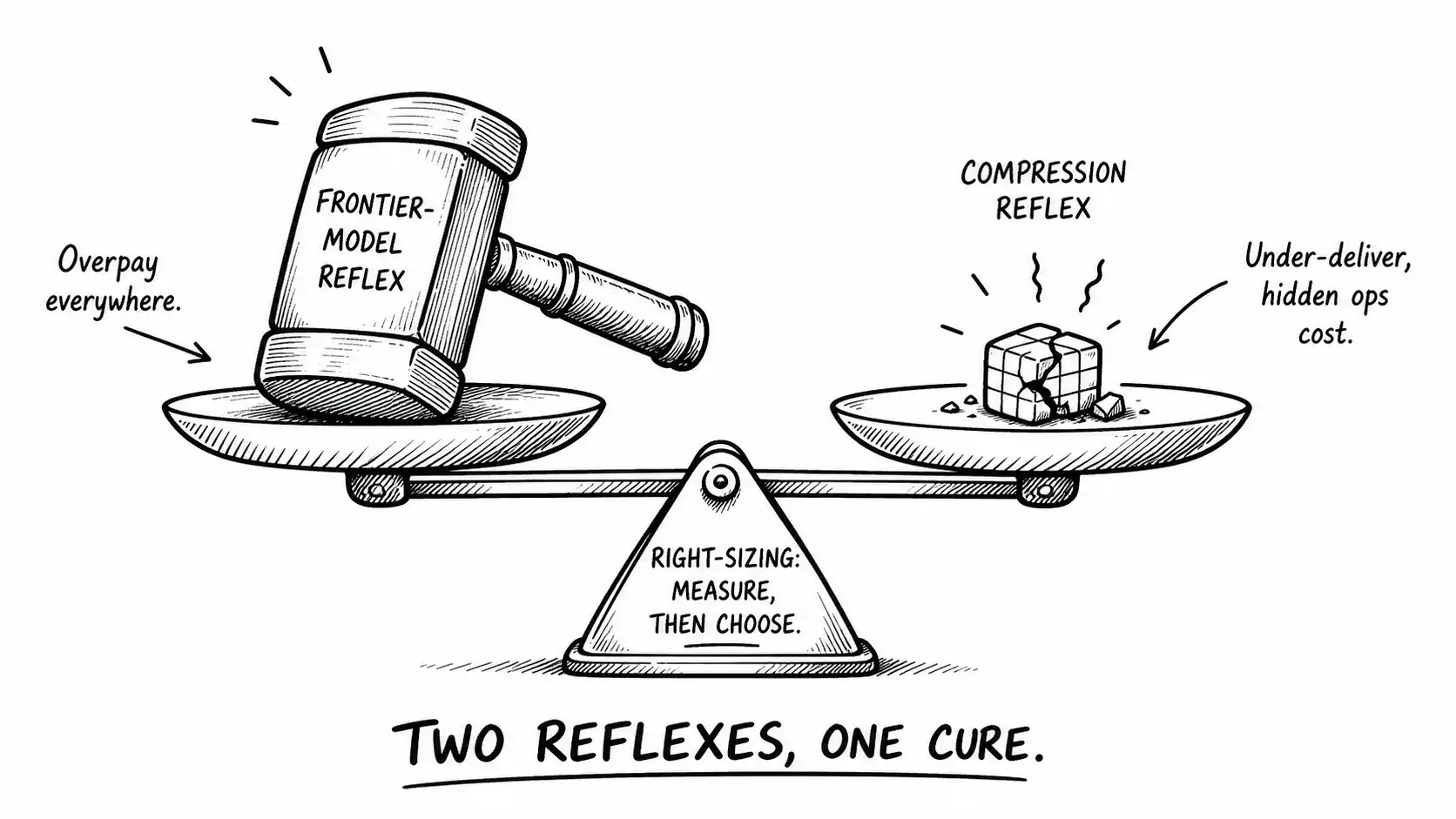
Research spine: this chapter stays grounded in DistilBERT result and FrugalGPT work, then applies that evidence to the operating judgment in the book. A book called In Defense of Small Models that only told you when small models win would be a sales brochure, and I have read enough of those to know they are useless precisely because they never tell you when the thing fails. So this is the chapter where I argue against my own thesis as hard as I can, because the frontier-model reflex has a mirror image, the compression reflex, the belief that smaller is always better and that reaching for a frontier model is a failure of engineering virtue. That belief is just as wrong as the reflex it opposes, and it fails in ways that are more embarrassing because they are self-inflicted by people who thought they were being clever. The whole point of this book is choosing the right size, and sometimes the right size is the frontier.
Where small models genuinely fail
Let me be specific about where small models fall down, because "they are worse on hard tasks" is too vague to act on.
Open-ended reasoning and synthesis. Tasks that require chaining many steps of reasoning, holding a lot of context in mind at once, or synthesizing across disparate inputs are where the frontier's scale earns its cost. A small model can follow a recipe; it struggles to invent one. If your task is "read these twelve documents and produce a coherent novel analysis that weighs the tensions between them," a small model will give you something shallower and more error-prone, and no amount of fine-tuning fully closes that gap because the gap is in the raw reasoning capacity, not the domain knowledge.
The genuinely long tail. Small models, especially fine-tuned ones, are good on the distribution they were trained for and brittle outside it. The frontier model's broad training gives it a graceful-degradation property: it has probably seen something like your weird input before. A narrow small model has not, and it fails harder on the truly novel case. This is exactly why the cascade exists, but it means a standalone small model with no escalation path is dangerous on tasks with a fat, unpredictable tail.
Instruction following under ambiguity. When the instruction is underspecified and the model has to infer intent, larger models are noticeably better at doing the reasonable thing. A small model is more likely to take an instruction too literally or miss an implicit constraint. For tasks where the input is messy human intent rather than clean structured data, the frontier's edge is real.
Robustness to adversarial and out-of-distribution input. A fine-tuned small classifier can be brittle to inputs crafted to fool it or simply unlike anything it trained on. In settings where inputs are adversarial (fraud, abuse, security) the small model's narrow competence becomes a liability, because adversaries probe exactly the edges where it is weak.
None of these is a reason to abandon small models. They are a map of where to keep the frontier in the loop, via escalation, via human review, via a higher-capability default for that specific feature. The mature posture is not "small everywhere" but "small where it fits, frontier where it does not, and a measured way to tell which is which."
The compression reflex and its costs
The mirror-image mistake is treating smallness as a virtue independent of outcomes, and it has specific, recognizable failure modes that I have watched teams walk into.
Over-compression that quietly degrades quality. The team that quantizes to 3 bits because 4 felt insufficiently aggressive, or stacks pruning and quantization and distillation until the model is tiny and subtly broken in ways the demo does not show. Each compression step trades quality for size, and stacked aggressively the losses compound unpredictably. Compression past your quality floor is not thrift, it is self-sabotage that you pay for in support tickets later.
Under-investing in the escalation path. A team commits to a small model, ships it without a real escalation path, and then quietly ships wrong answers on the hard cases the small model cannot handle. The small model was fine; the architecture that gave it no way to say "I do not know" was not. A small model without escalation is only as good as its worst case, and its worst case can be very bad.
Optimizing a cost that does not hurt. A team spends three engineering weeks shrinking a model that was serving low volume, saving a few dollars a month, while a frontier API would have cost less than the engineering time. This is the compression reflex as misallocated effort: small is intellectually satisfying, so people optimize it even when the volume does not justify the work. The arithmetic, again, is the corrective: optimization effort has to be justified by the savings at real volume.
Rebuilding what you could have bought. The team that fine-tunes and self-hosts a small model to save money, then discovers they have acquired a training pipeline, an eval harness, a serving stack, a monitoring system, and an on-call rotation, all of which they now maintain forever. Sometimes that ownership is worth it. Sometimes it is a self-inflicted operational burden that dwarfs the per-token savings they were chasing. Smallness in the model can mean largeness in the operation, and the operation is mostly people.
The silent failure problem
The most dangerous failure mode of small models is not being wrong, it is being wrong silently and confidently. A frontier model that is uncertain often hedges, asks for clarification, or produces a visibly tentative answer. A small fine-tuned model frequently produces a wrong answer with the same confident formatting as a right one, because it was trained to produce answers in a format, not to know the limits of its own competence.
This is why the failure modes of small models are an operational problem, not just a quality problem. A small classifier that is 94 percent accurate makes a wrong call 6 percent of the time, and unless you have built detection, those 6 percent flow downstream looking exactly like correct answers. The defenses are the ones we have built throughout the book - and Proving Good Enough With Evals provides the measurement machinery that makes them operational - now reframed as failure mitigation:
- Verifiers catch confident-wrong answers that the model's own confidence will not flag. The deterministic business rule that says tax cannot exceed total catches an extraction error regardless of how confident the model was.
- Calibrated confidence lets the model abstain or escalate when uncertain, but only if you have verified the calibration, because an uncalibrated confidence signal is worse than none, it is misleading.
- Escalation paths give the system somewhere to send the cases it should not decide, rather than forcing a guess.
- Monitoring for drift catches the slow degradation as production inputs move away from the training distribution, which is the way small models fail over months rather than instantly.
A small model with these defenses is safe to ship. A small model without them is a confident-wrong-answer generator wearing the costume of a working feature, and it will hurt you in proportion to how much you trusted it.
A decision rule for "is this a frontier task"
Pulling the honest failures together, here is a rule for deciding when a task genuinely needs the frontier, so you can reach for it without guilt and without the compression reflex talking you out of the right tool.
A task likely needs the frontier model, at least as the escalation tier, when:
- The reasoning is genuinely multi-step and open-ended, not a bounded judgment.
- The input space is unbounded and unpredictable, so no training distribution covers it.
- The instructions are ambiguous and require inferring intent.
- The inputs may be adversarial.
- The cost of a wrong answer is high and there is no cheap verifier to catch errors.
- The volume is low enough that the per-request cost does not matter and the engineering cost of a small-model solution would exceed the savings.
If a task hits several of these, do not torture it into a small model. Use the frontier, or use the frontier as the escalation tier in a cascade where a cheap router sends it the hard cases. The skill this book is teaching is not "always go small." It is recognizing which tasks are which, and the failure modes in this chapter are the diagnostic for the ones that are not small at all.
What to do tomorrow
Audit your small-model deployments for the silent-failure risk. For each one, ask: how would we know if this model started being confidently wrong? If the answer is "we would not, until someone complained," you have an undefended small model, and the fix is a verifier, a calibrated abstention path, an escalation route, and drift monitoring, in roughly that order of use. And separately, audit for the compression reflex: is there a small-model project consuming engineering time to save a cost that does not actually hurt, or rebuilding something you could buy? Killing that project is as much a right-sizing decision as shrinking an over-large model. Both reflexes cost money. The discipline is the same: measure, then choose - which is exactly the posture the Conclusion calls the senior move.
Key Takeaways
- Small models genuinely fail on open-ended reasoning and synthesis, the truly novel long tail, ambiguous instruction following, and adversarial or out-of-distribution input. These are the map of where to keep the frontier in the loop.
- The compression reflex is the mirror-image mistake: over-compressing past the quality floor, shipping without an escalation path, optimizing costs that do not hurt, and rebuilding what you could have bought. Both reflexes cost money.
- The most dangerous small-model failure is being wrong silently and confidently, because small fine-tuned models produce wrong answers in the same confident format as right ones. Verifiers, calibrated confidence, escalation, and drift monitoring are the defenses.
- A task likely needs the frontier when reasoning is open-ended, inputs are unbounded or adversarial, instructions are ambiguous, errors are expensive with no cheap verifier, or volume is too low to justify a small-model build.
- The skill is not "always go small." It is recognizing which tasks are which, and choosing the right size by measurement rather than by either reflex.