The Guardrail System
Working claim: Guardrails are not a feature you add; they are a property of how the whole system is built.

Key Takeaways
- The Guardrail System treats guardrails as placed controls, not a single wall around the model.
- The right question is ROAD: which risk, at which operation, with which action, and which detection signal?
- A useful guardrail system reduces both bypasses and overblocking while keeping residual risk observable.
Working claim: Guardrails are not a feature you add; they are a property of how the whole system is built. The book's controls compose into one layered architecture where no single layer has to be perfect, the gentle action is always tried before the blunt one, and the residual risk is named, observed, and owned rather than denied.
Reassembling the system
We began with an afternoon in which a support assistant both refused a paying customer and refunded an attacker, and the diagnosis was that the team had built a wall, a single moderation-plus-prompt barrier, when the system needed guardrails: layered controls placed where the road is actually dangerous. Every chapter since has built one part of that layered system. This final chapter reassembles them into a single architecture and states the principles that make the assembly more than the sum of its filters.
Here is the whole system as one request flows through it, with each control tagged by the chapter that built it and the boundary operation it occupies.
REQUEST ──► [GATEHOUSE] auth · rate-limit · intent · moderation · injection · PII (Ch.6, ops 1-3)
 │ produces signals -> combined into a DISPOSITION (Ch.4/5)
 ▼
 [RETRIEVAL FIREWALL] permission pre-filter · search · sanitize · wrap-as-evidence (Ch.7, ops 4-7)
 │ retrieved text enters as UNTRUSTED EVIDENCE, never instruction
 ▼
 [MODEL INFERENCE] trained refusal as ONE layer; instructions in a channel the data can't write (op 8)
 │
 ├──► OUTPUT TEXT ──► [OUTPUT SIEVE CHAIN] schema · policy · evidence · leakage · moderation (Ch.8, ops 9,11)
 │ │ revise > redact > degrade > refuse (Ch.9)
 ▼ ▼
 OUTPUT TOOL CALL ──► [TOOL POLICY ENGINE] manifest · argument validation · AUTHORIZATION (fact) · constraints (Ch.10, op 12)
 │
 ▼
 [SIDE-EFFECT LADder] read/draft free · bounded write w/ limits · irreversible -> dry-run/stage/approval (Ch.11, op 13)
 │
 ▼
 [RESULT VALIDATION] tool results = untrusted; wrap + scan 2nd-order injection (Ch.10, op 14)
 │
 ▼
 RESPONSE ──► USER (op 15)
 │
 ├──► [AUDIT / TELEMETRY] every decision logged w/ policy_version (Ch.13, op 16)
 └──► [HUMAN ESCALATION] the cases the system must not decide alone (op 17)

 ABOVE IT ALL: POLICY (versioned, owned - Ch.4) · EVALS + RELEASE GATE (Ch.12) · MONITORING + RUNBOOK (Ch.13)
No single box in that diagram is the safety system. The safety system is the composition, and the composition has five load-bearing properties.
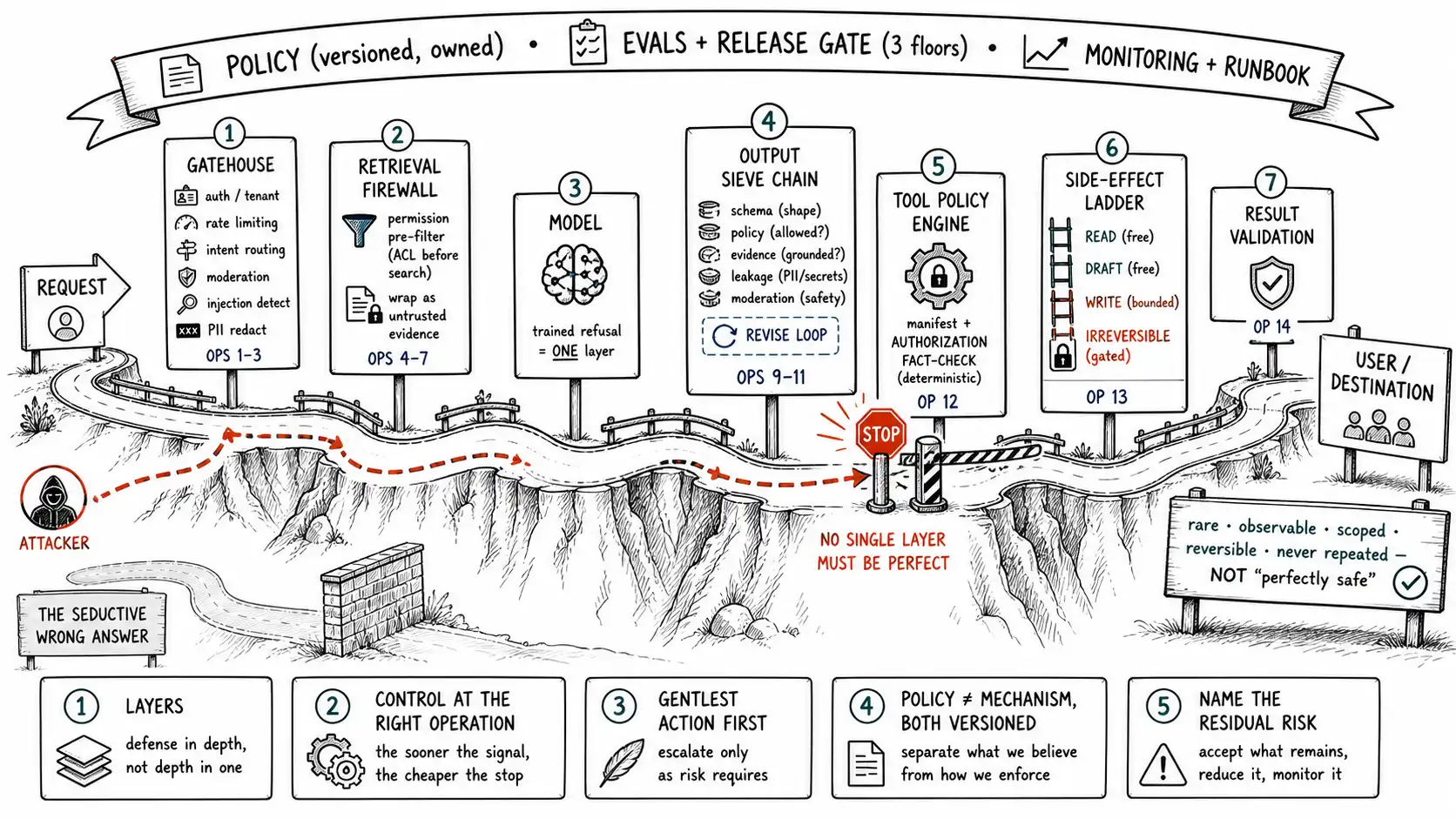
The five principles that hold it together
1. Layers, so no single control must be perfect. Defense in depth is not redundancy for its own sake; it is the deliberate arrangement that lets the last layer be deterministic even when the earlier ones are probabilistic. The gatehouse reduces attack volume but need not catch everything; the retrieval firewall reduces injected instructions but need not be flawless; the output sieve validates structure but need not anticipate every payload, because behind them all, the tool policy engine authorizes against real facts and the side-effect ladder bounds the blast radius. The refund attack failed in the rebuilt system not because one filter got smart but because even a fully successful manipulation of the model hit a deterministic authorization check it could not satisfy. That is the whole point of layering: you design so the bypass of any one layer is survivable.
2. Place the control at the operation that owns the risk. The single most repeated lesson of the book, and the one that distinguishes a guardrail from a wall, is that a control reduces a risk only when it sits at the operation where the risk lives (Ch. 3). The text moderator could not catch the tool call; the input filter could not catch the retrieved document. Most real bypasses are not weak controls but well-built controls at the wrong operation. ROAD, risk, operation, action, detection, is the procedure that keeps controls placed correctly, and it is worth running for every guardrail in the system, because a control at the wrong operation is worse than no control: it provides false confidence while the real path stays open.
3. Reach for the gentlest action that reduces the risk. The action ladder, allow, log, redact, degrade-safe, require approval, refuse, escalate, is the difference between keeping the road usable and walling it off. A wall knows only the two ends. A guardrail uses the middle: it answers the safe part, transforms rather than blocks, scopes down rather than refuses, requires approval rather than forbidding, escalates rather than guessing. The overblocking that drives invisible churn is almost always a control reaching for refuse when a gentler action would have reduced the same risk while serving the user. Every disposition in the system should be the gentlest one that actually closes the risk, not the most reassuring one to put on a slide.
4. Separate policy from mechanism, and version both. What the system should do is a normative policy with an owner, a version, and an audit trail; how it does it is a set of mechanisms that can change independently. This separation is what turns "we have guardrails" from an unfalsifiable claim into a reviewable one: every decision carries its policy version, every control names the concern it serves and the operation it occupies, and the question "why did the system do this, under what rule, approved by whom" always has an answer. Without this, guardrails accrete into the nine-hundred-line prompt nobody can explain; with it, they stay legible, attributable, and changeable.
5. Name the residual risk; do not deny it. The honest principle, and the one that separates this book from safety theater. None of these layers, individually or together, makes the system perfectly safe. Trained refusal can be jailbroken; classifiers have false negatives; authorization can be misconfigured; a novel attack will eventually appear. The NIST AI RMF is explicit that the goal is risk management, not elimination, and the OWASP guidance and the limits of approaches like Constitutional AI say the same. A mature guardrail system therefore does not claim to have closed every path; it claims to have made the dangerous failure rare, observable within a cycle, scoped quickly, mostly reversible, and never repeated. That is a defensible claim."Perfectly safe" is not, and a team that believes it has rebuilt the green dashboard from the introduction.
What "done" looks like
A team can ask whether its guardrail system is real, as opposed to theater, with a short interrogation drawn from the whole book. Not a checklist of controls to own (that produces the wall), but a set of questions whose answers must be yes, with evidence.
- Can you name, for each guardrail, the specific risk, the operation, the action, and the detection? (ROAD: Ch. 3.) If a control's risk is "unsafe output, " it is not yet designed.
- Is your policy a versioned, owned artifact separate from the mechanisms, with every decision carrying its policy version? (Ch. 4.) If your policy is a system prompt, you have no policy.
- Does every consequential action pass a deterministic authorization check that does not depend on the model's reasoning? (Ch. 10.) If the model's judgment is your authorization, you have a confused deputy.
- Is the agent's maximum autonomous side-effect rung an explicit, reviewed property, with irreversible actions gated by approval or converted to reversible form? (Ch. 11.) If autonomy crept up by feature accretion, you have excessive agency.
- Do you measure four numbers per control, overblock, underblock, bypass, correct, and does your release gate hold a usefulness floor as well as a safety floor? (Ch. 12.) If you measure only catch rate, you measure half the system.
- Can your monitoring detect a bypass by its consequences, and do you have a written runbook that contains, scopes, remediates, and structurally fixes? (Ch. 13.) If your only detection is the control's own alerts, you cannot see the bypass that matters.
- For your specific product, do you know which controls are theater and have you declined to build them? (Ch. 14.) If you copied another product's controls, you may have built a wall.
A system that answers yes to these is not perfectly safe, nothing is, but it is defensibly safe: it reduces real risk, it keeps the road usable, and when it fails it fails in ways the team can see and recover from. That is the destination the book has been driving toward.
The road, one more time
The motif has carried the whole argument: a wall stops movement; a guardrail keeps the road usable. The wall is seductive because it is simple, visible, and easy to defend in a meeting, and it is wrong, because it stops the friends along with the foes and stands in only one place while the road has many lanes. The guardrail is harder: it requires knowing where the road is actually dangerous, placing a specific control at each of those places, choosing the gentlest action that keeps travelers safe, and watching the road for the drift and the attacker that a static barrier would never see. But it is the only design that delivers what an AI product is for, reaching the destination, without driving off the cliff.
Build guardrails, not walls. Not because walls are unsafe, a wall is very safe, in the way that a product nobody can use is very safe, but because the goal was never to stop the traffic. The goal was to get it where it is going, on the road, alive. The controls in this book are how you do that: layered, placed correctly, gentle by default, versioned and owned, measured on both sides, watched in production, and honest about the risk that remains. A guardrail keeps the road usable. Now you know how to build one.
Chapter summary
Guardrails are not a feature you add but a property of how the whole system is built, and the book's controls compose into one layered architecture: gatehouse (Ch. 6), retrieval firewall (Ch. 7), model inference with trained refusal as one layer, output sieve chain (Ch. 8) with the revise-over-refuse disposition (Ch. 9), tool policy engine (Ch. 10), side-effect ladder (Ch. 11), and result validation, all sitting under a versioned owned policy (Ch. 4), an eval suite and release gate (Ch. 12), and monitoring with a bypass runbook (Ch. 13). No single box is the safety system; the composition is, and it holds together on five principles. Layers so no single control must be perfect, the last layer (deterministic tool authorization) is survivable even when the probabilistic earlier ones are bypassed, which is why the rebuilt refund attack fails against an authorization check a fully manipulated model still cannot satisfy. Place the control at the operation that owns the risk, most real bypasses are well-built controls at the wrong operation, and a misplaced control is worse than none because it provides false confidence. Reach for the gentlest action that reduces the risk, the action ladder's middle (redact, degrade-safe, require approval) is what keeps the road usable, and overblocking is almost always a reflexive refuse where a gentler action would have served. Separate policy from mechanism and version both, so "we have guardrails" becomes a reviewable claim with every decision carrying its policy version. Name the residual risk rather than denying it, the goal is management not elimination (NIST, OWASP, and the limits of Constitutional AI all agree), so a mature system claims its dangerous failures are rare, observable within a cycle, scoped quickly, mostly reversible, and never repeated, never that it is perfectly safe."Done" is a short interrogation whose answers must be yes-with-evidence, not a checklist of controls to own. The wall is seductive because it is simple and defensible and wrong; the guardrail is harder and is the only design that gets the traffic to its destination on the road, alive.