Designing the Calibrated Answer
The Calibrated Answer Contract specifies what every high-stakes answer must carry: source, scope, freshness, confidence behavior, actionability, and an escalation rule.

Research spine: this chapter stays grounded in risk-coverage tradeoff and A Gentle Introduction to Conformal Prediction and Distribution-Free Uncertainty Quantification, then applies that evidence to the operating judgment in the book. Most teams specify what their AI should answer. Almost none specify what a good answer is allowed to look like. That omission is why answer quality is inconsistent and why the bad answers are bad in dangerous ways. An API contract specifies the shape of a valid response so that callers can rely on it. An answer needs the same thing: a contract that defines what a trustworthy answer must carry before it is allowed to reach a human. This chapter builds that contract, the Calibrated Answer Contract, and shows how to enforce it.
Why a contract, not a guideline
I deliberately call it a contract, not a guideline or a best practice, because the enforcement model is different. A guideline is advice the generation step may follow. A contract is a checkable specification that an answer either satisfies or does not, enforced by a layer that sits between generation and presentation. If an answer cannot satisfy the contract, it does not get displayed in its confident form. It gets downgraded, caveated, or escalated.
This matters because the generation step, the model, is exactly the component we have established cannot be trusted to police its own confidence. Leaving "be appropriately uncertain" to the model is leaving the safety property to the component that fails at it. The contract moves the safety property into a separate layer you control and can test.
The contract has six clauses. Each answers a question the user implicitly relies on but the fluent answer usually leaves unstated.
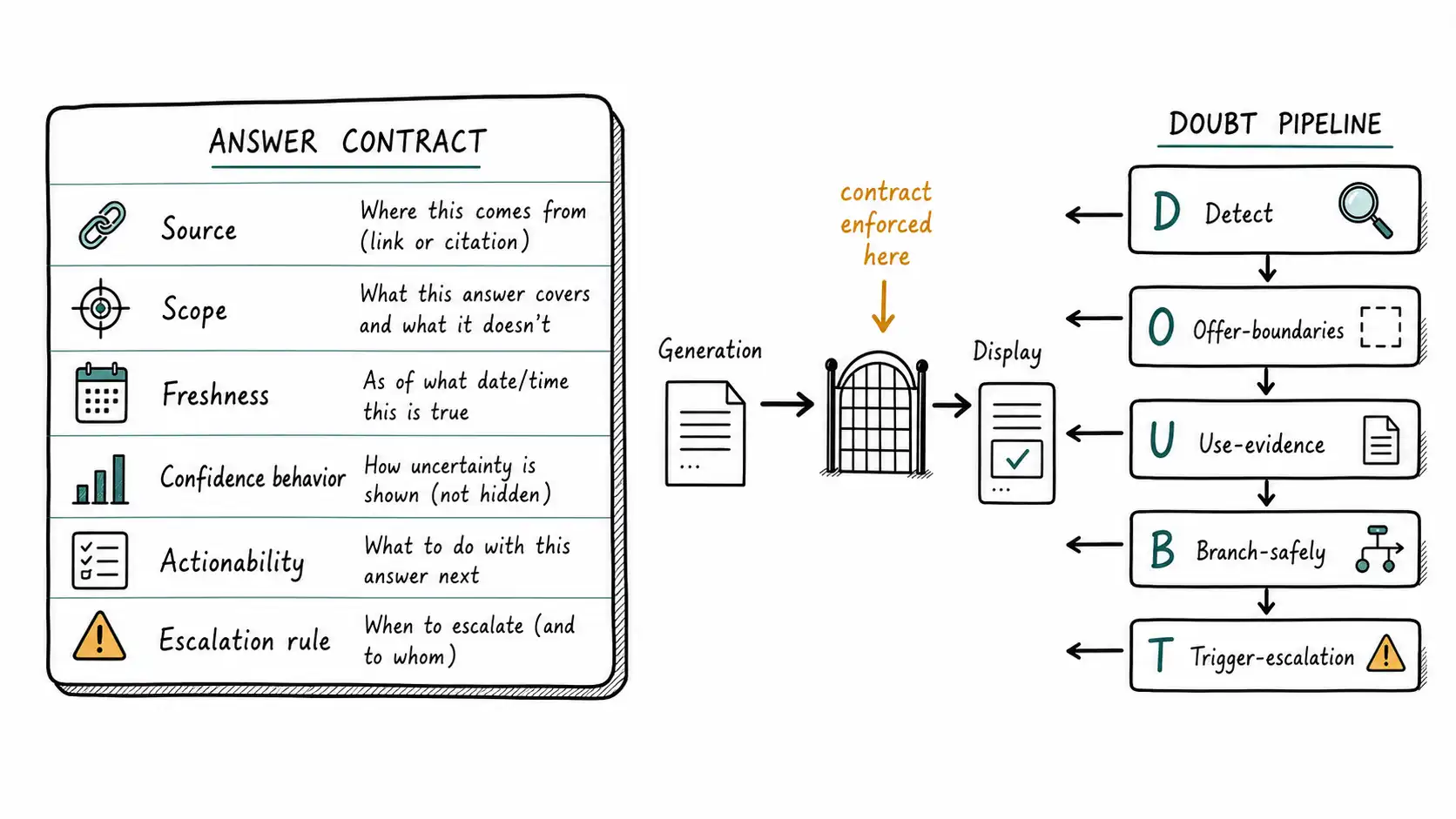
The six clauses
Source. Where does this answer come from? Not a vague "based on your documents," but the specific source, with the supporting passage surfaced as discussed in the previous chapter, and ideally with entailment verified. If there is no identifiable source, that is itself a fact the answer must carry: this is the model's general knowledge, not your data, and it should be marked as such. An answer that cannot name its source is making an unsourced claim, and unsourced claims in high-stakes contexts should be the exception that triggers extra caution, not the silent default.
Scope. What question does this answer actually address, and what is it not addressing? Fluent answers are notorious for confidently answering a slightly different question than the one asked, or for generalizing beyond what the source supports. The scope clause forces the answer to state its boundaries: "this covers refunds on standard plans; I do not have information on enterprise contracts." Scope is where you contain the model's tendency to over-generalize from a narrow source.
Freshness. As of when is this true? Every factual answer has a temporal validity, and most fluent answers omit it entirely. The freshness clause attaches the relevant date and, more importantly, an assessment: is this fresh enough for this question. A pricing answer from a document updated yesterday is fresh; the same answer from a document updated two years ago is a different, and weaker, answer that should be presented differently.
Confidence behavior. How does this answer behave as confidence drops? This is the clause that operationalizes everything from chapter three. The contract specifies a mapping from internal confidence to expressed behavior: above a high threshold, state plainly; in a middle band, state with explicit caveat and evidence; below a low threshold, hedge and offer escalation; below a floor, abstain. The contract does not just say "be calibrated"; it specifies the bands and what each band does.
Actionability. Is the user supposed to act on this directly, or is this informational? An answer the user will act on irreversibly needs more guardrails than an answer that is one input among many. The actionability clause forces the answer to be honest about whether it is decision-grade or merely a starting point, which directly affects how much confidence and how much friction the presentation should carry.
Escalation rule. When and how does this answer hand off to a human or to a more reliable process? Every high-stakes answer needs a defined escalation path, and the contract requires that the path exist and be surfaced when the confidence or stakes warrant it. An answer with no escalation rule is an answer that traps the user inside the AI's competence even when that competence runs out.
The contract as a checkable artifact
Here is the contract expressed as a structure your answer-assembly layer can enforce, before display.
{
 "answer_text": "...",
 "source": {
 "id": "policy-refunds-2026-03",
 "supporting_passage": "Refunds are available within 30 days of purchase for standard plans.",
 "entailment_verified": true
 },
 "scope": {
 "covers": "standard plan refunds",
 "excludes": ["enterprise contracts", "promotional purchases"]
 },
 "freshness": {
 "source_updated": "2026-03-01",
 "freshness_assessment": "current"
 },
 "confidence": {
 "internal_score": 0.86,
 "band": "high",
 "expressed_behavior": "state_plainly"
 },
 "actionability": "decision_grade",
 "escalation": {
 "available": true,
 "trigger": "user disputes or asks about excluded scope",
 "route": "human_support_queue"
 }
}
Notice what this structure makes impossible. It is impossible to ship a confident, plainly-stated answer with entailment_verified: false or band: low, because the assembly layer reads these fields and refuses to render the confident form. The contract is not documentation; it is a gate. An answer that arrives at the gate without satisfying the clauses gets transformed, downgraded to a caveated form, or escalated, before it reaches the user. The model proposes; the contract disposes.
A sample answer contract, rendered three ways
Let me show the same query satisfying the contract at three confidence bands, so you can see how the clauses change the surface.
High band, verified source, current, decision-grade:
Refunds on standard plans are available within 30 days of purchase. (Source: refund policy, updated March 2026. This covers standard plans only, not enterprise contracts.)
Middle band, source found but freshness uncertain:
The policy I found says standard-plan refunds are available within 30 days, but I am working from a help-center page I could not confirm against the current terms. Treat this as likely but unverified, and check the current policy before acting. I can connect you with support to confirm.
Low band, retrieval weak, contradiction detected, escalation triggered:
I am not confident I can answer this accurately. I found conflicting information about refund eligibility in your account type, and I do not want to give you a wrong answer on something that affects a purchase. Let me connect you with a support agent who can check your specific account.
The content question is the same. The contract makes the answer's form track its reliability, and crucially, the low-band version does not pretend. It says "I am not confident" and routes to a human. That sentence, "I am not confident, let me connect you with someone," is one of the most valuable things an AI product can say, and most products are architecturally incapable of saying it because nothing computes the confidence band that would trigger it.
How this maps to the DOUBT pattern
The contract and the DOUBT pattern are two views of the same machinery. DOUBT is the runtime pipeline; the contract is the specification the pipeline produces.
Detect uncertainty produces the confidence.internal_score. This is where you compute a real signal from retrieval scores, source quality, verifier agreement, and any model-level confidence you can extract. If you skip this step, every downstream clause is guesswork.
Offer boundaries produces the scope clause. The pipeline determines what the answer does and does not cover and states it.
Use evidence produces the source clause with verified entailment. Evidence is checked, not attached.
Branch safely produces the confidence.expressed_behavior. Based on the band, the pipeline branches into state-plainly, caveat, hedge, or abstain. This is the safety branch, and it is where the contract earns its keep.
Trigger escalation produces the escalation clause. When confidence is low or stakes are high, the pipeline surfaces the human path.
Where to enforce the contract: the verifier-policy layer
Architecturally, the contract lives in a layer between the model/retrieval and the user interface. I call it the verifier-policy layer, and it is the single most important component most teams are missing.
The model and retrieval produce a candidate answer plus the raw materials: retrieved passages, scores, any internal confidence. The verifier-policy layer then does the work the contract specifies: it checks entailment, scores source quality and freshness, computes the confidence band, determines scope and actionability, and decides the expressed behavior and escalation. Only after the answer satisfies the contract, in whatever form the bands dictate, does it reach the UI.
This layer is testable in a way the model is not. You can write assertions: high-stakes answers with unverified entailment must never render in the plain-statement form; answers below the confidence floor must always abstain or escalate; answers citing stale sources must carry a freshness caveat. These are unit tests for safety behavior, and they pass or fail deterministically even though the model underneath is stochastic. That is the deep reason to put the safety property in a contract layer: it makes the unsafe behaviors testable and the safe behaviors enforceable, neither of which is true if you leave them to the model.
Common objections, answered
This will slow us down and add latency. The verification and scoring steps do add latency, and for low-stakes answers that is not worth it, which is exactly why the Confidence-Cost Matrix exists: enforce the full contract in the danger zone, run a lighter version elsewhere. The contract is a tiered control, not a uniform tax.
Users will trust us less if we hedge. The opposite is the durable outcome. A system that occasionally says "I am not sure, let me get a human" and is right to do so earns more trust over time than one that sounds certain and is sometimes wrong, because the first system's confidence carries information and the second's does not. We will treat the algorithm-aversion nuance, the risk that visible uncertainty triggers abandonment, in the chapter on doubt as a feature; the resolution is that calibrated, well-scoped uncertainty builds trust while sloppy uncertainty destroys it.
The model already sounds careful when it is unsure. Sometimes, by accident. But the model's hedging is not a function of a measured confidence band; it is a function of the prompt and the topic. You cannot test it, you cannot tune its thresholds, and you cannot guarantee it triggers when it should. The contract makes hedging a controlled behavior instead of an emergent one.
Practical exercise: write the contract for one answer type
Take your highest-stakes answer type from the Confidence-Cost Matrix worksheet. Fill in the six clauses concretely.
For source, define what counts as an acceptable source and whether you will verify entailment. For scope, write the explicit covers/excludes the answer must state. For freshness, define the freshness window for this answer type and what happens past it. For confidence behavior, define the actual thresholds for high, middle, low, and floor, and what each band does. For actionability, decide whether this answer is decision-grade or informational, and what guardrails that implies. For escalation, define the route and the triggers.
Then ask: does your current system produce answers that satisfy this contract, or does it produce a uniform confident paragraph regardless? The gap is your implementation backlog for the verifier-policy layer, and it is almost always larger than teams expect, because most systems have no place where these clauses are even computed, let alone enforced.
Summary
Teams specify what their AI answers but not what a good answer is allowed to look like, which is why bad answers are dangerous. The Calibrated Answer Contract is a checkable specification with six clauses: source (with verified entailment), scope (covers and excludes), freshness (date and assessment), confidence behavior (banded mapping from internal confidence to expressed behavior), actionability (decision-grade or informational), and escalation rule (route and triggers). Expressed as a structured artifact, the contract becomes a gate enforced by a verifier-policy layer between generation and display, making unsafe behaviors testable and safe behaviors enforceable, which is impossible if you leave confidence to the model. The contract is the static view of the DOUBT pipeline, and it should be enforced in full in the danger zone and lightly elsewhere per the Confidence-Cost Matrix. Doubt as a Product Feature addresses how to express the uncertainty the contract surfaces without triggering algorithm aversion or crying wolf.
Key Takeaways
- A contract, unlike a guideline, is a checkable specification enforced by a layer between generation and display, not left to the model.
- The six clauses are source, scope, freshness, confidence behavior, actionability, and escalation rule, each answering a question fluent answers leave unstated.
- Expressed as structured data, the contract makes it impossible to render a confident answer with unverified evidence or low confidence; the model proposes, the contract disposes.
- The contract is the static view of the DOUBT runtime pipeline: Detect, Offer boundaries, Use evidence, Branch safely, Trigger escalation.
- Enforce it in a testable verifier-policy layer so safety behaviors pass or fail deterministically despite a stochastic model underneath.
- Enforce the full contract in the danger zone and a lighter version elsewhere; "I am not confident, let me get a human" is a valuable sentence most products cannot say.