Doubt as a Product Feature
The Doubt UX Ladder gives you graded ways to express uncertainty, from a subtle cue to human escalation, without crying wolf.

There is a failed demo I think about often. A team had built genuine calibration into their assistant. When the model was unsure, the answer said so. The demo went badly, not because the system was wrong, but because every other answer carried a yellow warning banner reading "I may not be accurate, please verify." By the fifth banner, the executive watching had stopped reading them. By the tenth, she said the thing that killed the project: "If it's always warning me, the warnings are useless, and if it's this unsure, why are we shipping it?" The team had done the hard part, measuring uncertainty, and then expressed it with a single blunt instrument that managed to be both annoying and uninformative. Doubt was real but the UX was broken.
This chapter is about expressing doubt well. The central tool is the Doubt UX Ladder, a graded set of ways to communicate uncertainty, each appropriate to a different level of risk and confidence. The thesis is that doubt is a product feature with its own design discipline, and that a single warning banner is to calibrated doubt what a single error code is to good error handling: technically present, practically useless.
The boy who cried wolf is a calibration failure too
Before the ladder, the constraint. The yellow-banner demo failed because of habituation, the well-documented tendency for repeated warnings to lose their effect. The warning literature in human factors is consistent on this: warnings that fire too often, or that are not matched to actual risk, get tuned out, and once tuned out they no longer protect against the rare case that matters. Parasuraman and Riley named the related dynamic in automation: false alarms drive disuse, the neglect of a system because its alerts cried wolf.
So expressing doubt is itself a calibration problem. Express doubt on everything and the doubt carries no information, exactly like the uniform confidence we have been fighting, just inverted. The goal is not maximum doubt. It is doubt that fires in proportion to actual uncertainty and actual stakes, so that when the system does express strong doubt, the user has learned that it means something. A doubt signal is only valuable if it is rare enough to be believed and frequent enough to be present when needed. That is calibration applied to the warning, not just to the answer.
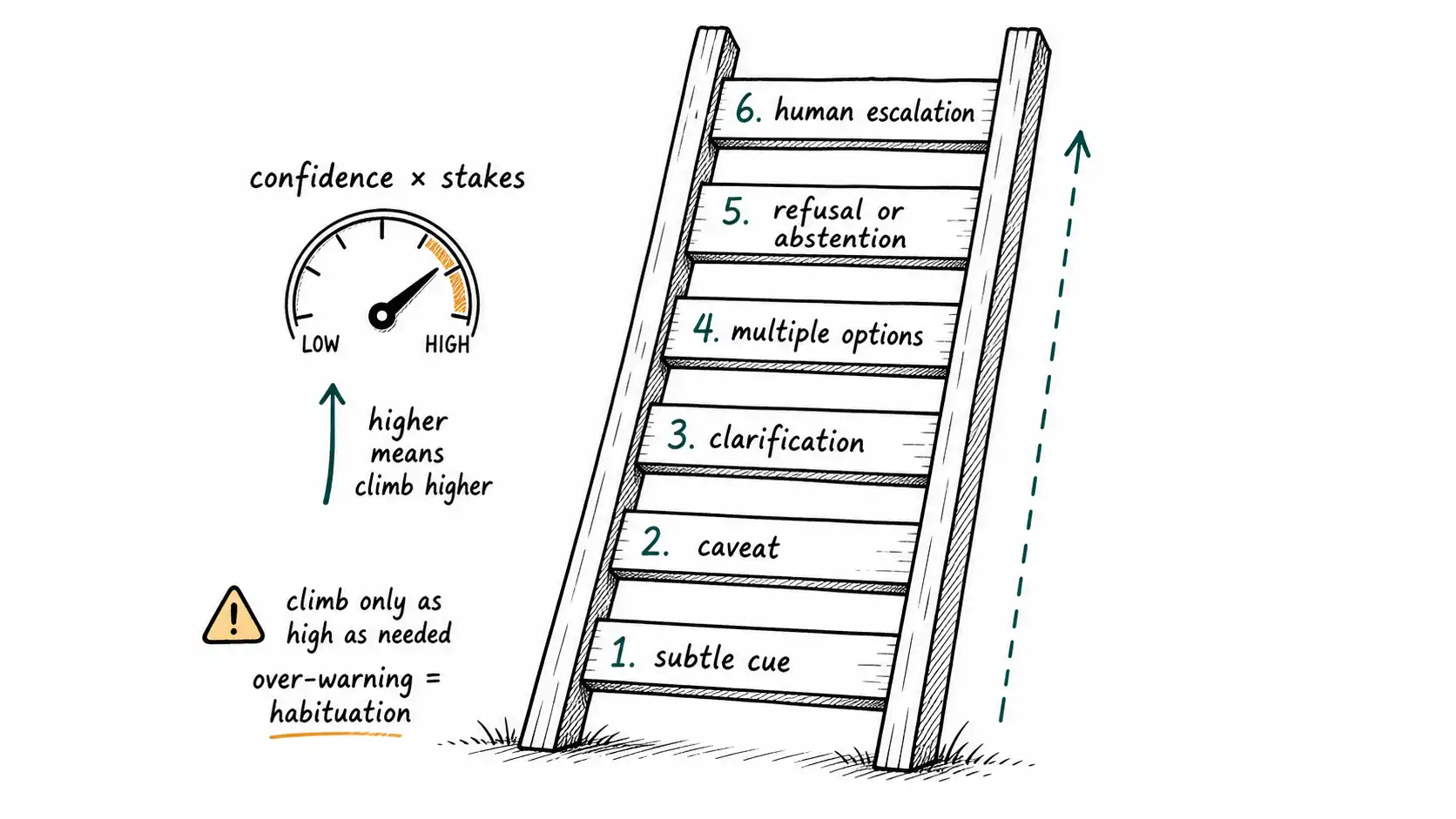
The Doubt UX Ladder
The ladder has six rungs, ordered by how much they interrupt the user and how strongly they express uncertainty. The design discipline is to climb only as high as the confidence and stakes require, and no higher.
Rung 1: subtle cue. The lightest touch. A small visual signal, softer phrasing, a muted confidence indicator, that communicates "this is solid" versus "this is less certain" without interrupting. The user who is paying attention notices; the user who is not is not slowed down. Use this as your default differentiator between high-confidence and merely-good answers. It does the most work for the least friction.
Rung 2: caveat. An explicit, inline qualification attached to the answer: "this applies to standard plans only," or "based on a document from last year." The caveat names a specific limitation. It is not a generic "I might be wrong"; it is a precise boundary. Precise caveats inform; generic ones habituate, which is the yellow-banner mistake.
Rung 3: clarification. Instead of answering under uncertainty, the system asks. "Are you asking about your personal account or your organization's account? The answer differs." Clarification converts the system's uncertainty into a question that resolves it, which is often better than expressing doubt about a guess. This rung is underused; teams reach for a hedged answer when a single clarifying question would have removed the uncertainty entirely.
Rung 4: multiple options. When the system genuinely cannot determine which answer is correct, present the candidates with their conditions rather than gambling on one. "If your plan started before March, the limit is X; if after, it is Y." This is honest about the branching the model would otherwise have hidden by silently picking one branch. It also hands the user the discriminating question, letting them resolve it with knowledge the system lacks.
Rung 5: refusal or abstention. The system declines to answer because its confidence is below the floor. Crucially, a good abstention is not a dead end; it explains why and points somewhere useful. "I cannot reliably answer this from the documents I have. Here is what I would check, or I can connect you with someone." Abstention is a feature, and we will give it its own chapter, but on the ladder it is the rung where the system refuses to manufacture a confident answer it has not earned.
Rung 6: human escalation. The system hands off to a person, with context. This is the top of the ladder, reserved for high-stakes, low-confidence situations where neither answering nor abstaining is sufficient and a human must own the outcome. A good escalation carries the context forward so the human is not starting cold.
Choosing the rung: a function of confidence and stakes
The rung is not a free choice; it is a function of the confidence band and the cost of error, the same two quantities from the Confidence-Cost Matrix and the answer contract. A workable policy:
| Confidence band | Low stakes | High stakes |
|---|---|---|
| High | Rung 1: subtle cue | Rung 1 to 2: cue plus inline evidence |
| Middle | Rung 2: caveat | Rung 2 to 3: caveat or clarify |
| Low | Rung 2 to 3: caveat or clarify | Rung 4 to 5: options or abstain |
| Below floor | Rung 5: abstain | Rung 6: escalate |
The high-confidence, low-stakes cell, the overwhelming majority of traffic, gets the lightest touch, which is why your doubt signals stay rare and therefore credible. You climb the ladder only as confidence falls and stakes rise. This is what keeps you out of the yellow-banner trap: the strong doubt signals fire seldom, so when they fire, users believe them.
The algorithm-aversion nuance: do not look incompetent
There is a real tension I have to address honestly, because a naive reading of this book would have you hedging constantly and that is also a failure. Dietvorst, Simmons, and Massey documented algorithm aversion: people abandon algorithms faster than humans after seeing them err, losing confidence in a model more quickly than in a person who makes the same mistake. Visible uncertainty, done badly, can trigger this. A system that constantly hedges can read as incompetent, and an incompetent-seeming system gets abandoned even when it is more accurate than the human alternative.
This is the resolution, and it is the most important distinction in the chapter. There is a difference between expressing low competence and expressing well-scoped uncertainty, and users respond to them oppositely.
Low-competence expression sounds like: "I'm not sure, this might be wrong, I don't really know, you should probably check." It is vague, global, and apologetic. It signals that the system does not know what it is doing. It triggers aversion and abandonment.
Well-scoped uncertainty sounds like: "Standard-plan refunds are 30 days; I don't have data on your enterprise contract, so I can't speak to that part." It is specific, local, and confident about its boundaries. It signals that the system knows exactly what it knows and what it does not. This builds trust, because precise boundaries are a competence signal, not an incompetence signal.
The follow-up work by Dietvorst and colleagues found that letting people slightly adjust an algorithm's output substantially increased their willingness to use it, even when the adjustment hurt accuracy. The lesson generalizes: people accept imperfect systems when they retain agency and understand the system's limits. Well-scoped uncertainty plus an escalation path gives them exactly that, agency and understanding, which is why calibrated doubt builds trust while sloppy hedging destroys it. The ladder, used correctly, expresses well-scoped uncertainty at every rung. There is no rung that says "I'm just generally unsure." Even abstention is specific: it names what it cannot do and offers a path.
Copy matters more than you think
The same confidence band can be expressed as competence or incompetence purely through wording. This is not cosmetic; it determines whether your calibrated system gets adopted or abandoned. Some before-and-after copy:
| Avoid (reads incompetent) | Prefer (reads well-scoped) |
|---|---|
| "I might be wrong about this." | "This is current as of March; verify if your contract predates that." |
| "I'm not really sure." | "I can answer the standard-plan case confidently; the enterprise case I'd route to support." |
| "Please double-check everything." | "Here is the exact policy sentence I used, so you can confirm in one read." |
| "Sorry, I can't help with that." | "I can't verify this reliably, so I'm connecting you with someone who can." |
Every "prefer" version expresses the same or more uncertainty than its "avoid" counterpart. It just expresses it as a precise boundary plus a path forward, which reads as a system that knows its job. Build a small uncertainty-copy library like this for your product and treat it as part of the design system. The difference between a calibrated product users trust and a hedgy product they abandon is frequently nothing more than this copy.
Doubt as a first-class feature, not an apology
The mindset shift that makes all of this work: doubt is a feature you design, ship, measure, and improve, not an apology you bolt on when legal asks for a disclaimer. A disclaimer is generic, static, and ignored. A designed doubt feature is specific, dynamic, and informative. The yellow banner was a disclaimer pretending to be a feature. The ladder is the feature.
Treated as a feature, doubt gets the things features get: a design spec (the ladder and the rung-selection policy), copy standards (the uncertainty library), metrics (how often each rung fires, whether users trust the signals, whether escalations resolve well), and iteration (tuning thresholds so doubt stays rare and credible). That is the difference between a team that has calibration and a team that has a calibrated product.
Practical exercise: build your rung-selection policy and copy library
First, take the rung-selection table above and instantiate it for your product with your actual confidence bands and your actual stakes tiers from the Confidence-Cost Matrix. Decide, for each cell, which rung fires.
Second, audit your current product against it. How does it currently express uncertainty? In my experience the answer is one of two failure modes: it never expresses uncertainty (uniform confidence) or it expresses it with one blunt instrument (the yellow banner). Both are on the table to fix.
Third, write the uncertainty-copy library: for each rung, two or three approved phrasings that express well-scoped uncertainty rather than low competence. Run them past someone who has never seen the system and ask whether each makes the product feel more or less competent. Anything that reads as "this thing doesn't know what it's doing" gets rewritten until it reads as "this thing knows exactly what it does and doesn't know." That rewrite is the whole craft of doubt UX in one sentence.
Summary
Expressing doubt is itself a calibration problem: over-warning causes habituation and disuse, so the goal is doubt proportional to confidence and stakes, not maximum doubt. The Doubt UX Ladder provides six graded rungs, subtle cue, caveat, clarification, multiple options, refusal or abstention, and human escalation, and the discipline is to climb only as high as confidence and stakes require, keeping strong signals rare and therefore credible. Algorithm aversion means badly-expressed uncertainty can trigger abandonment, but the resolution is to distinguish low-competence expression (vague, global, apologetic, which triggers aversion) from well-scoped uncertainty (specific, local, bounded, which builds trust). Copy carries this distinction, so a small uncertainty-copy library is part of the design system. Doubt is a first-class feature with a spec, copy standards, metrics, and iteration, not a disclaimer bolted on for legal. Abstention and Escalation goes one rung higher - showing how to decline to answer with a controlled, measurable error rate and route the abstained cases somewhere useful.
Key Takeaways
- Over-warning causes habituation and disuse; expressing doubt is a calibration problem, and strong doubt signals must stay rare to remain credible.
- The Doubt UX Ladder has six rungs: subtle cue, caveat, clarification, multiple options, refusal/abstention, human escalation; climb only as high as confidence and stakes require.
- Select the rung as a function of confidence band and cost of error, the same axes as the Confidence-Cost Matrix.
- Algorithm aversion (Dietvorst et al.) means sloppy hedging triggers abandonment; the fix is well-scoped uncertainty (specific, bounded) versus low-competence expression (vague, apologetic).
- Letting users retain agency and understand limits increases adoption even of imperfect systems; well-scoped uncertainty plus an escalation path provides exactly that.
- Doubt is a first-class feature with a spec, an uncertainty-copy library, and metrics, not a generic disclaimer; the same confidence band reads as competence or incompetence depending entirely on copy.