2026 / Free online book · Points of View
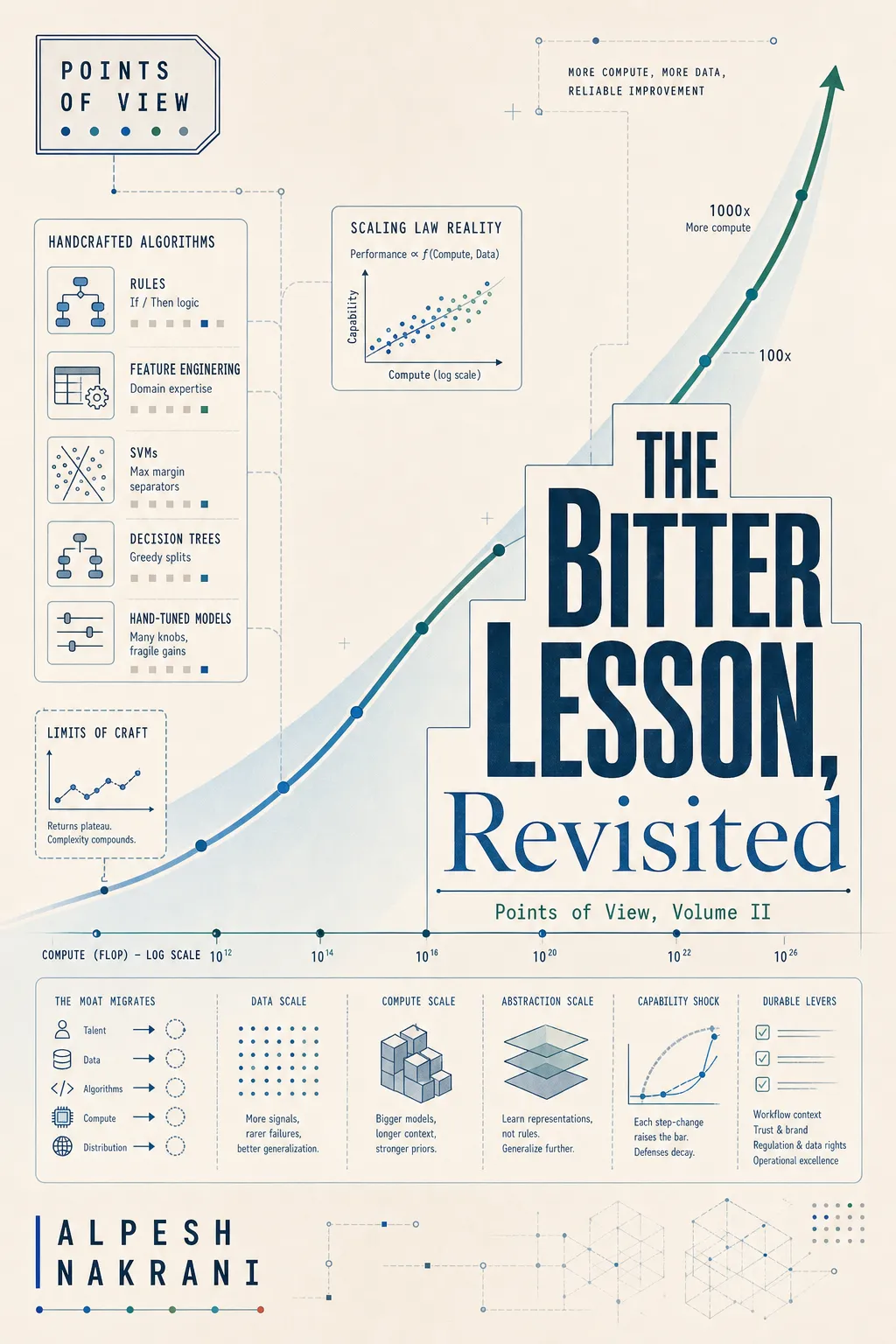
The Bitter Lesson, Revisited
Points of View, Volume II
Access
Free
Chapters
11
Read time
132 min

Alpesh Nakrani
VP of Growth at ViitorCloud · former CTO & COO
The second collection. Essays on why general methods keep winning, what survives the next order of magnitude of compute, and the uncomfortable question of which of your hard-won engineering advantages are about to be made irrelevant.
Scale beats cleverness more often than we admit. What that means for the moat you think you’re building.
This edition is free to read onsite. Each chapter has its own URL, so readers can bookmark, share, and return to the exact section they need.
Table of contents
INT Introduction: The Update That Erased a Year Why the bitter lesson is a business problem, not just a research observation, and what this book promises. 9 min 01 Seventy Years of Clever People Losing The historical pattern Sutton documented, told as a sequence of teams who built knowledge in and watched compute win. 11 min 02 Scaling Laws in Plain English What the scaling-law papers actually say, why they turn the bitter lesson into a forecast, and how to plan against a curve you do not control. 11 min 03 The Moat Migration Stack A six-layer map of where defensibility lives, why scale pushes it down the stack, and how to read your own business through it. 10 min 04 The Scale Exposure Test One question, run as a decision tree, that tells you whether an advantage will survive the next better model or melt under it. 9 min 05 Open Models and the Compression of Frontier Advantage Why open weights matter as a strategic pressure rather than a tribal allegiance, and how to use them without confusing the choice of weights with a strategy. 10 min 06 Data Moats That Survive Scale The precise line between data that scale absorbs and data that scale cannot reach, and a checklist for telling which kind you actually have. 11 min 07 Workflow Moats: Where Context Actually Lives Why the value of an AI product lives in the thirty minutes around the model call, not the few seconds of the call itself. 11 min 08 Distribution, Trust, and Compliance as Model-Era Moats Why the least technical layers of the stack became the strongest, and how the right to operate became a moat compute cannot touch. 10 min 09 Small Models as Economic Response, Not Ideology When compressing scale into a small model is a sound financial move, when it is a trap, and how to decide with a cost model instead of a belief. 10 min 10 Evals as Taste, Judgment, and Moat Why knowing whether your system is actually good is itself a defensible advantage, and how eval discipline compounds where models commoditize. 10 min 11 The Capability Shock Response Plan What breaks when a model improves suddenly, and a plan you can run in an afternoon instead of panicking for a quarter. 11 min END Conclusion: Build Where Scale Needs You A sober stance for the next capability shock: do not fight scale where it is structurally advantaged, build where it needs context, ownership, trust, and distribution to become useful. 9 min