Distribution, Trust, and Compliance as Model-Era Moats
Why the least technical layers of the stack became the strongest, and how the right to operate became a moat compute cannot touch.

Research spine
This chapter is grounded in Stanford HAI, 2026 AI Index Report, Stanford HAI, 2025 AI Index Report, and Rich Sutton, The Bitter Lesson.
The durable AI moat is not model cleverness alone; it is the workflow, data, trust, distribution, and evaluation stack that survives scale.
I once watched a deal close in favor of the worse product. Two vendors, same category, AI-heavy. One had a genuinely better model and a slicker demo. The other had a completed security review with the buyer, a signed data-processing agreement, and three years of incident-free operation in the buyer's industry. The procurement committee was not confused about which model was better. They picked the worse model anyway, because the better one would have required a fresh six-month security review and the buyer had a regulatory deadline in four months. The better model lost to a stack of paperwork and a track record.
That deal is the whole chapter. In the model era, the least technical layers of the stack, distribution, trust, and compliance, became the strongest moats, precisely because they are the layers a better model does not touch. Compute improves capability. It does not produce a completed audit, a procurement relationship, or the habit of a million users opening your product every morning. Those are accumulated, not computed, and accumulation is something scale cannot do for your competitor.
Distribution: the moat that predates and outlasts the model
Distribution is how you reach and acquire users, and it is the most boring moat in business and one of the most durable, which are related facts. It predates AI by centuries and it will outlast the current model cycle, because a better model does not give your competitor your customer relationships, your channel partners, your embeds, or your place on the shortlist.
The reason distribution matters so acutely right now is the asymmetry between startups and incumbents in the AI wave. A startup can build a better AI feature in six months. An incumbent who already owns the surface the user looks at can ship a good-enough version of that feature into a product the user already opens daily, and reach more users on day one than the startup will reach in two years. The startup has the better model. The incumbent has the distribution. In a world where the model commoditizes on the schedule we established, the better model is a six-month lead and the distribution is a structural advantage. Bet on the wrong one and you become a feature in the incumbent's roadmap.
This is not a counsel of despair for startups, it is a counsel of where to fight. Startups win the distribution game by finding the surfaces incumbents do not own, the workflows that span multiple incumbents none of whom control the whole thing, the users the incumbent neglects, the channels the incumbent cannot move through. The same logic as the workflow chapter: live in the seams. A startup that builds a better model inside an incumbent's home territory is fighting on the incumbent's strongest layer. A startup that builds distribution where the incumbent is absent is fighting where the model lead actually has time to matter.
Run distribution through the Scale Exposure Test and it is almost comically durable. Q1, is it that the model is more capable, no. Q2, does it depend on the model being expensive, no. Q3, does it rely on something the model cannot access, yes, the customer relationships and channels. Q4, would a better model leave those untouched, yes. LOW EXPOSURE. The model can improve forever and it will not hand your competitor your distribution.
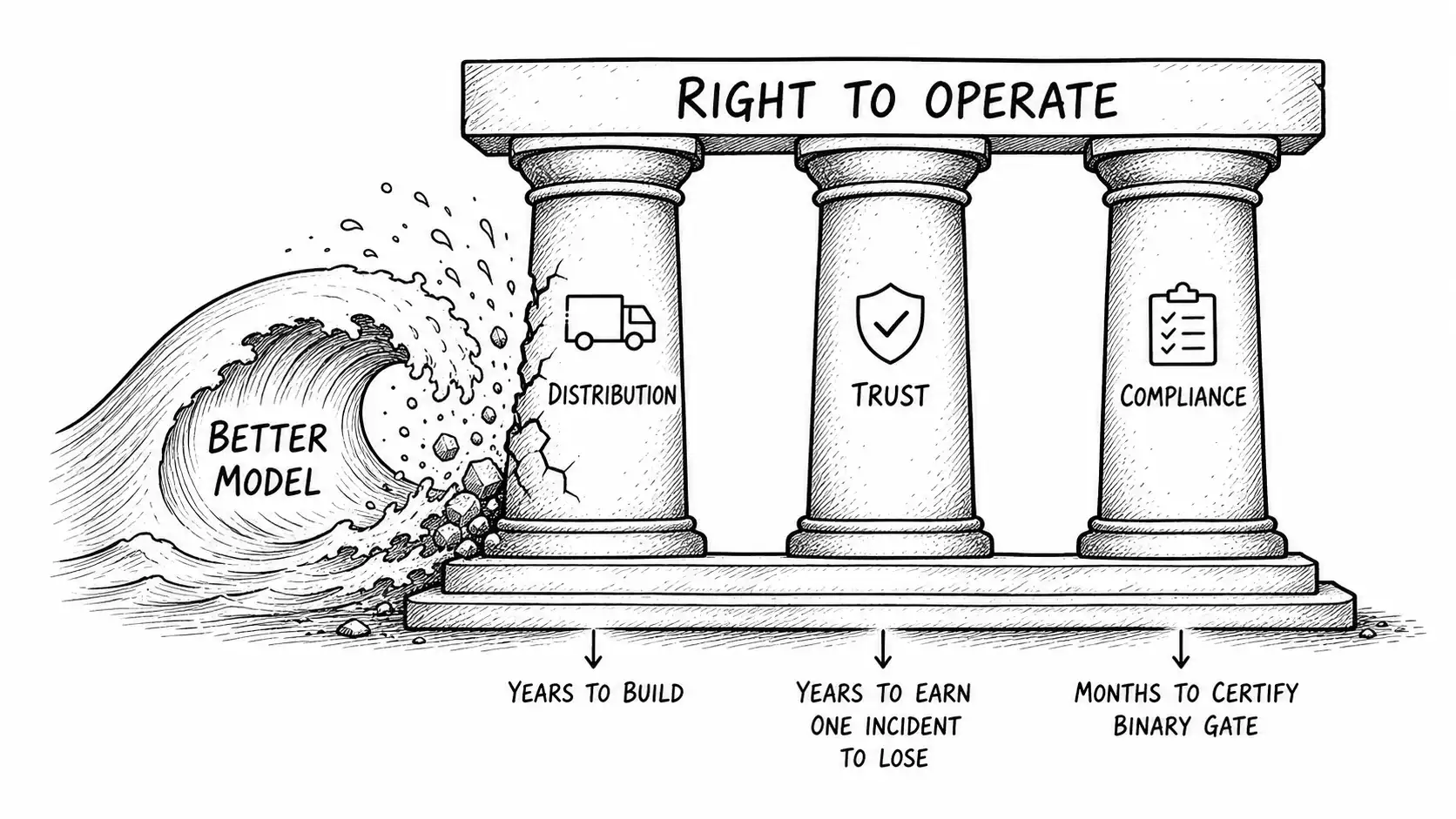
Trust: the moat that takes years and dissolves in one incident
Trust is the willingness of a buyer to rely on you with something that matters: their data, their compliance posture, their customers, their reputation. It is a moat because it takes a long time to build and a general model getting smarter does not build it. It is also the most fragile moat, because it takes years to accumulate and a single bad incident to destroy, which makes it both valuable and dangerous to depend on.
In AI specifically, trust has a sharp new edge. Buyers are nervous about AI systems doing something wrong with their data or their customers, and rightly so. A vendor who has earned trust, through track record, through transparency about how the system behaves, through clear handling of errors, through honest communication about what the AI does and does not do, has something a better-model competitor cannot quickly acquire. The competitor can demo a better model tomorrow. They cannot demo three years of not screwing up.
The operational lesson is that trust is built in how you handle the bad days, not the good ones. Every AI product makes mistakes. The trustworthy vendor is the one whose workflow catches the mistakes before they reach the customer, whose communication is honest when one slips through, whose system has an audit trail that lets the customer understand what happened, and whose incident response is fast and straight. I have seen vendors lose years of accumulated trust in a week because they were evasive about an AI failure, and I have seen vendors deepen trust through an incident because they handled it transparently. Trust is a moat you build with logging, monitoring, honest error handling, and the discipline to communicate badly-shaped news clearly. None of that is model work. All of it is the work that makes the model safe to depend on.
Compliance: the right to operate as a moat
Compliance is the most literal version of a moat: in regulated contexts, it is the legal right to operate, and without it you cannot sell at all, no matter how good your model is. A buyer in a regulated industry cannot use your product if you do not meet the regulatory bar, period. That makes compliance a binary gate, and binary gates are powerful moats, because being on the right side of the gate while competitors are on the wrong side is worth more than any benchmark.
Compliance posture is accumulated, not computed. A SOC 2 report, a HIPAA posture a hospital's security team has audited, the controls and documentation a regulated buyer's risk team requires, the certifications that get you onto an approved-vendor list, these take months to years to build and they do not improve when the model does. They are also a genuine barrier to entry: a startup with a better model but no compliance posture cannot sell into the regulated buyer until it does the compliance work, which takes time the startup's model lead does not have.
The emerging layer here is AI-specific governance. As regulators turn their attention to AI systems, the obligations are growing: documentation of how the system makes decisions, risk management practices, transparency to affected individuals, human oversight of high-stakes outputs. Frameworks like the NIST AI Risk Management Framework give organizations a structured way to manage these risks, and regulatory regimes are codifying similar expectations. The vendor who builds genuine AI governance, real risk management, real documentation, real human oversight where it matters, is building a compliance moat that a better model does not provide and that competitors have to spend real time to match. Governance is unglamorous, it is largely process and documentation, and it is exactly the kind of accumulated posture that compute cannot shortcut.
A caution, because compliance is where the organization-level rule about sensitive operations bites hardest: compliance is a moat only when it is real. A claimed compliance posture that does not survive an audit is not a moat, it is a liability and potentially a legal exposure. Do the actual work. Build the actual controls. The moat is the genuine posture, not the badge.
Why these three belong together
I grouped distribution, trust, and compliance into one chapter on purpose, because they share a structure that distinguishes them from everything higher in the stack. All three are accumulated over time through non-technical work, all three are nearly immune to the compute curve, and all three are barriers an incumbent or an established vendor holds against a newcomer with a better model.
They also reinforce each other. Distribution gets you in front of the buyer; trust gets the buyer to rely on you; compliance gives the buyer permission to. A vendor strong on all three has a position that a frontier model release does not dent, because the release improves a layer the vendor was never depending on. The worse-model vendor in the opening scene won because they were strong on all three and the buyer's decision was being made at those layers, not at the model layer. The better model never got to matter.
This is the deepest version of the book's thesis. Strategy moved to the layers scale does not automatically solve, and the layers scale touches least are the ones that are least technical: where you can reach the customer, whether the customer trusts you, and whether you are allowed to operate. A field full of brilliant model engineers is, somewhat ironically, a field where the durable advantages are increasingly held by the people who do the unglamorous work of distribution deals, security reviews, and regulatory documentation. The bitter lesson eats the cleverness and the cleverness migrates all the way down to the paperwork.
The artifact: the durable layer audit
Here is a worksheet to assess your position on these three layers honestly. For each, rate where you stand and what it would cost a competitor to match you.
| Layer | Your position | Time for a competitor to match | Is it real or claimed? |
|---|---|---|---|
| Distribution: channels, embeds, daily-use surfaces | |||
| Trust: track record, transparency, incident handling | |||
| Compliance: certifications, governance, right to operate |
The "time for a competitor to match" column is the moat measured in calendar time, which is the only honest unit. A model lead is months. A distribution position can be years. A trust track record cannot be bought at any price, only earned over time. A compliance posture is months to years and gates the market entirely. Fill the column truthfully and you will see that your most durable advantages, measured in the time it would take to copy them, are almost never at the model layer. They are here, at the bottom, where the work is least exciting and the moats are deepest.
The "real or claimed" column is the integrity check. Anything claimed but not real is not a moat, and pretending otherwise is how companies walk into audits and incidents unprepared. Be ruthless here. The moat is the reality.
What to do differently tomorrow
If you are a startup, find the distribution surface the incumbents do not own and go there, instead of building a better model inside an incumbent's home turf where the model lead will not last long enough to matter. If you are an established vendor, recognize that your security reviews, your track record, and your compliance posture are probably your strongest moats, and invest in them as moats rather than treating them as cost centers the engineering team resents.
And whichever you are, do the trust work on the bad days. Build the logging, the monitoring, the error handling, and the honest communication that let you survive the incident that will eventually come, because the vendor who handles the bad day well deepens the moat and the vendor who handles it badly drains it. Trust is the layer you cannot rebuild quickly once it breaks, which is exactly why it is worth protecting like the asset it is.
The next chapter turns from defense to economics, and looks at small models, not as an ideology, but as a financial response to the bitter lesson that can rebuild margin where scale compressed it.
Key Takeaways
- In the model era the least technical layers of the stack, distribution, trust, and compliance, became the strongest moats, because a better model does not touch any of them.
- Distribution is the asymmetry that decides the startup-versus-incumbent fight. Incumbents who own the surface can ship a good-enough feature to more users than a startup reaches in years. Startups win in the seams incumbents do not control.
- Trust takes years to build and one incident to destroy. It is built in how you handle the bad days: logging, monitoring, honest error handling, and straight communication when something goes wrong.
- Compliance is the right to operate, a binary gate in regulated markets. It is accumulated posture, not computed capability, and it is a genuine barrier a better-model competitor must spend real time to clear.
- Measure moats in calendar time to match. Model leads are months; distribution is years; trust cannot be bought at any price; compliance is months to years and gates the market.
- These moats must be real, not claimed. A compliance posture that fails an audit is a liability, not a moat. Do the actual work.
Internal map
For the larger argument, keep this chapter connected to The Bitter Lesson, Revisited, the judgment economy, the case for smaller models, and A Field Guide to Evals.