2026 / Free online book · Technical Deep Dives
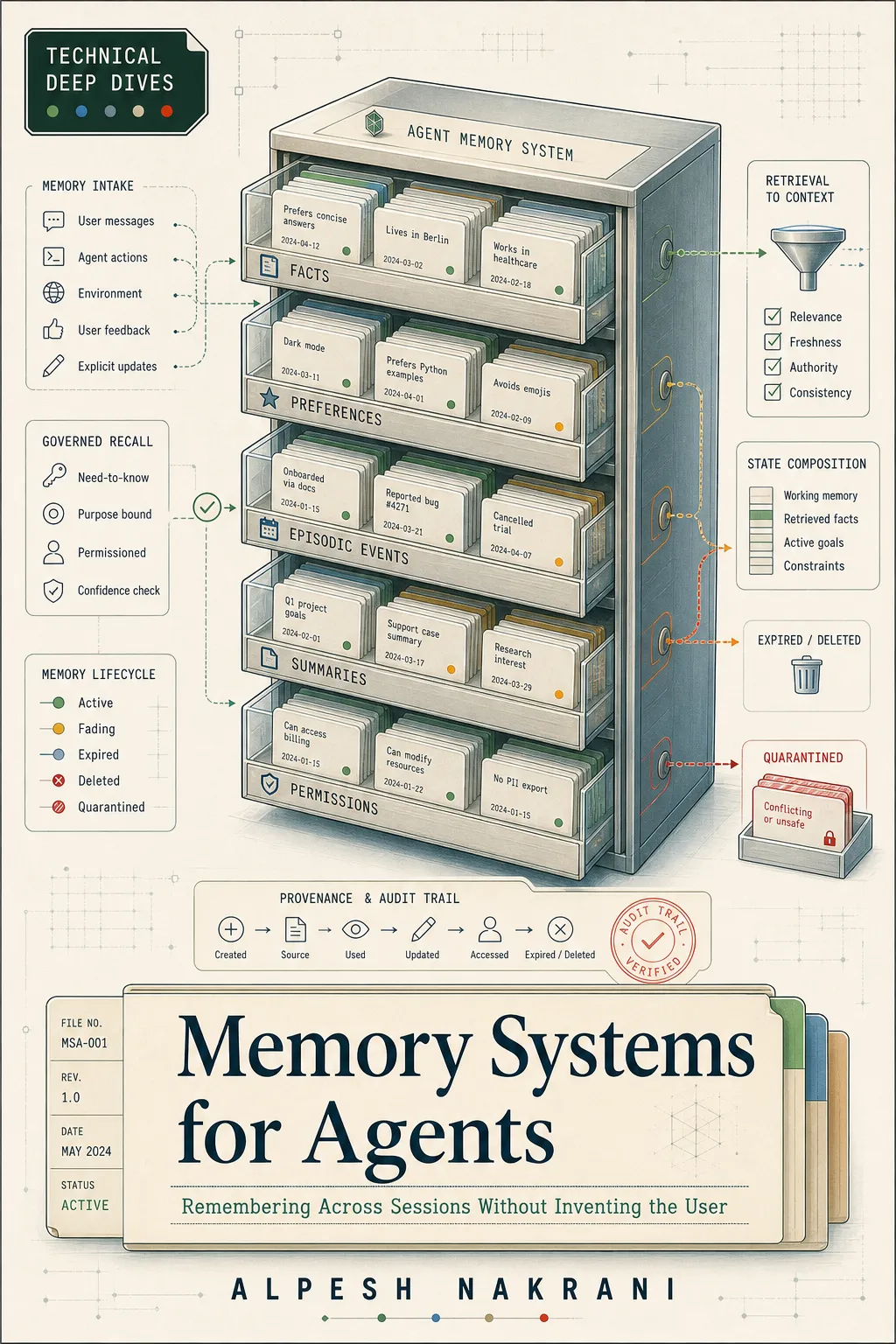
Memory Systems for Agents
Remembering Across Sessions Without Inventing the User
Access
Free
Chapters
15
Read time
184 min

Alpesh Nakrani
VP of Growth at ViitorCloud · former CTO & COO
An agent that forgets is useless; one that misremembers is dangerous. Designing memory that is honest about what it knows.
This edition is free to read onsite. Each chapter has its own URL, so readers can bookmark, share, and return to the exact section they need.
Table of contents
FM Front Matter: Memory Systems for Agents Remembering Across Sessions Without Inventing the User 6 min INT Introduction: The Agent That Knew Too Much, Too Soon The first time I watched a memory system do real damage, it was being helpful. That is the part that stays with me. 11 min 01 The 7 a. m. Memory Working claim: The seductive thing about agent memory is that it makes a stateless system feel like it knows you. The dangerous thing is the same thing. 13 min 02 A Memory Is a Claim with a Source: A Working Taxonomy Working claim: "Memory" is not one thing, and the single most common architectural mistake is building one undifferentiated store and pouring everything into it. 13 min 03 The Agent's Read/Write Loop Working claim: A chatbot reads memory at the start of a turn and writes it at the end. An agent lives in a loop where memory is touched at every step, read to decide, written as it acts, re-read after each tool result. 11 min 04 The Write Gate: Deciding What Deserves to Persist Working claim: Reading memory is a ranking problem you can iterate on; writing memory is a commitment you live with. A bad read pollutes one action and is gone. 12 min 05 Recall Is Not Retrieval Working claim: Retrieval finds memories that match a query. Recall decides which of those memories should actually shape the agent's next action, and that is a different, harder problem. 11 min 06 Reflection, Consolidation, and the Summaries That Lie Working claim: An agent that reflects is an agent that improves without retraining, but reflection is generative, and generative means it invents structure that was not in the evidence. 10 min 07 Procedural Memory and Skill Libraries Working claim: Facts let an agent answer; skills let an agent act. A skill library is the memory that turns a hard-won success into a reusable capability, and it is the closest thing an agent has to genuine improvement. 11 min 08 Long-Horizon Task Memory Working claim: Real agents do not finish in one session. They work on something for days, get interrupted, resume, hand off, and come back after the world has changed. 9 min 09 Shared and Private Memory in Multi-Agent Systems Working claim: A single agent's memory is a private notebook. 10 min 10 Forgetting, Decay, and Conflict Resolution Working claim: A memory system is defined as much by what it forgets as by what it keeps. Forgetting is not failure; it is the mechanism that keeps memory true, relevant, small, and safe. 10 min 11 Privacy, Consent, Deletion, and Governance Working claim: A memory system that cannot forget is not a feature; it is a liability with a deletion deadline. 9 min 12 Memory Poisoning and Security Working claim: Every other failure in this book is an accident. Poisoning is on purpose. 9 min 13 Does the Agent Actually Improve? Evaluating Memory Working claim: The only question that justifies a memory system is whether the agent gets better because of it, more correct, more efficient, less repetitive, more trusted over episodes. Most teams never measure this. 9 min 14 Operating Memory in Production Working claim: A memory system that passes evaluation can still fail in production, because production adds the things evals cannot: real drift, real scale, real cost, schema evolution under live data, and the incident you did not anticipate. 10 min 15 Use Case Playbooks This chapter turns use case playbooks into a concrete operating problem for the memory systems book. 12 min A Appendix A: Back Matter Glossary, implementation checklist, and source register for the book. 8 min