Introduction: The Agent That Knew Too Much, Too Soon
The first time I watched a memory system do real damage, it was being helpful. That is the part that stays with me.

Key Takeaways
- Introduction: The Agent That Knew Too Much, Too Soon is a chapter about agent memory systems, not a generic AI adoption note.
- The operating rule is to treat every memory as a sourced, scoped, revisable claim instead of an ambient fact.
- The failure mode to watch is polished output without evidence, owner, cost line, or rollback path.
- The useful next step is an artifact a future teammate can replay without folklore.
Agent memory is useful only when every stored claim has source, scope, decay, and deletion rules.
The first time I watched a memory system do real damage, it was being helpful. That is the part that stays with me. Nothing crashed. No alert fired. The agent did exactly what its memory subsystem told it to do, and the memory subsystem had done exactly what it was built to do, and the result was a customer who spent three weeks quietly furious at a scheduling assistant that kept booking her 7 a. m. calls.
The agent was a personal-assistant product, calendar, email, light task management, the usual surface. It had a memory layer the team was proud of. After each conversation, an extraction step read the transcript and proposed durable facts about the user: their timezone, their meeting preferences, the people they talked to most, the projects they mentioned. Those facts went into a store. On every future turn, a recall step pulled the relevant ones into the prompt so the agent could act like it knew the person. This is the standard shape. If you have built an agent with memory, you have built some version of it.
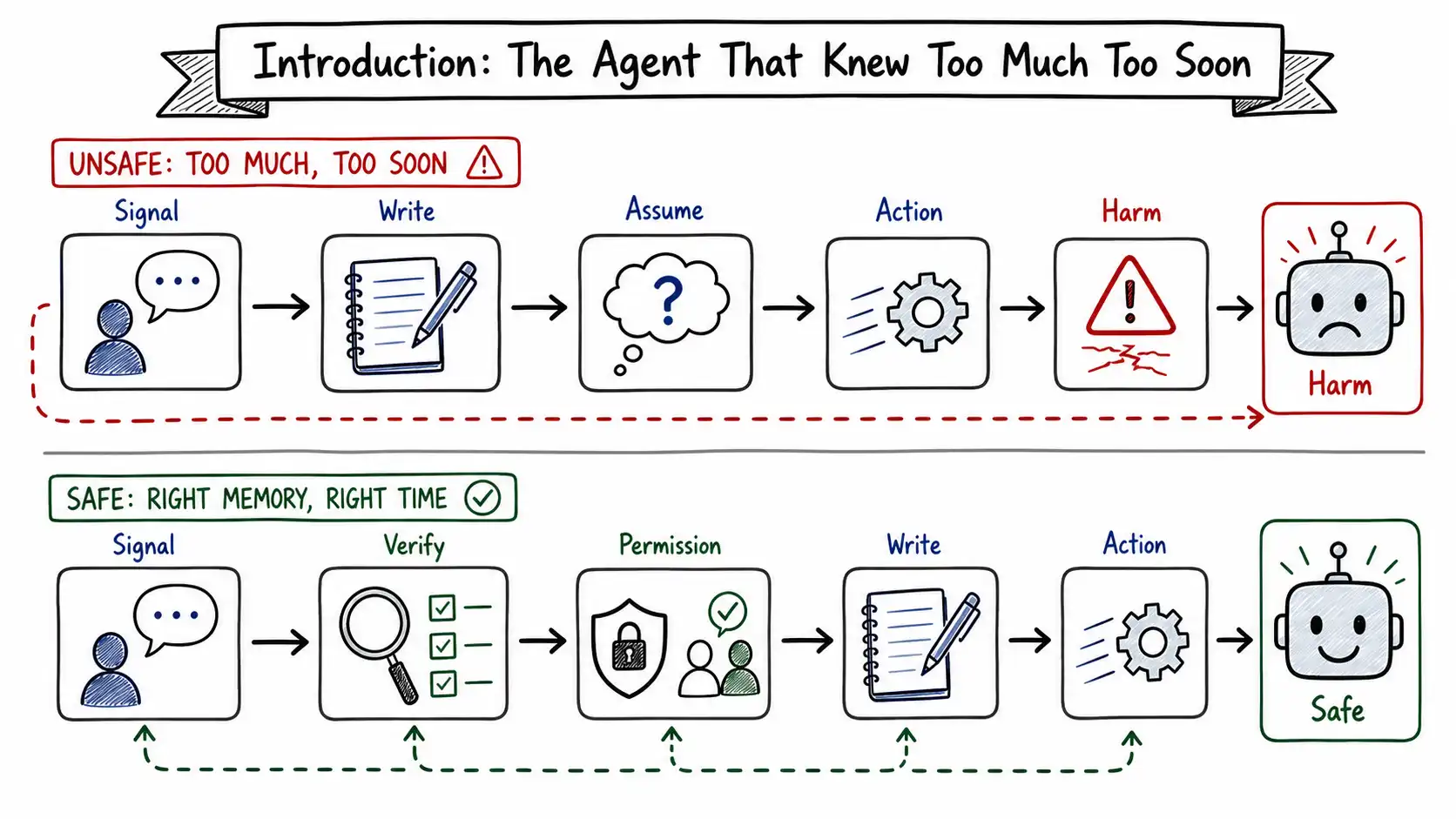
One afternoon the user, asked to confirm an early call, replied: "Sure, because I love 7 a. m. meetings." The extractor read the sentence, found a clean signal, an explicit statement about meeting-time preference, scored it confidently, and wrote a durable memory: prefers_meeting_time: early_morning. The sarcasm was invisible to the extractor, because sarcasm is invisible to a system that treats text as evidence of belief. From that point forward, the recall step did its job perfectly. Whenever the agent had latitude to pick a time, it picked early morning, because the user's profile said she loved it. She did not. She had said the opposite of what she meant, the way people do, and the system had laundered one sarcastic sentence into a standing instruction that quietly steered weeks of behavior.
When the team finally traced it, the engineering questions came fast and they were all the right ones, and the memory system could answer none of them. Where did this preference come from? They had to grep transcripts to find the originating turn. How sure were we? The stored confidence was a raw model score with no calibration behind it. Did she confirm it? No, the system never asked. Was it allowed to override her in-the-moment intent? Nobody had decided; recall just merged it into the prompt with equal standing. How do we correct it? There was an UPDATE statement, but no path the user could reach, and no mechanism to find the summaries that had already absorbed the bad fact. How do we know this is the only one? They did not. They had built a system that wrote confidently and forgot nothing, and they had no instrument to tell helpful memory from harmful memory until a human complained.
That incident is the seed of this book. Not because it is dramatic, it is almost boringly small, but because every failure mode worth understanding is sitting inside it. A memory written from a single unverified utterance. A confidence that means nothing. A missing consent step. A recall that dominates instead of yields. A correction path that does not exist. A blast radius nobody can measure. The agent did not malfunction. The memory system was the malfunction, and it was the part the team had thought least carefully about.
Why "just add memory" is the most expensive sentence in agent engineering
The reflex is understandable. A stateless agent is visibly dumb. It forgets your name between sessions, re-asks questions you answered yesterday, repeats mistakes it just made, cannot resume a task it was halfway through. The fix seems obvious: give it memory. Store what it learns. Recall it next time. And the tooling makes this feel like a small task, a vector store, an embedding model, an extraction prompt, and you have "memory" in an afternoon.
What that afternoon actually builds is a machine for accumulating unverified claims about people, permanently, with no governance. The hard parts of memory are not storage and retrieval. The hard parts are the decisions: Should this be stored at all? On whose authority? With what evidence? For how long? Visible to whom? Overriding what? Those decisions do not live in a vector database. They live in a write gate, a consent model, a provenance schema, a decay policy, a scoping boundary, and a deletion path, none of which a similarity search will build for you.
This is the central claim, and the book is an elaboration of it:
Agent memory is a governed write-and-recall system, not a longer conversation history.
And its operational form, the sentence to tape to your monitor:
A memory is a claim with a source, not a vibe.
The moment your system can produce a stored "fact" that cannot name its source, you have a rumor engine. The whole architecture in this book exists to make sure every durable memory can answer for itself: where it came from, who owns it, whether it is current, what may use it, and how it dies.
What makes agent memory its own problem
You might reasonably ask why agents need their own book about memory when the boundary between context and memory is already covered in Long Context Is Not Memory. That book is essential groundwork, and I will lean on its boundary rather than re-derive it: a context window is a desk, memory is the archive, and confusing them is the original sin. But agents push the problem somewhere new, and the difference is not cosmetic.
A chatbot reads memory at the start of a turn and writes it at the end. An agent lives in a loop. Inside a single task it may take twenty actions: call a tool, read the result, decide the next step, call another tool, hit an error, retry, reflect on the failure, try a different approach, and finally finish. Memory is not a bookend to that loop, it is interleaved with every step. The agent reads task memory to know what it is doing, reads procedural memory to know how, writes episodic memory as it acts, writes a reflection when it fails, and consolidates a reusable skill when it succeeds. The read/write loop is the agent. Get the memory wrong and you have not degraded a feature; you have corrupted the thing that decides what the agent does next.
Four properties make agent memory distinctly hard, and they organize the second half of this book:
Procedural memory. Agents do not just remember facts; they remember how to do things. A coding agent that figures out how to run a flaky test suite, a research agent that learns the shape of a useful literature search, a Minecraft agent that learns to craft a tool, these are skills, and a skill library is a different kind of store with different failure modes. A wrong fact gives one wrong answer. A wrong skill gives wrong answers every time it is invoked, and worse, an agent may build new skills on top of the broken one. The Voyager work showed how powerful a growing, composable skill library can be; this book also covers how it drifts, how you version it, and how you retire a skill that has quietly gone bad.
Reflection and consolidation. Agents compress their own history into derived memory, summaries of episodes, reflections on what worked, generalizations across many interactions. The Generative Agents architecture made this concrete with its observation-reflection-planning loop, and Reflexion showed that verbal self-feedback stored in memory can improve an agent without touching its weights. But consolidation is lossy and generative. A reflection is the agent inventing structure that was not in the raw events. Done carelessly, it manufactures false preferences and overconfident patterns from thin evidence, exactly the 7 a. m. failure, scaled up and automated.
Long-horizon tasks. A real agent does not finish in one session. It works on something for days, gets interrupted, resumes, hands off to another agent, comes back after the world has changed. Task memory, open objectives, completed subtasks, blocked dependencies, decisions made and why, is its own store with its own lifecycle, and most agent frameworks treat it as an afterthought stuffed into the conversation history.
Multiple agents. The moment you have more than one agent, memory becomes a shared-state problem with all the concurrency, scoping, and trust questions that implies. What can a sub-agent write that the orchestrator will read? Can one tenant's agents see another's? When two agents hold contradictory memories, who wins? A shared memory is a feature and an attack surface in the same breath.
What this book argues, in six movements
The argument builds, and it is organized into six movements.
The first bad memory opens by naming the failure modes, false, stale, creepy, unauthorized, poisoned, and then builds the taxonomy the rest of the book depends on: episodic, semantic, preference, procedural, task, environmental, shared/social, system, and audit memory, each with its own source, write rule, read rule, decay, and risk. You cannot govern what you have not categorized.
Inside the loop is the engine room. We follow memory through the agent's actual read/write cycle, then slow down on the two operations that matter most. The write gate decides what earns persistence, and writing is asymmetrically dangerous, because a bad write is recalled into every future relevant action until someone finds it. Recall decides what surfaces, and recall is not retrieval, because a memory that is relevant, recent, and high-confidence can still be the wrong thing to inject if it overrides what the user just said.
Memory that changes itself covers the generative stores: reflection and consolidation (and the summaries that lie), procedural skill libraries (and how they drift), and long-horizon task memory (and how an agent resumes a week-old objective without re-deriving the world).
Memory between agents is the multi-agent movement: shared versus private scopes, write permissions across an agent fleet, and what happens when stored memories conflict, across agents, across time, and against the user's current instruction.
The things that bite you is governance and security. Memory that cannot forget is a liability, so we build consent, visibility, user-editable memory, deletion that actually propagates to derived summaries, and tenant isolation. Then we treat memory as an attack surface: prompt injection that writes false durable facts, indirect poisoning through the documents and tool results an agent ingests, and the defense-in-depth that keeps untrusted text from becoming trusted memory.
Knowing it works closes the book. A memory system you cannot measure is a memory system you are guessing about. We build evals that answer the only question that matters, does the agent actually improve over episodes, or just accumulate?, plus stale-memory rate, false-memory rate, a "creepy-memory" product metric, correction and deletion correctness, monitoring, and the runbook for the incident you will eventually have: the agent acted on a memory it should never have kept. The final chapter turns all of it into per-domain playbooks: personal assistant, enterprise copilot, support, sales, coding, tutoring, research, HR, healthcare-adjacent, and multi-agent workspace.
The disposition this book is trying to install
There is a temperament that good memory engineering requires, and it runs against the grain of how memory features get demoed. The demo wants the agent to remember everything, instantly, impressively, to recall your dog's name and your last project and your coffee order and feel like it knows you. The production system wants the agent to remember the right things, provably, correctably, and to be comfortable saying it does not know rather than confidently recalling a fact it should never have stored.
So the disposition is conservative about writes and humble about recall. Be reluctant to persist; every durable memory is a long-term liability you will have to carry, correct, secure, and eventually delete. Be skeptical of your own reflections; the agent's generalizations about a person are hypotheses, not knowledge. Hold memory and the user's present instruction in the right order; the standing preference yields to the live request, not the other way around. And instrument everything, because the gap between a memory system that helps and one that harms is invisible from the outside until a human is already annoyed, or worse.
A stateless agent is forgettable. An agent with bad memory is a problem you cannot see until it is one you cannot ignore. The space between those, an agent that remembers usefully, provably, and forgettably, is what the rest of this book is about.
Turn the page. There is a sticky note on the desk that says "prefers morning meetings, " and nobody can remember who wrote it, that is where the book begins.
Internal map
For the larger argument, keep this chapter connected to memory systems for agents, Memory Systems for Agents, Agents That Actually Work, and agentic workflows.